Max Estates: Betting Big on the NCR Boom

“Trust” is a heavy word.
In business, it is the only currency that doesn’t devalue over time; it compounds.
For the Max Group; over the decades they didn’t just build businesses in Insurance and Healthcare;
They built a reputation. A trust.
 Ethica Invest
Serious about long-term investing?
Unlock our professionally managed portfolios.
And today, that same DNA is being run through one of its youngest, most ambitious businesses: Max Estates.

Max Estates didn’t burst onto the scene with a flashy super-project.
It began in a boardroom, as a quiet outcome of corporate surgery.
What looks today as an aggressive Delhi-NCR developer was, at birth, a housekeeping decision: untangle a conglomerate so each business could breathe, focus, and build.
How the “Child” Was Born (2016–2019)
Back in January 2015, a modest entity named Capricorn Ventures was incorporated. It looked harmless on paper, but it would become the vessel for Max’s “third act” in real estate.
A few months later,
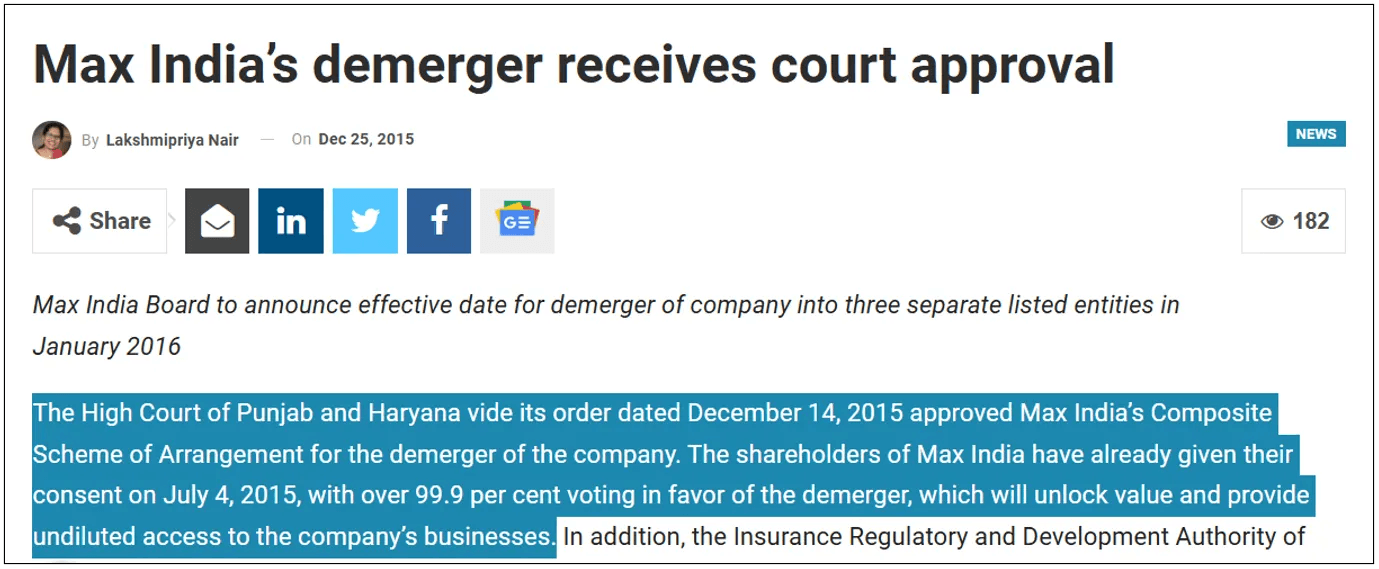
The High Court of Punjab and Haryana sanctioned a Composite Scheme of Arrangement on 14 December 2015, splitting the original Max India Limited into three focused pieces:
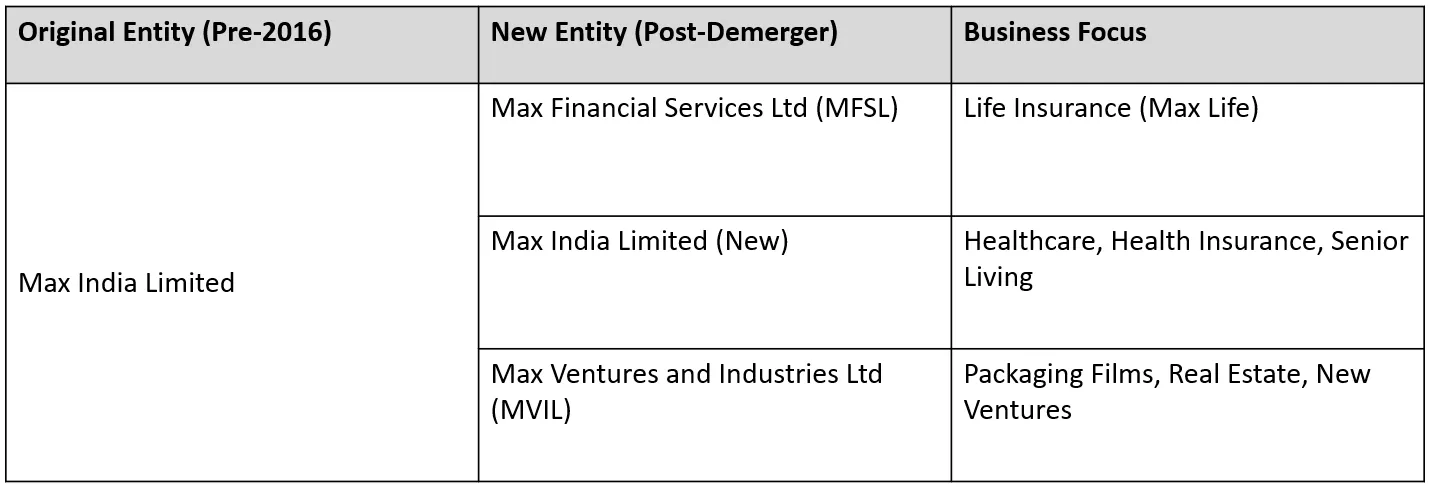
Max Financial Services, a new Max India Limited, and Capricorn Ventures.
The demerger became effective on 15 January 2016, and within days Capricorn was renamed “Max Ventures and Industries Limited (MVIL)” on 22 January 2016. Max Estates Limited was then incorporated as a 100% subsidiary of MVIL on 22 March 2016.
In simple terms, the group went from a single crowded house to three separate homes:
Why split? Focus.
Real estate is capital-heavy, long-gestation, and execution-driven. Housing it along with insurance and healthcare would only blur priorities and valuations. By giving real estate its own structure, the group effectively said: “This business will have its own capital, its own management, and its own story.”
Ethica Invest
Serious about long-term investing?
Unlock our professionally managed portfolios.
The first tangible decision for Max Estates came in May 2016, when the board approved a small joint development that would become the laboratory for two ideas that now sit at the heart of the brand: “WorkWell” for offices and “LiveWell” for homes.
The First Test: 222 Rajpur

Launched in June 2016.
It was a gated enclave of just 22 villas beside the Malsi forest. No scale, no frenzy. On paper, it would barely move a needle. But that wasn’t the point.
222 Rajpur was about intent:
- Low-density, nature-adjacent living.
- Thoughtful design.
- A “LiveWell” philosophy before the term had even become a brand plank.
That project’s success gave Max Estates what every developer craves at the start: proof of concept.
When Institutional Capital Walked In
The next big turning point wasn’t a project; it was a partner.
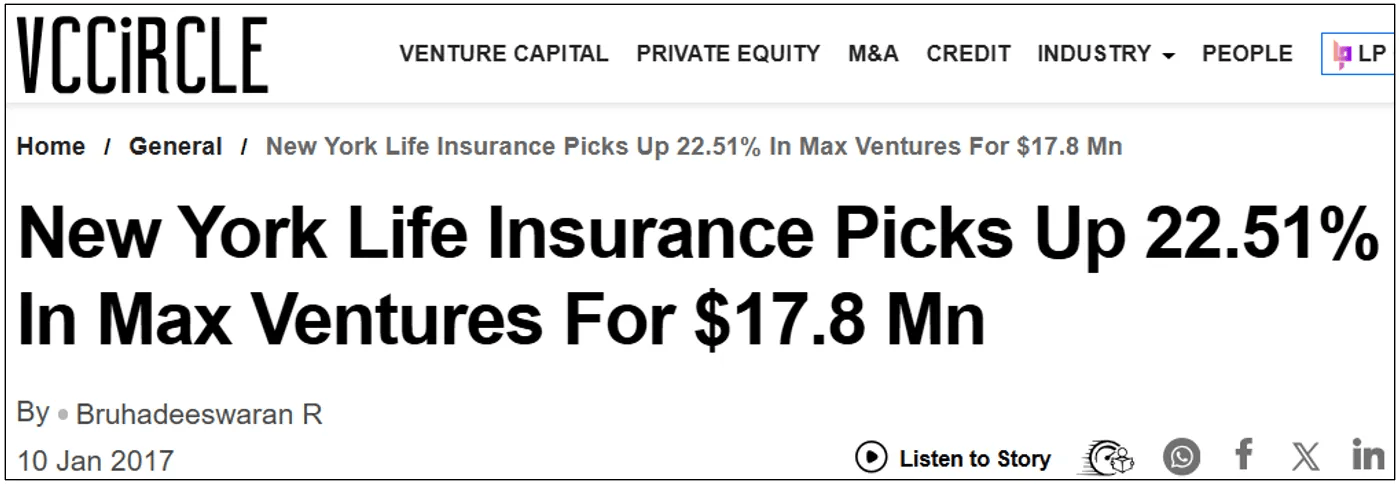
New York Life Insurance Company (NYL) came in during 2017-2019, and invested ~₹220 crore, taking 22.5% stake in MVIL. This partnership mattered because: long-term capital and institutional discipline let Max Estates build landmark commercial assets without overstretching.
Parallelly, the company started behaving like a serious institutional developer: It bulked up its land pipeline, including acquiring Wise Zone Builders in 2017.
The “quiet, careful craftsman” phase was ending. A more ambitious, institutional phase was about to begin.
Max 2.0: Commercial Benchmarks (2019–2022)
If 222 Rajpur was the pilot, the real franchise was built in Noida and Delhi.
Max Towers: The WorkWell Flagship
- Max Towers, in Sector 16B, Noida, sits right off the DND Flyway. It wasn’t just another glass box; it was designed around the “WorkWell” philosophy; good air quality, daylight, human-centric spaces. By FY22, it had reached 100% occupancy and, by FY23, generated lease rental income of about ₹34 crore.
Max House: Okhla’s Upgrade
- In Okhla, New Delhi, Max House Phase 1 was delivered in FY21 and also achieved full occupancy by FY23, with annual rentals around ₹14.3 crore. Sleek design, curated common areas, and a “club” feel made it a magnet for design-sensitive tenants.
These two projects did something crucial:
- They proved Max Estates could build and lease institutional-grade offices.
- They positioned the brand as a premium landlord in NCR, not just a land trader.
To support this growing commercial engine, Northern Propmart Solutions Limited was incorporated on 24 June 2019 to house and grow commercial assets in a more structured way.
NYL Doubles Down
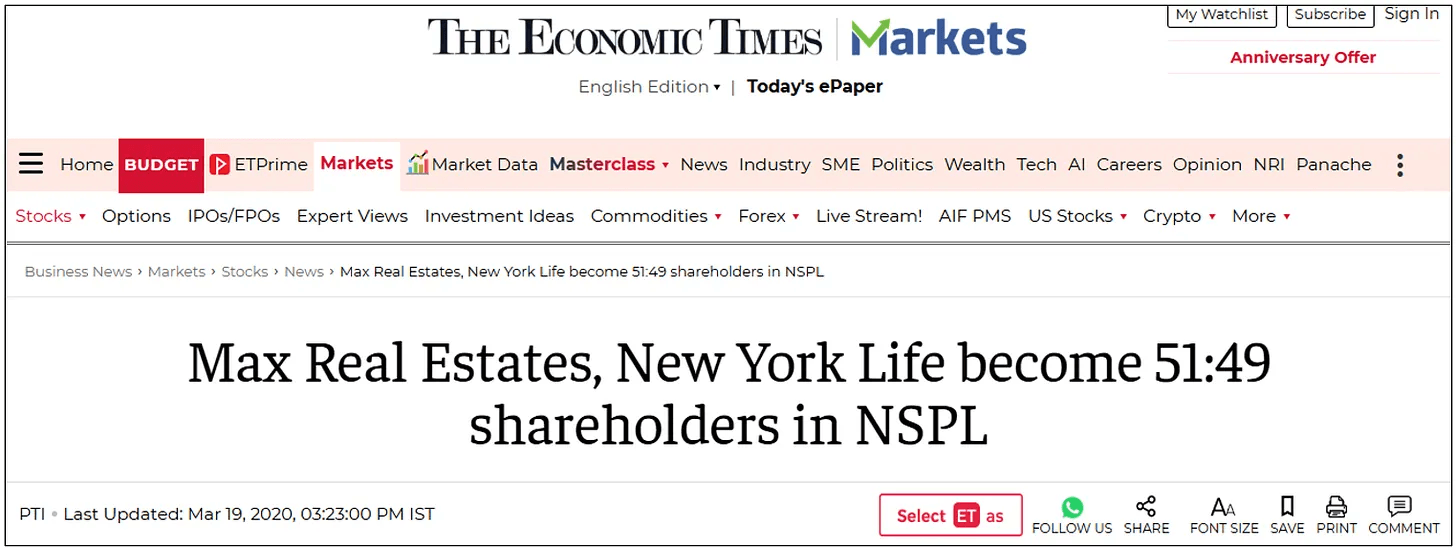
On 18 March 2020, NYL acquired a 49% equity stake in Northern Propmart Solutions. This move:
- De-risked Max Estates’ balance sheet (shared ownership of large office assets).
- Kept the annuity stream strong, while freeing up capital for new projects.
In a market where many developers over-leverage to build offices, Max Estates used a different formula: build, stabilize, share ownership with a deep-pocketed partner, and recycle capital.
Max 3.0: The Reverse Merger and Pure-Play Identity (2022–2023)
Even as the real estate business grew, MVIL still carried a legacy baggage: a packaging films business (Max Speciality Films).
This mix confused investors.
Was MVIL a real estate company or a speciality films company? The market hates fuzzy stories.
So, the group did something bold.
Exiting Manufacture, Leaning into Real Estate
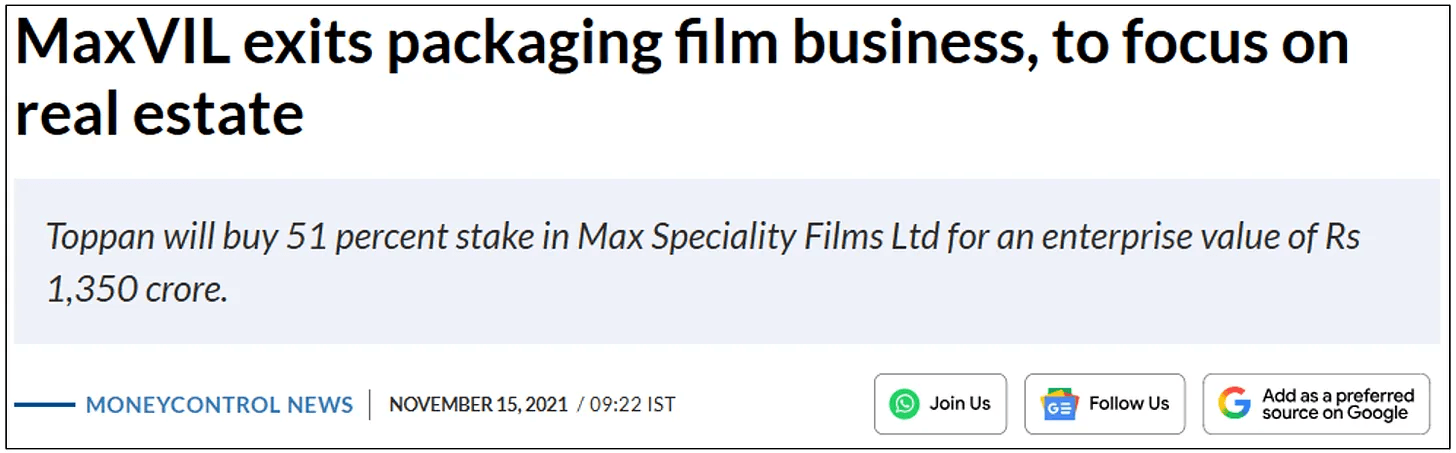
In February 2022, MVIL started the process of divesting Max Speciality Films to Toppan, bringing in ~₹696 crore.
This was a hard reset.
The message was clear: “Go all-in on real estate”.
The Reverse Merger
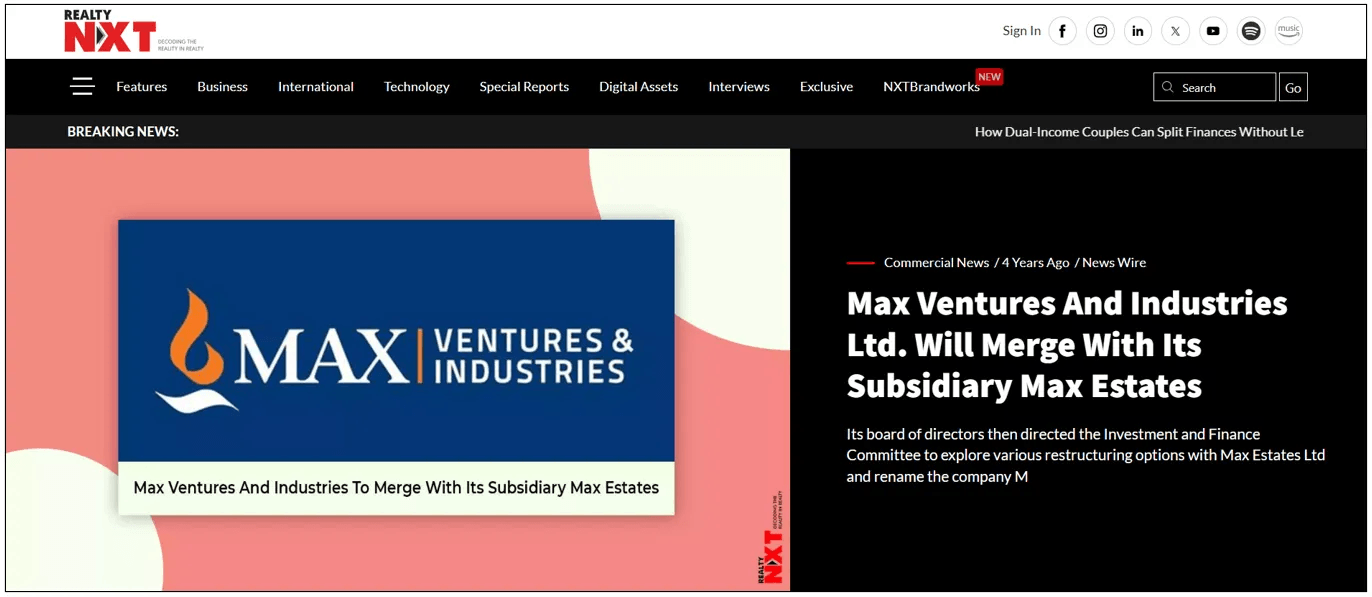
On 19 April 2022, MVIL’s Board approved a Composite Scheme of Amalgamation where MVIL would merge into its own subsidiary, Max Estates Limited. In simple terms, the child (Max Estates) became the surviving listed parent.
The goals were clear:
- Simplify the corporate structure.
- Eliminate layers.
- Cut duplicate costs.
- Present a clean, pure-play Max Estates to public investors.
Newly consolidated shares were allotted to MVIL shareholders on 11 August 2023 in a 1:1 ratio, and the company relisted as Max Estates Limited (MAXESTATES) on 30 October 2023.
From here onward, the story was no longer “Max Ventures and Industries with a real estate arm.” It was simply: Max Estates, a focused NCR developer.
The Residential Inflection: (2023–2024)
After proving itself in offices, Max Estates swung hard into residential.
Estate 128 – The Noida Breakthrough
In 2023, Max Estates launched Estate 128 in Sector 128, Noida. It was pitched as a “LiveWell” community: low density, high design, with an emphasis on wellness.
The Gurugram Push – Estate 360 & Max District
In FY24, the company entered Gurugram; India’s most competitive premium housing market.
- Sector 36A, Dwarka Expressway – Estate 360: An 11.8-acre joint development, designed as an intergenerational community in partnership with Antara Senior Living. It leaned heavily on wellness, community, and long-term living.
- Sector 65, Golf Course Extension Road – Max District: A 7.15-acre commercial campus, planned as a mixed-use hub with office and retail.
At this point, Max Estates wasn’t “testing” its residential strategy anymore. It had found its formula.
Fuel for Scale: QIP, Cash & Capital
Ambition needs fuel.
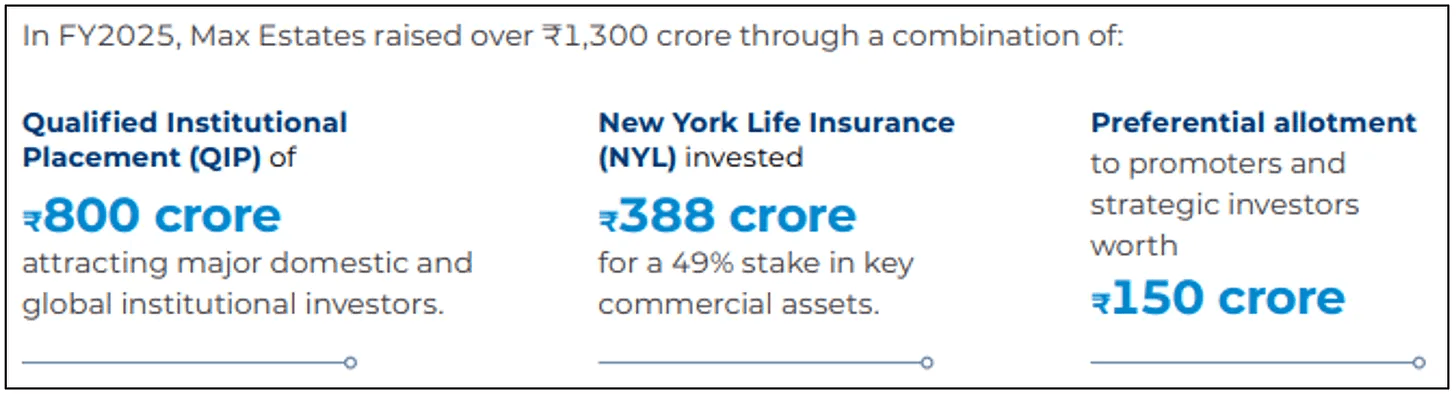
In August–September 2024, Max Estates raised ~₹800 crore via a Qualified Institutional Placement at about ₹597.5 per share, with an additional ~₹150 crore via preferential warrants from promoters and partners.
By FY25, the company had:
- Cash and Bank Balances of more than ₹1,000 crore post-QIP.
- Fully leased commercial assets generating about ₹110–115 crore of annual rentals (Max Towers, Max House, Max Square) with near 100% occupancy.
The annuity stream from offices became the financial “ballast” that stabilizes the boat while residential launches rock the top line.
Strategic Turnarounds: 2025–Early 2026
The next phase of Max Estates’ evolution involved not just greenfield launches, but also complex asset turnarounds and prime land aggregation.
Delhi One → Max One: Reviving a Stalled Giant
Boulevard Projects Private Limited (BPPL), which held the stalled “Delhi One” mixed-use project in Sector 16B, Noida, had been a problem child of NCR real estate for years. Max Estates completed the acquisition of BPPL and took over this ~2.5 million sq.ft. stalled project.
Rebranded as Max One, the plan is to turn it into an integrated luxury campus.
Estimated gross development value (GDV): over ₹2,000 crore.
If executed well, this is more than a project; it’s a brand statement.
Base Buildwell: Gurugram Sector 59
In September 2025, Max Estates acquired Base Buildwell Private Limited (BBPL), an SPV that owns 7.25 acres on Golf Course Extension Road (Sector 59), Gurugram.
- Planned as a ~1.3 million sq.ft. luxury residential project.
- GDV potential: over ₹3,000 crore.
- Launch expected around FY27.
Sector 105, Noida: A Mixed-Use Bet
In May 2025, the company secured a 10.33-acre parcel in Sector 105, Noida, via allotment from the Noida Authority for about ₹711 crore.
Plan:
- Revenue potential: over ₹3,000 crore.
- Rental potential: ~₹140 crore annually once stabilized.
By now, Max Estates isn’t just “present” in NCR.
It is stitching together a high-quality cluster of residential and commercial projects across Noida, Dwarka Expressway, and Golf Course Extension; arguably the three hottest belts in the region.
The Business Model
For an investor, the key question is simple: how does Max Estates make money?
The answer is also simple.
1. Residential – “LiveWell” Homes
Focus: premium and ultra-luxury housing in Delhi-NCR.
How it works:
- Acquire land (outright or via joint development agreements, so upfront cash outgo is moderated).
- Launch high-end projects with strong branding and wellness-led design.
- Aggressively pre-sell units; turn bookings into “committed receivables.”
- Use those receivables to fund construction, minimizing reliance on expensive debt.
2. Commercial – “WorkWell” Offices
Max Estates develops Grade A+ offices that are then leased to blue-chip tenants and GCCs.
Revenue streams:
- Lease rentals: Long-term contracts, typically with 15% escalations every three years.
- Lease Rental Discounting (LRD): Once an asset is fully leased, the rental cash flows are used to raise low-cost debt, which is then reinvested into new projects.
- Capital appreciation / partial monetization: Through strategic stakes with NYL and potential future REIT options.
3. Max Asset Services (MAS) – The “Pulse”
Most developers build and move on. Max Estates wants to run the “pulse” of its assets.
Max Asset Services:
- Manages facilities, security, and day-to-day operations.
- Curates community via its “Pulse” platform; events, wellness programs, learning sessions, networking.
In a world where office space can become a commodity, MAS helps Max Estates keep a moat around its assets.
The Numbers: Where They Stand Now
Max Estates is still young and capital-intensive. Its P&L often lags behind the story told by bookings.
For FY25 (consolidated):
- Revenue: ~₹161 crore.
- PAT: ~₹27 crore.
These numbers don’t fully reflect the pre-sales surge.
For 9M FY26:
- Consolidated revenue: ~₹150 crore (24% YoY growth).
- EBITDA: ₹27 crore.
- PAT: ₹20 crore.
- Pre-sales: over ₹1,900 crore in Q3 alone, mainly from Estate 361.
- Lease rentals: ₹115 crore, up ~38% YoY.
Net debt stands around ₹414 crore, which is moderate relative to the GDV pipeline, but still meaningful for a company at this early scale.
Max Estates’ key return ratios are still weak: ROE around 2%, ROCE ~2.5% versus mid double digits for more mature peers. That’s the classic early-scale problem: assets and pipeline build up first, returns normalize only when projects complete and income stabilizes.
The Future Pipeline: 3–5 Years of Launches
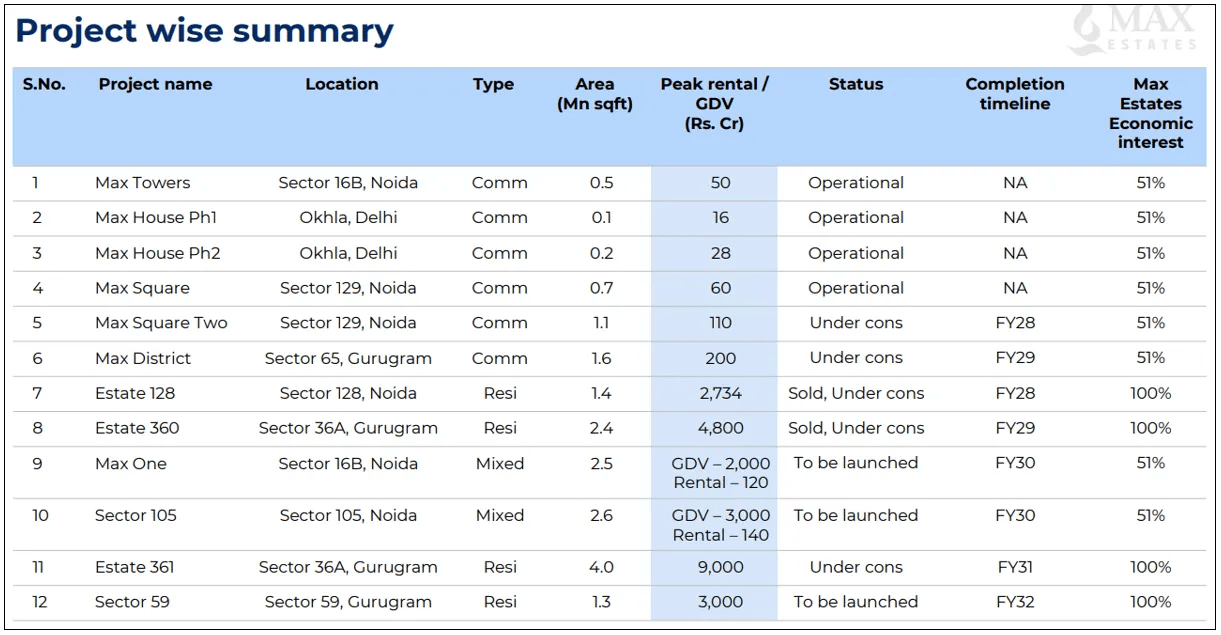
Over the next 3–5 years, Max Estates has lined up launches with an estimated GDV of ~₹14,000–15,000 crore, primarily across Noida and Gurugram.
Max Estates now controls ~17 million sq.ft. of development potential in NCR and has stated a goal: add at least 2 sq.ft. in residential plus 1 million sq.ft. in commercial every year, backed by annual capital deployment of roughly ₹1,000 crore into new projects.
Why the Playbook Seems to Work
Pre-Sales First, Then P&L
Max Estates is pre-selling projects faster than it builds them. Estate 128 sold out; Estate 360 and 361 together have already racked up more than ₹6,000 crore of bookings.
This matters because:
- Cash comes in early via advances.
- Construction can be funded largely from customer money and LRDs.
- Balance-sheet stress is lower than if everything were funded purely via debt.
The trade-off: reported profits will remain lumpy until projects hit completion milestones and revenue recognition catches up.
Wellness as a Pricing Moat
“LiveWell” and “WorkWell” are not just taglines. Estate 360 is designed as a forest-anchored community with underground parking so that most of the ground level is car-free. Air quality, light, noise, and community spaces are all engineered, not left to chance.
Buyers are voting with their wallets:
- Estate 360 and 361 are selling at 30%+ premiums versus surrounding projects.
- Max District’s pre-lease was struck at around 35% premium to micro-market rentals.
In a crowded market, wellness is becoming a new form of scarcity; and Max is selling that scarcity.
Institutional Capital as a Safety Net
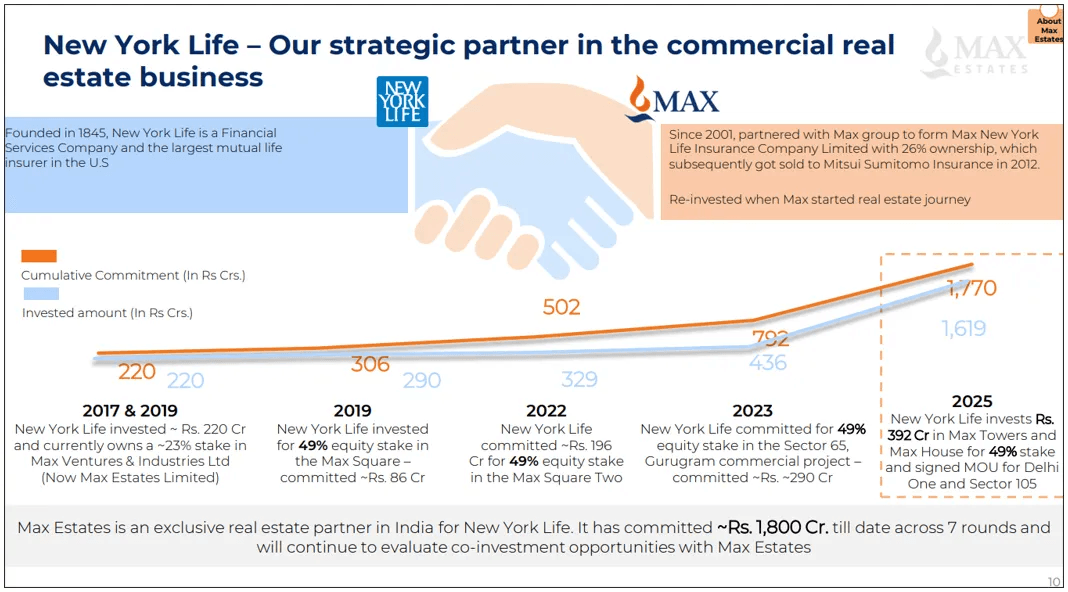
The Max Group’s legacy gives comfort. More tangibly:
- New York Life has committed roughly ₹1,800 crore into Max Estates’ ecosystem through equity stakes and joint platforms.
- The QIP and warrants added close to ₹950 crore of fresh equity.
This makes future fundraising; for land or construction, easier and cheaper than for a standalone, first-generation developer.
Key Risks You Can’t Ignore
This is not a smooth, straight-line compounding story yet.
Execution Complexity:
Max Estates is now running and planning multiple large projects simultaneously: Estate 360/361, Max One, Sector 105, Gurugram Sector 59. Any delays in approvals, construction, or handovers can quickly jam cash flows.
Lumpy and Noisy Earnings:
Q3 FY26 shows the flip side: despite healthy sales growth, the company reported a net zero profit as margins compressed and other income fell sharply. Operating margin dropped to around 6% from ~21% QoQ, highlighting how dependent current profitability is on non-core income and timing.
Market Cycle Risk (NCR Luxury):
Today’s NCR luxury upcycle may not last forever. If demand slows or pricing weakens just as Max is launching big-ticket projects, the pre-sales engine could slow, and leverage might start to bite.
Return Ratios Still Weak:
ROE and ROCE remain low at ~2–3%, far below more mature developers. The thesis requires patience: only if projects get delivered on time and rentals ramp up will these improve meaningfully.
The central investor question: Can Max convert a ~₹15,000+ crore GDV pipeline and strong booking momentum into clean, sustainable earnings and double-digit returns on capital before the cycle turns?
The Bottom Line
Max Estates today stands at a classic inflection point. The “quiet building” years are largely over. It has:
- A proven commercial franchise (Max Towers, Max House, Max Square) with ₹100+ crore annual rentals and 100% occupancy.
- A residential engine that has shown it can generate pre-sales in the thousands of crores at healthy premiums.
- A large, well-located pipeline across Noida and Gurugram, backed by institutional capital and a services layer (MAS) that keeps its assets differentiated.
Over the next 3–5 years, everything hinges on execution:
- Do Estate 361, Max One, Sector 105 and Sector 59 launch and get built on schedule?
- Do pre-sales translate into timely collections and free cash flow, not just headline booking numbers?
- Do ROE and ROCE move from low single digits toward the double digits that justify a premium valuation?
If Max Estates can pull this off;
using pre-sales and institutional capital to fund growth while keeping debt and delays under control; earnings could surprise on the upside, and the stock may evolve from “story-heavy, earnings-light” to a solid NCR compounding franchise.
If not,
The same pipeline that looks exciting today can quickly start to look heavy.
For now, Max Estates is building not just projects, but a brand and ecosystem around LiveWell and WorkWell.
The next phase will decide whether that brand becomes a durable compounding engine or just another cyclical NCR story.
General Disclaimer and Release: Nothing contained herein constitutes tax, legal, insurance or investment advice, or the recommendation of or an offer to sell, or the solicitation of an offer to buy or invest in any investment product, vehicle, service or instrument.
About Ethica Invest
Ethica Invest is a principled, Shariah-compliant investment platform that assists investors in assessing companies using well-defined criteria for finances, operations, and governance. Though grounded in Shariah guidelines, Ethica’s approach resonates beyond any single faith by prioritizing openness, strong balance sheets, and responsible business practices.
Ethica Invest works with SEBI-registered analysts and seasoned investment experts who deliver organized, compliant analysis on stocks and other opportunities. Those interested in seeking more on Shariah-aligned investing, can connect with our Ethica team.
The goal is straightforward: empower investors with decisions based on ethics, solid data, and performance; not just stories.