Is Amazon’s entry into rapid delivery a threat to incumbents?
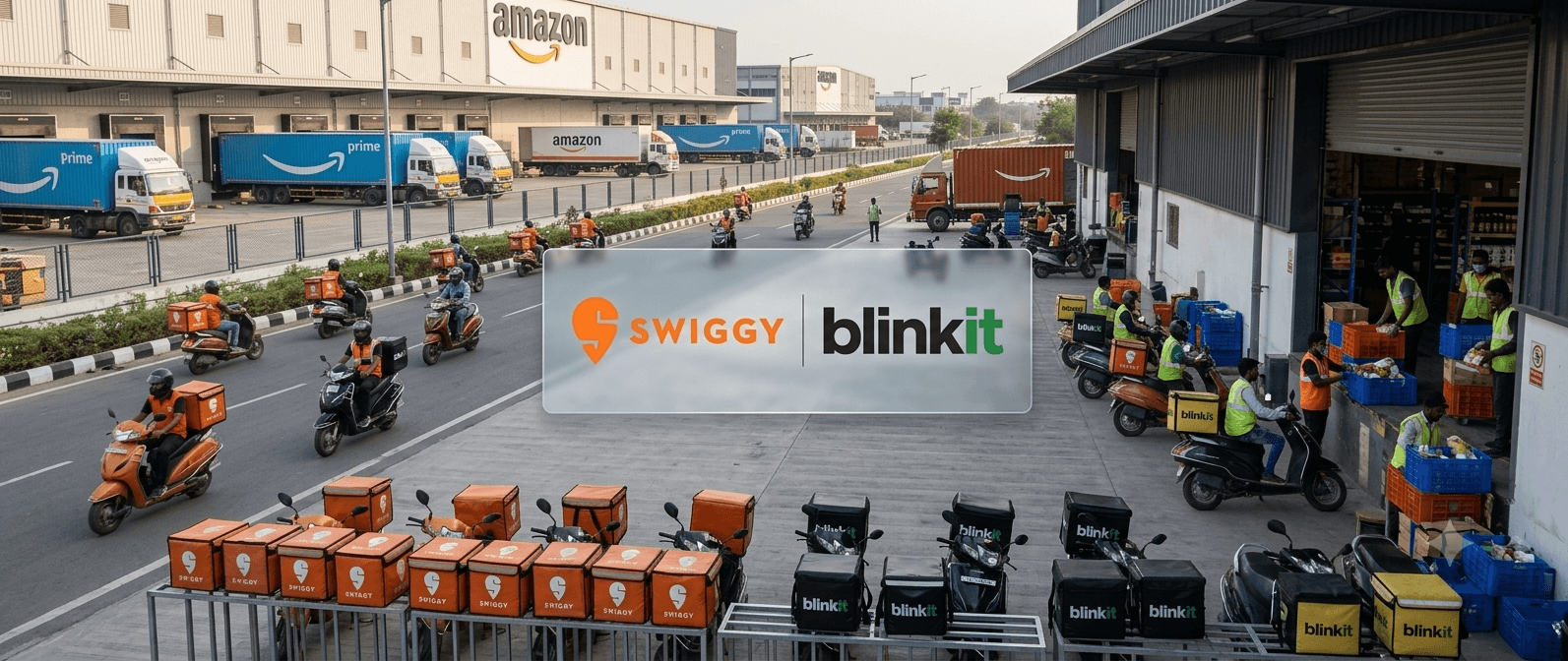
Amazon and Flipkart are aggressively pivoting toward India’s $11 billion rapid-commerce market, aiming to leverage their massive logistics networks to challenge early movers. While companies like Eternal (Blinkit) and Swiggy pioneered 10-minute delivery, the arrival of deep-pocketed tech giants shifts the battlefield. Amazon is expanding its service to over 300 cities, putting significant pressure on existing players to defend their turf in an increasingly crowded segment.
Why have Blinkit and Swiggy shares taken a beating?
Investors are reacting to the erosion of the market moat surrounding these quick-commerce leaders. Eternal’s Blinkit has shed 28% from its October highs, while Swiggy has plummeted 47% from its September peak, contributing to a collective $15 billion market rout. The influx of competition from Amazon, Flipkart, and Reliance is forcing all players into a high-cost "land-grab" phase, keeping near-term profitability suppressed and spooking shareholders.
How does intense competition impact growth projections?
The market is bracing for a protracted pricing war. Despite Blinkit reaching Ebitda-level profitability late last year, Swiggy and emerging challenger Zepto are still burning substantial cash—reporting annual losses of $460 million and $600 million, respectively. Analysts at Macquarie have already begun downgrading stocks in the sector, warning that the competitive intensity will likely persist for years rather than quarters, making it difficult for pure-play operators to sustain current valuations.
What is the one thing market analysts are watching next?
Market participants are now fixated on Zepto’s upcoming $1 billion IPO. The listing will act as a litmus test for the sector’s resilience against Amazon’s hardware-backed infrastructure push. As Zepto attempts to secure its war chest, investors are gauging whether the firm’s execution capabilities can overcome the cooling sentiment in the unlisted market—where its shares have already dropped over 32% since February—amid a landscape dominated by aggressive discounting.