Aarti Pharmalabs: Q2 FY27 Earnings Review
Quarter ended 30 September 2026 · Earnings call: 29 October 2026
How the business earns its profits
Aarti Pharmalabs sells xanthine derivatives, including caffeine; active pharmaceutical ingredients (APIs), which give medicines their therapeutic effect; and intermediates used in production. It also develops and manufactures compounds for pharmaceutical customers through its contract development and manufacturing business, or CDMO/CMO. Profitability depends on volumes, product mix, raw-material costs and plant utilisation. Passing higher input costs into selling prices can increase revenue without a proportionate increase in profit. Contract-manufacturing orders arrive unevenly, making quarterly comparisons sensitive to shipment timing.
New capacity is contributing to sales
Aarti’s investments are translating into API and contract-manufacturing sales. The next test is whether higher second-half sales convert into cash while newly commissioned assets add costs. Standalone sales rose about 15% from June, but EBITDA rose only 2% and net profit fell 8%. Management retained its growth expectations rather than raising them.
The API recovery followed the reopening and expansion of the steroid block. CDMO sales roughly doubled sequentially from a weak first quarter. Xanthine and allied-product sales remained broadly flat: stronger allied chemicals offset weaker xanthine sales, where lower realisations and delayed dispatches intervened. The recovery is broader than in June, although earnings remain sensitive to costs and mix.
 Ethica Invest
Serious about long-term investing?
Unlock our professionally managed portfolios.
The catalyst: second-half CDMO shipments and collections
Management reaffirmed 40–50% CDMO revenue growth for FY27. Using FY26 sales of ₹276 crore and approximately ₹120 crore in the first half, that implies roughly ₹265–295 crore of second-half sales. This is our calculation from rounded figures, not additional guidance. The required acceleration makes delivery in the December and March quarters the most immediate catalyst.
Customers increased from 22 to 23 since August. Active projects rose from 57 to 59, with commercial projects increasing from 37 to 39 and development projects unchanged at 20. Their revenue potential varies considerably: management said 10–12 projects could eventually account for ₹700–800 crore of its ₹1,000 crore CDMO aspiration. Investors should watch the larger programmes, customer approvals and repeat orders. As explained in both calls, project counts reflect additions and departures, including failed programmes.
The ₹1,000 crore aspiration applies to CDMO alone and has no firm delivery year. Management reiterated that customer approvals could move the timing by a year.
Strong annual growth, limited sequential profit progress
Standalone financials; ₹ crore except margins. Q2 FY27 is July–September 2026; Q1 FY27 is April–June 2026. Year-on-year comparisons are against July–September 2025.
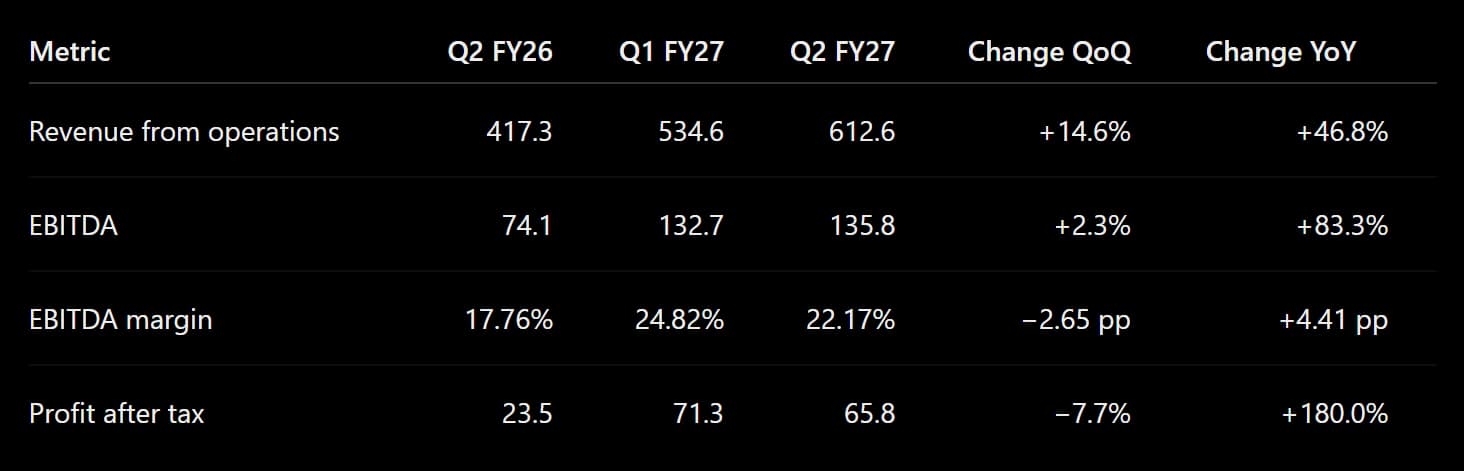
EBITDA is the company’s operating-profit measure before interest, tax, depreciation and amortisation. Figures and growth rates follow its 29 October presentation, subject to rounding. Prior-year profit is restated for valuation losses on a foreign-currency contract; “pp” means percentage points.
Why margins declined despite a better CDMO mix
June benefited from selling-price increases against raw materials bought earlier at lower costs. Management explicitly warned in August that this benefit would normalise. October’s lower margin is therefore consistent with the earlier explanation. Higher input costs were being passed through in xanthine and some API products, expanding the sales denominator without an equivalent increase in profit.
The sequential profit decline also reflects finance costs rising to about ₹15 crore from ₹12.9 crore, a smaller currency gain and lower other income. A ₹2.04 crore stamp-duty provision added an exceptional charge. Conversely, annual profit growth benefits from replacing last year’s currency loss with a gain. Consolidated net profit was ₹71.5 crore versus ₹76.1 crore in June, down about 6%; these group figures differ from the standalone discussion above.
Higher CDMO sales could improve margins in the second half, but new plant expenses and depreciation will also enter the accounts. Management expects finance costs to remain broadly similar from here, while acknowledging depreciation will rise. It declined to upgrade the existing multi-year revenue and EBITDA growth framework of 15–18%.
API recovery is supported by restored production
API and intermediate sales were approximately ₹184 crore, compared with about ₹160 crore in June, based on rounded segment shares. Management described the improvement as largely volume-driven. The steroid block’s roughly six-week shutdown in Q1 had constrained output; the completed expansion added 33% capacity and is now contributing sales.
The indicated quarterly sales range improved modestly from ₹170–190 crore in August to ₹180–200 crore for the second half. This supports a recovery, rather than an abrupt change in prospects. Anticancer expansion and new-product validations are next. Launch sales depend on customer approvals and market share after patent expiry.
Xanthine: distinguish available capacity from actual sales
Xanthine and allied products contributed 50% of turnover, versus 57% in June. Applying those rounded shares gives approximately ₹306 crore in both quarters. That stable segment total masks different movements: xanthine realisations softened and some dispatches were delayed, while allied-product volumes and sales increased. Management estimated that about 5% of quarterly xanthine sales were held up and hoped to resolve the shipment issue in Q3. It did not provide a complete price-and-volume reconciliation.
The beverage share of segment volumes fell from 74% to 62%, while the export share of sales fell from 79% to 59%. Those changes, together with the allied-product contribution, mean flat revenue cannot be read as flat xanthine volumes or unchanged profitability.
Ethica Invest
Serious about long-term investing?
Unlock our professionally managed portfolios.
The year-end capacity milestone is not a promise of full utilisation. Management clarified this explicitly during the latest questions. Installed capacity is around 9,600 tonnes annually, while the current operating level was described as near 7,000 tonnes. It expects 7,500–8,000 tonnes in FY28 and approximately 8,800 tonnes within about two years. August had already envisaged utilisation above 80% by FY28. The latest figures refine that gradual ramp-up rather than bring forward full utilisation to March 2027.
Pricing remains another moving part. October commentary put average realisations about 10–15% above last year, despite the sequential softening. Management’s ₹1,400–1,500 crore sales potential at expanded utilisation was conditional on prices staying elevated. It should not be treated as FY27 guidance or directly compared with August’s broad current-year sales range. Lower input prices could reduce revenue through pass-through arrangements, while spot-market margins remain exposed to competition. Management expressed greater confidence in absolute margins for beverage and pharmaceutical customers than in spot prices.
Atali: commissioning advances, commercial ramp-up still matters
August’s expectation was for both phases of Atali Block 1 to be operational in Q2. By the October call, Phase 1B trial batches were still underway and accounting capitalisation was expected in Q3. The larger commercial line was already operating; the smaller line supports early-stage work and adds less immediate commercial capacity. Completion and recognition of the remaining assets therefore extended beyond the earlier quarterly milestone.
Management expects the existing Atali assets to be fully used in the second half. Shareholders should look for higher dispatches and earnings contribution to confirm that expectation, particularly as more running costs reach the profit statement.
Groundbreaking for the ₹149 crore dedicated Block 2 has now occurred, with commercialisation targeted for H2 FY28. The block is intended for a few recurring customer programmes, freeing multipurpose equipment for newer projects. August commentary envisaged meaningful occupation over 12–18 months after start-up. The latest call did not establish immediate full revenue on commissioning or disclose customer-backed minimum purchases.
Cash conversion is the main financial constraint
Standalone first-half operating cash flow was only ₹29.9 crore, against ₹268.5 crore of EBITDA. Working-capital movements absorbed about ₹215 crore. Borrowings, excluding leases, rose from approximately ₹686 crore in March to ₹836 crore in September. The 28 October results show growth requiring substantial funding before producing cash.
Management attributed the build-up to higher sales and inventory ahead of second-half CDMO deliveries. It cautioned that CDMO growth would continue to require more inventory. Better collections and cash generation alongside growth are therefore the relevant tests.
Different speakers described the cash cycle at roughly 150–167 days without reconciliation, preventing a precise comparison. Both indicate a long funding cycle. With FY27 capital expenditure targeted at ₹350–400 crore, management explicitly said more debt would be needed. Its expectation of broadly stable finance costs should be monitored against that requirement.
A separate contingent liability deserves attention
The demerger-related stamp-duty dispute carries ₹57.46 crore of additional disputed duty and penalties as a contingent liability, alongside the ₹2.04 crore provision. The company has challenged the order in court and considers the additional outflow not probable. This remains a separate potential cash exposure.
New research capabilities remain an early investment
Laboratories for more complex peptide and oligonucleotide drug-development work are expected to operate by FY27-end. Management hopes to win customer business in FY28, but declined to quantify revenue and acknowledged that experience needs to be built. Laboratory readiness, customer projects and commercial orders are the milestones. Material near-term earnings are unproven, while research spending will increase.
What shareholders should monitor next
- CDMO execution: second-half shipments, progress on larger customer programmes and conversion of those sales into collections.
- Atali economics: completion of Phase 1B, utilisation of existing assets and profit growth after additional expenses and depreciation.
- Xanthine recovery: release of delayed shipments, actual production volumes and margins as selling prices and customer mix change.
- API continuity: sustained ₹180–200 crore quarterly sales, anticancer expansion and customer approvals for new products.
- Funding: operating cash flow, receivables, inventory and additional debt, alongside developments in the stamp-duty case.