“I am not a machine.”
You might have said it after a long day at work, when someone expected you to keep going without a break.
Well, it’s a fair argument.
Because, we get tired. Our mood swings. Some days we are sharp, some days we are not. And no human can do the same task the same way ten thousand times.
 Ethica Invest
Serious about long-term investing?
Unlock our professionally managed portfolios.
But, a machine can. One command, and it repeats. No bad days. No drift.
That’s how machines began, as a helping hand.
They lifted, pressed and spun, but the human was still in charge. Then, slowly, the helping hand became the backbone. The extension became the replacement.
But here’s the question we rarely ask. Who builds the machine?
Not by hand. Not at the scale the world needs. To make a machine, you need another machine. One that cuts, drills and shapes metal to a fraction of a hair’s width.
It’s called a “machine tool”. The Mother Machine. Almost every metal part around you started life on one.
Today, the most advanced form of that mother machine is the CNC. Give it a design and a set of numbers, and it cuts the same part perfectly the first time and the ten-thousandth.
And the company which we are going to discuss today has spent years building exactly these machines.
That company is “Macpower CNC Machines”.
But before we get to Macpower, we need to understand what a CNC machine really replaced, and who it replaced. So let’s start where every machine started: with a man, a piece of metal, and nothing but his own hands.
The Man Was the Machine
Go back a few hundred years. A metalworker sits in his shop with a block of iron and an idea in his head.
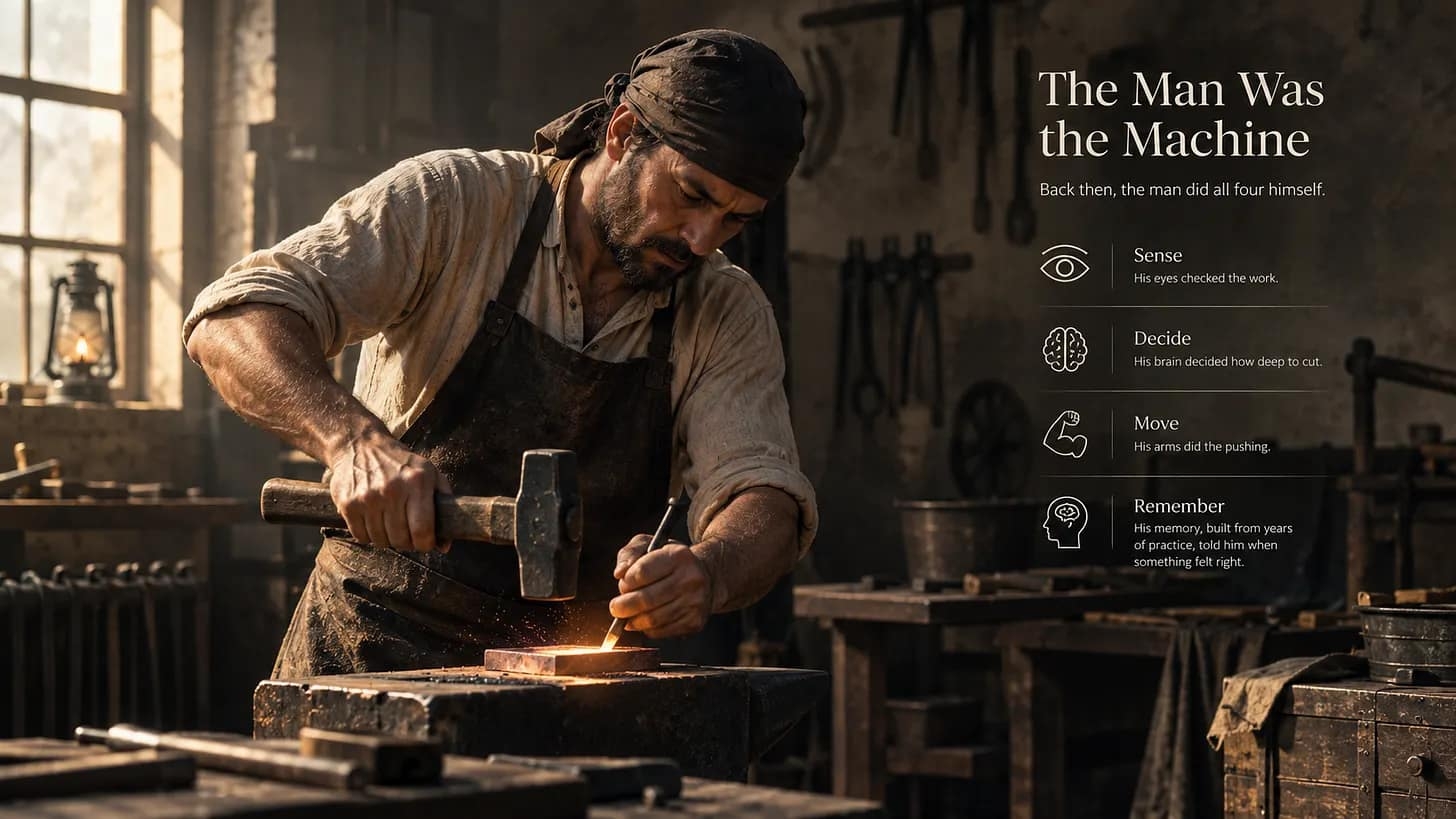
A machine today does four things: it senses, decides, moves, and remembers how.
Ethica Invest
Serious about long-term investing?
Unlock our professionally managed portfolios.
Back then, the man did all four himself:
- Sense - His eyes checked the work.
- Decide - His brain decided how deep to cut.
- Move - His arms did the pushing.
- Remember - His memory, built from years of practice, told him when something felt right.
He was skilled. But, he was also human. Some days his hands were steady, some days they weren’t. So no two things he made ever came out exactly the same.
This is the whole story of machines. Over two centuries, those four jobs moved, one by one, from the man into the machine.
Machine Gets Muscle First
Steam engines arrived in the late 1700s. A machine could now push harder than a hundred men, without ever stopping to rest.
But a steam engine only works if its parts fit tightly, and hand made metal wasn’t accurate enough. So a new kind of machine was built whose only job was cutting other metal into exact shapes, “a machine tool”.
Around 1800, a mechanic named Henry Maudslay built a lathe that used gears and a screw to guide the cutting tool. The man still decided what to make, but the steadiness that used to live only in his hands now lived inside the machine.
Not everyone was happy because of these developments just as we are because of Artificial Intelligence.
Between 1811 and 1816, skilled weavers in England, watching machines eat into their wages, went out and smashed them.
History calls them the ‘Luddites’.
They weren’t scared of machines. What they were watching was a lifetime of skill suddenly counting for less. Just as we are today.
Then Machine Learns to Repeat
Muscle wasn’t enough. Factories wanted the exact same product, made a thousand times without variation.
Henry Ford’s car factory shows this best.
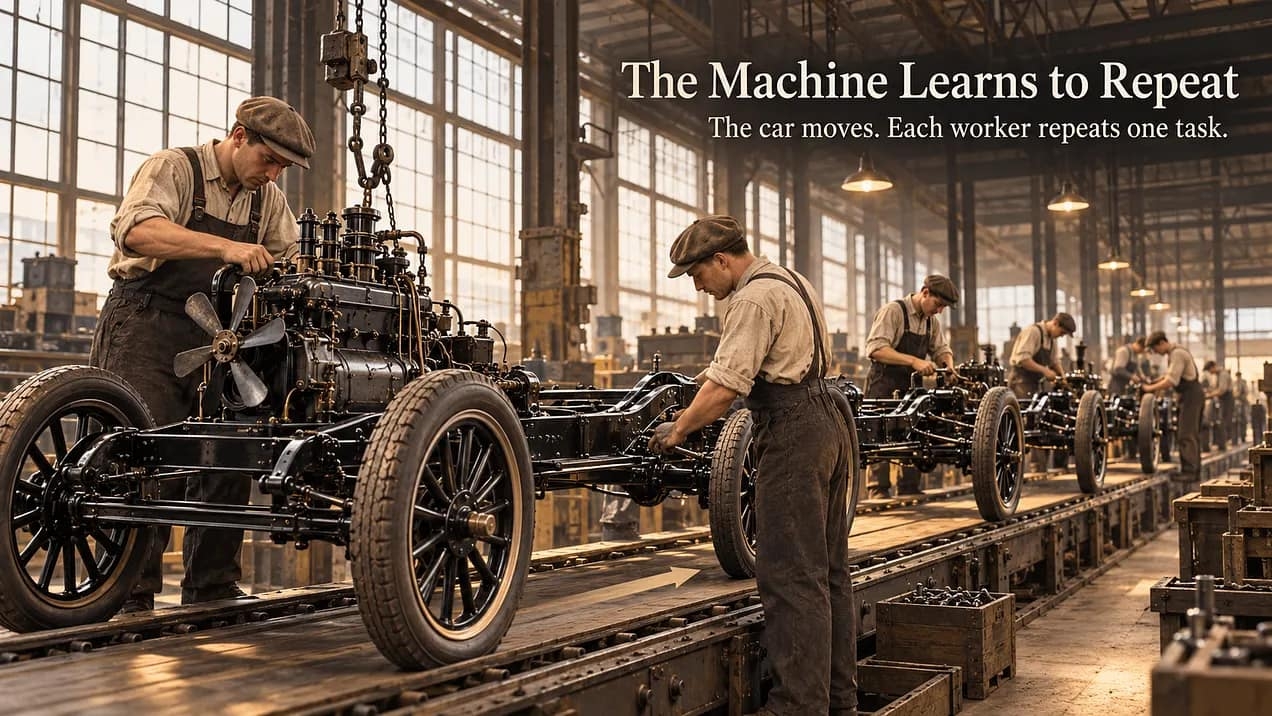
In 1913, instead of a worker walking around a parked car, Ford made the car move past workers standing in one spot, each doing one small task, over and over.
The result?
Building a chassis dropped from 12.5 hours to 93 minutes. And a Model T’s price fell from $850 to as little as $260, and ordinary families could finally afford one.
But look at the worker.
He used to understand the whole car. Now he tightened one bolt, all day. Ford had to pay an unusually high wage, $5 a day, partly just to stop people quitting out of boredom.
The skill hadn’t disappeared.
It had moved into how the factory was designed. But a line built for one part could only make that one part.
Want something different tomorrow? Rebuild the whole line.
Then Machine Learns to Follow Instructions
This leap came from aeroplanes. Wings and propeller blades curve in ways no fixed tooling could handle, and no hand could cut the same curve twice.
In the late 1940s, an American engineer named John Parsons had an idea: describe a shape as a list of numbers, and let motors follow it, like dots on a map. MIT built on this, and in 1952 showed a milling machine that read instructions off a strip of punched paper tape, moving exactly as told, no hands required.
This is the turning point.
For the first time, nobody stood at the machine turning wheels by hand. Want a different part? Just change the tape.
This was called “Numerical Control”, or ‘NC’.
Finally, Machine Gets a Brain
Paper tape tore and jammed. One small mistake meant cutting a whole new tape.
As computers shrank through the 1960s and 70s, one was fitted into the machine itself. A program could now be stored, edited on a screen, and reused in seconds. NC became ‘CNC’, “Computer Numerical Control”.
From there, the machine kept getting more independent.
It began changing its own cutting tools. It gained more directions to move in. It started checking its own accuracy with a built-in probe. A part that once travelled between three machines, carried and measured fresh each time, could now finish inside one box, untouched.
So What a CNC Machine Actually Is?
Put it together, and a CNC machine stops looking like a faster lathe. It becomes a packaged unit of productivity, the ability to make the same precise part again and again, without needing a highly trained pair of hands standing beside it every time.
And because it’s a machine tool, one that makes other machines and parts, that value flows into everything built using it.
That is where ‘Macpower’ stepped into.
A Workshop in Rajkot
The year was 2003, and the place was Rajkot, a city where making machines was already established as a business.
Into that city, a new workshop was started, “Macpower CNC Machines”.
Initially, Macpower’s customers were an auto-component maker in Rajkot. An engineering workshop in Pune. A die-maker in Coimbatore.
For businesses like these, a CNC machine is a serious purchase.
So they need something affordable, accurate, and dependable enough to run long hours without leaning on one craftsman’s judgement.
Macpower built its business around exactly that gap, and it’s still visible in the numbers today.
More than 380 machine variants now. A cumulative installed base of over 13,800 machines. Revenue of roughly ₹333 crore in FY26, an EBITDA margin of 16.2%, a return on capital employed north of 20%, all built on a balance sheet that carries almost no debt. Revenue has compounded at ~24% a year over the last five years.
The pending order book, ₹456 crore as of June 2026, had grown 32% y-o-y. And inside that order book, something is quietly shifting. Macpower’s premium range, branded NEXA, the company’s label for its higher-end offerings, by June 2026 made up around 40% of the order book by value.
Now, this is just to hype you up so that while reading this you open the company’s price chart and you can say, “something is there about the company”.
And to understand why that climb matters so much to Macpower’s future, we need to open up the machine itself and see where the money actually goes.
Making the Mother (Machine)
Remember our metalworker? His hands gave him strength, his eyes checked the work, and his brain decided what to do.
A CNC machine needs all three. And somebody has to build them into it.
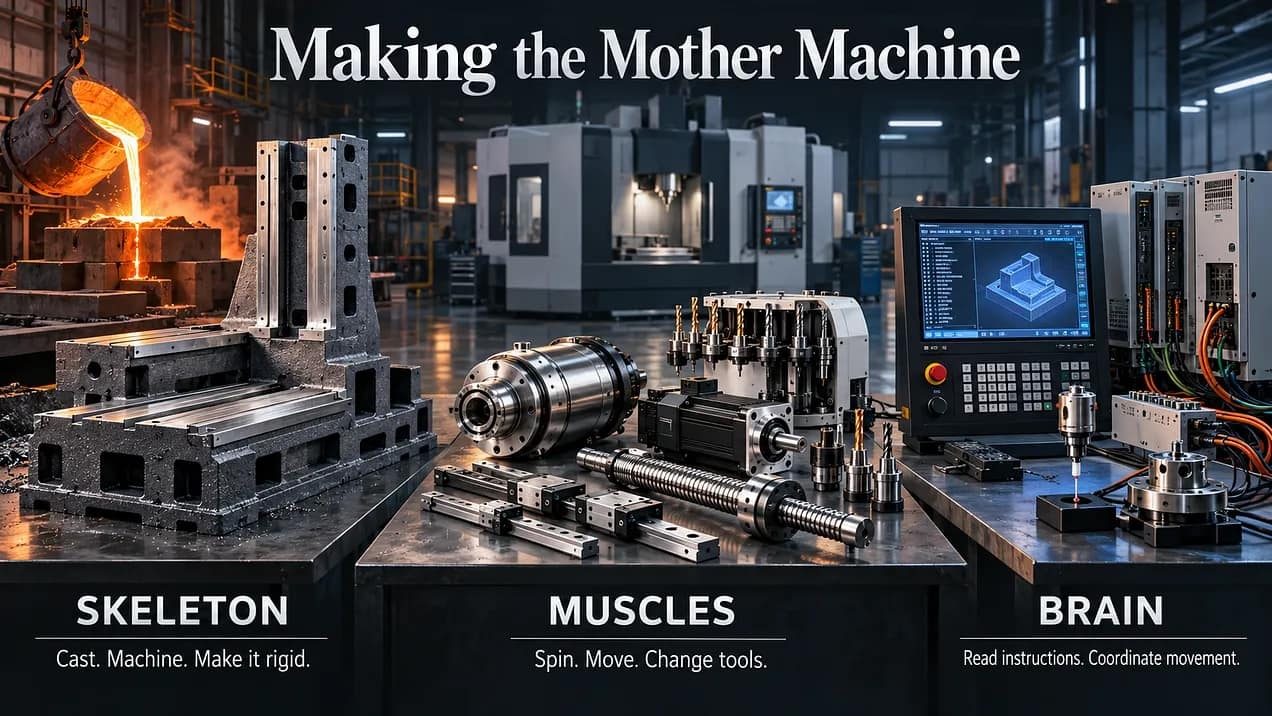
It starts with a foundry. Molten metal poured into moulds becomes the machine’s bed, its columns, the heavy structural parts that everything else bolts onto. This is the skeleton, and it has to be extraordinarily rigid, because even a tiny vibration during cutting throws off the accuracy of the part. Once cast and cooled, these pieces move to a machine shop, where their surfaces are machined to exact dimensions.
Then come the muscles: spindles that spin the cutting tool, guideways and ball screws that let the machine move with precision, servo motors that power that movement, tool changers that swap cutting tools automatically instead of waiting for a person to do it by hand.
None of this knows what to do on its own.
It needs a brain. That is the “CNC controller”, working with servo drives and feedback systems to read the program and translate it into exact, coordinated movement.
Finally, everything gets assembled, calibrated, and tested as per customer needs.
But, here’s what you don’t see from the outside: the manufacturer may not have made most of what’s inside.
The casting might come from one supplier, the spindle from another, the motors from a third. And the controller, the part that actually runs the show, has historically come from Japan or Germany, from names like Fanuc, Siemens, Mitsubishi. An Indian company can build and assemble an entire CNC machine while still importing its brain.
Every bought-in component carries someone else’s margin. So the more of the machine a manufacturer makes itself, the more of that margin it keeps.
Basically, “the more value you can make inside, the more value you can keep at your side”.
That’s backward integration.
There’s also a second, separate lever. And it involves selling a different machine.
Picture two factories.
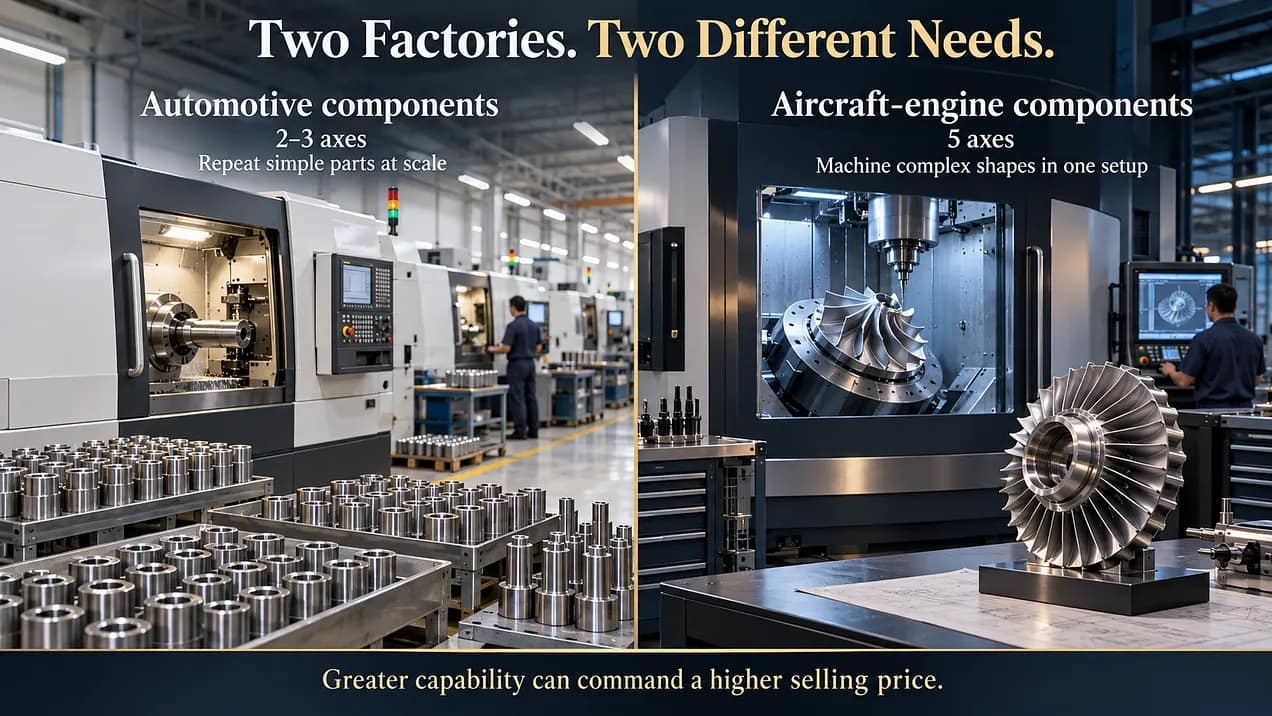
One makes thousands of simple automotive components a day and needs an affordable machine that repeats the same cut, fast and accurately.
The other machines aircraft-engine components with complicated curves and tolerances so tight they leave no room for error.
The first factory buys a basic 2 or 3-axis machine. The second needs a sophisticated 5-axis machine that can approach a part from several directions in a single setup, no repositioning, no repeated handling, far less room for error to creep in.
The customer pays a lot more for that capability.
And here’s the part that actually explains where margins come from: raw-material eats up roughly 65% of the selling price on a basic 2-to-3-axis machine, leaving about 35% gross margin. On a 4-axis machine, that rises to around 40%. On a 5-axis machine, it climbs to roughly 55%.
Why such a gap?
Because the electronic brain, the controller, drives and motors, doesn’t get proportionally more expensive as the machine gets more advanced. That package eats up around 31% of a basic machine’s total cost. On a 5-axis machine, its share falls to ~11%.
The bought-in, lower-margin part of the machine shrinks. Everything the manufacturer actually builds and engineers itself, the structure, the precision, the customer-specific work, grows.
So a CNC company has two separate ways to improve its margins: Make more of the machine yourself. Or sell further up the machine.
And the two reinforce each other, because a company with stronger in-house manufacturing and engineering capability finds it easier to earn the trust needed to sell a sophisticated machine in the first place.
Macpower’s business today still sits mostly in the affordable, entry-and-mid tier, its FY26 gross margin of ~39% reflects that. But its NEXA share is rising, and its longer-term plan includes an in-house foundry it doesn’t yet have.
Both levers are still mostly ahead of it. But none of that matters, though, if nobody’s buying.
And The World Keeps Building Factories
India’s machine-tool demand has grown fast, from ~₹12,040 crore in FY21 to ~ ₹36,420 crore by FY26.
And imports have captured most of the increment. By FY26 imports were ~59% of India’s machine-tool demand.
That leaves domestic manufacturers a genuine substitution opportunity. And it exists at two levels.
India imports a large share of its finished machines outright. And even the machines built in India often carry an imported controller inside them. Closing the first gap needs competitive manufacturing and customer trust. Closing the second needs an entirely different level of electronics capability, one that even India’s most advanced domestic players are only just trying to build.
Where does new demand come from?
Historically, automotive and general engineering carried Indian CNC demand almost on their own, together accounting for ~64% of the market in FY25, with tooling at 8%, electrical and electronics at 7%, aerospace and defence at 5%, and others at 16%.
That base hasn’t gone anywhere. But newer demand pools are layering on top of it.
end-market growth of about 8% for aerospace and defence (to 2030), 7%+ for EMS (2026-34), about 20% for EVs (2025-34) and about 11% for semiconductors (FY26-30).
- Aerospace and defence (end-market growth of ~8% to 2030) need sophisticated multi-axis machines the domestic industry is still building the credibility to supply.
- Electric vehicles are changing what automotive components look like, less engine machining, more motor housings and structural parts. End-market growth of ~20% 2025-34.
- And electronics manufacturing (end-market growth of ~11%, FY26-30), EMS, could alone need over 100,000 CNC machines over the next five years as India builds out its own device-assembly base, a volume opportunity that leans toward exactly the kind of productive, mid-range machines Macpower already knows how to build.
Macpower has already put down a marker in the segment that matters most for credibility, defence and aerospace. It also ~₹304 crore of bids under evaluation as of June 2026, distinct from its confirmed order book and still subject to how those procurement decisions land. A bid isn’t an order. But it’s a foothold in a market that doesn’t open its doors easily.
None of this demand converts into revenue, though, if the factory can’t build fast enough.
What does it mean for Macpower?
On the ₹333 crore of FY26 revenue against ₹17,390 crore of domestic production, Macpower holds roughly 2% of the market by value, against Jyoti’s 12%.
The comparison is rough because definitions differ.
But it makes the headroom clear: each additional percentage point of FY26 production is worth about ₹174 crore, roughly half of Macpower’s current revenue.
Two other data points cut in different directions:
- Recent growth has been market-like. Macpower maintained a three-year revenue CAGR of 15%, against about 14% for industry consumption since FY23. The five-year 24% suggests an earlier, faster phase. Share gains are not obvious in the recent numbers.
- The order book shows demand outrunning supply. The ₹456 crore backlog (up 32%) is about 1.4 times FY26 revenue. The ₹304 crore of bids equals two-thirds of that backlog but is not yet ordered. Every 10% of those bids that convert adds about ₹30 crore, or roughly 9% of FY26 revenue.
The demand case is sound: a large, slowly widening import gap and a small starting share. What is unproven is Macpower’s win rate against imports and its ability to deliver on time.
That depends on the factory.
And The Factory Ran Out of Room
Macpower’s installed capacity has grown in three steps: from around 600 machines a year in its early days, to about 1,300 after debottlenecking around its IPO, to roughly 2,500 machines a year today.
Each step followed the same pattern.
Orders grew faster than assembly space, delivery timelines stretched, and eventually the existing plant simply ran out of room to absorb more.
That’s exactly where Macpower found itself again through FY26 and into FY27, an order book worth more than a full year’s revenue, and management openly flagging that existing capacity would constrain how much of it could actually be built and delivered on time.
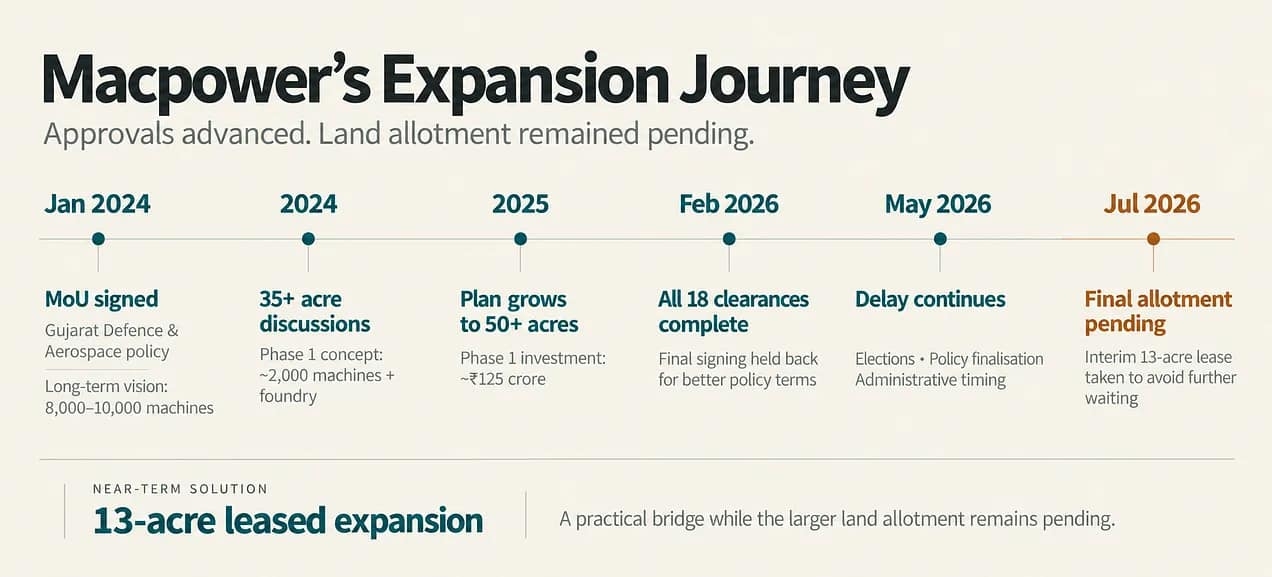
The plan to fix this began in January 2024, when Macpower signed an MoU with the Gujarat government at Vibrant Gujarat, aiming at a large new facility that would eventually take it toward a long-term target of 10,000 machines a year by 2030.
What followed was two years of a plan that kept changing shape.
The land on offer shifted from roughly 35 acres to, eventually, more than 50. The proposed first phase moved from an undefined ambition to a specific 2,000-to-2,500-machine addition, complete with an in-house foundry, the very piece of backward integration the company doesn’t yet have. Clearance stages piled up one after another, ten of seventeen by mid-2025, all eighteen required stages complete by February 2026.
And then, even with every clearance in hand, management chose to wait.
Because Gujarat was about to roll out a new industrial policy with better subsidies, and holding off on the final land transaction meant a chance to capture those terms.
That’s a reasonable trade to make on paper.
But waiting also meant delaying capacity the company badly needed, and the wait stretched further still, into elections, policy redrafting, and administrative timing that pushed things back another few months.
Rather than let the whole growth plan sit hostage to a government process, Macpower did something practical in mid-2026: it took a 13-acre plot on a 30-year lease right next to its existing Rajkot plant.
Around ₹50 crore of capex, roughly 1.5 to 2 lakh square feet of shop floor, a 12-month construction timeline, eligible for a 25% capital subsidy and a 7% interest subsidy under the new state policy.
It isn’t a replacement for the bigger plan. It’s a bridge, a way to relieve the existing plant’s constraints while the larger 50-plus-acre proposal, its clearances already done, continues waiting on the government’s side of the process.
Management hasn’t yet put a specific machine-capacity number on what the 13-acre site will add, so it shouldn’t be read as an automatic 2,500 more machines. Its actual contribution will depend on how the space gets equipped and run.
Put together, this is a company mid-expansion on two fronts at once, one already under construction, one still waiting on land. And that’s precisely the point where another Rajkot company’s history becomes useful.
The Road Jyoti Already Walked

Twelve years before Macpower was incorporated, another machine-tool company began its own journey in Rajkot.
“Jyoti CNC Automation”.
Like Macpower, it started as a mechanical manufacturer, a gearbox maker, before pivoting into CNC machines. But in 2007, it made a decision that changed its trajectory entirely: it acquired Huron Graffenstaden, a 150-year-old French machine-tool maker with genuine expertise in 5-axis technology. Instead of building that capability from nothing, Jyoti bought its way to the frontier.
The years since show what compounds when a company keeps pulling both levers at once, more in-house manufacturing, and a heavier mix of high-end machines.
Jyoti’s aerospace and defence revenue share rose from around 5% in FY21 to close to 39% by FY26. It built its own foundry, machine shop, and integrated manufacturing base, and today makes ~70% of a machine’s value internally, close to the practical ceiling of what backward integration can achieve. Its FY26 EBITDA margin sits above 25%, against Macpower’s 16%.
And Jyoti isn’t standing still even at that scale.
It has already developed its own proprietary operator interface and is working toward prototypes of its own CNC controllers and servo motors, an attempt at the one piece of the machine almost nobody in India has managed to bring in-house. Its own large capacity expansion, taking it from 6,000 to roughly 16,000 machines a year, is going commercial from September 2026, already live now.
That’s the comparison worth sitting with.
Jyoti has already done what Macpower is only now starting: full backward integration, a high-end product line through Huron, real scale, and expanded capacity that’s already running.
A company that has already walked the entire road tends to have that road priced into it.
Why Is This Worth Watching?
Here’s the way to think about where that leaves Macpower.
Judged only on what it is today, a mid-tier CNC manufacturer with a 16% margin and a mostly entry-to-mid product mix, the business is reasonably well understood, and the market has largely priced it as such.
That, on its own, isn’t the interesting part of this story. What makes it interesting is what sits ahead of it.
The demand backdrop, aerospace and defence, EMS, EVs, and a domestic market that still imports close to 60% of what it consumes, looks set to stay strong for years.
And Macpower still has both of its margin levers largely untouched: an in-house foundry it hasn’t built yet, and a NEXA mix that’s climbing but still a minority of the business.
If the 10,000-machine long-term plan actually gets built and commissioned, if the backward integration that comes with it materialises, and if the mix keeps shifting toward higher-end machines the way it already has inside the order book, margins have real room to move the way Jyoti’s did as it walked this same road over the last two decades.
That is not a guaranteed outcome.
It depends on execution, and the last two years of shifting land allocations, delayed clearances, and a deliberate wait for better subsidy terms are a reminder that this execution has not been simple so far. It depends on demand actually showing up at the scale the industry currently expects. And it depends on Macpower converting a rising bid pipeline and a growing NEXA share into real, delivered revenue, not just a larger number sitting in the order book.
But that is also the whole case for looking at Macpower now rather than later.
Jyoti’s road is already travelled, and largely priced.
Macpower’s is still ahead of it, capacity under construction, backward integration still to come, mix still shifting.
Whether it gets there is still an open question. That it has the same road available to walk is not.
About Ethica Invest
Ethica Invest is a principled, Shariah-compliant investment platform that helps investors like you in identifying companies using well-defined criteria for finances, operations, and governance. Though grounded in Shariah guidelines, Ethica’s approach goes beyond any single faith by prioritizing openness, strong balance sheets, and responsible business practices.
Ethica Invest works with SEBI-registered analysts and seasoned investment experts who deliver organized, compliant analysis on stocks and other opportunities. Those interested in seeking more on Shariah-aligned investing, can connect with our Ethica team.
The goal is straightforward: empower investors with decisions based on ethics, solid data, and performance; not just stories.
General Disclaimer and Release: Nothing contained herein constitutes tax, legal, insurance or investment advice, or the recommendation of or an offer to sell, or the solicitation of an offer to buy or invest in any investment product, vehicle, service or instrument.