Jeena Sikho: Green Growth with Red Flags?
As human beings, we usually want two things from life: ‘Growth’ and ‘Comfort’.
Investing is not very different.
Growth attracts us because it creates wealth. Comfort allows us to stay invested when markets become difficult.
Ideally, we want both.
 Ethica Invest
Serious about long-term investing?
Unlock our professionally managed portfolios.
But what happens when the growth is impossible to ignore, while the comfort becomes harder to justify the deeper one looks?
“Jeena Sikho” Lifecare is a good test case for that question.
The headline numbers are exceptional.
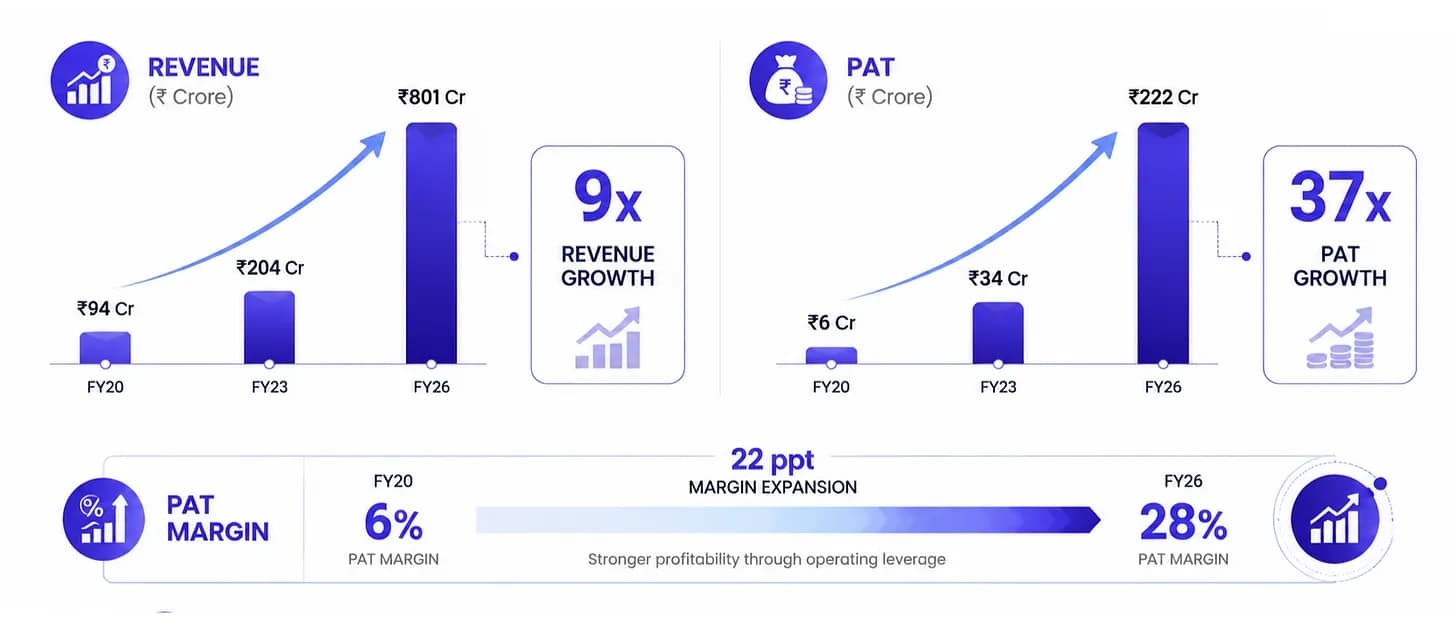
The Company now operates 61 hospitals and 58 clinics, with around 2,800 beds in the network, and migrated from the SME platform to the Main Boards of NSE and BSE in August 2025.
The growth is undeniable.
The question is: whether investors are mistaking rapid expansion for institutional quality, medical credibility and governance comfort?
A Healthcare Ecosystem, Not Merely a Hospital Chain
At first glance, Jeena Sikho may look like an Ayurvedic hospital company. That description misses the most commercially important part of the business.
The Company operates hospitals, Panchkarma centres, day-care clinics and consultation channels under the HIIMS and Shuddhi brands. It also sells more than 300 Ayurvedic medicines and wellness products through its hospitals, stores, franchises, call centres and online channels.
In FY26, healthcare services contributed ~Rs. 385 Cr, while medicine sales contributed ~Rs. 416 Cr. The two businesses are almost equal in size, but they are not independent of each other.
Here’s how:
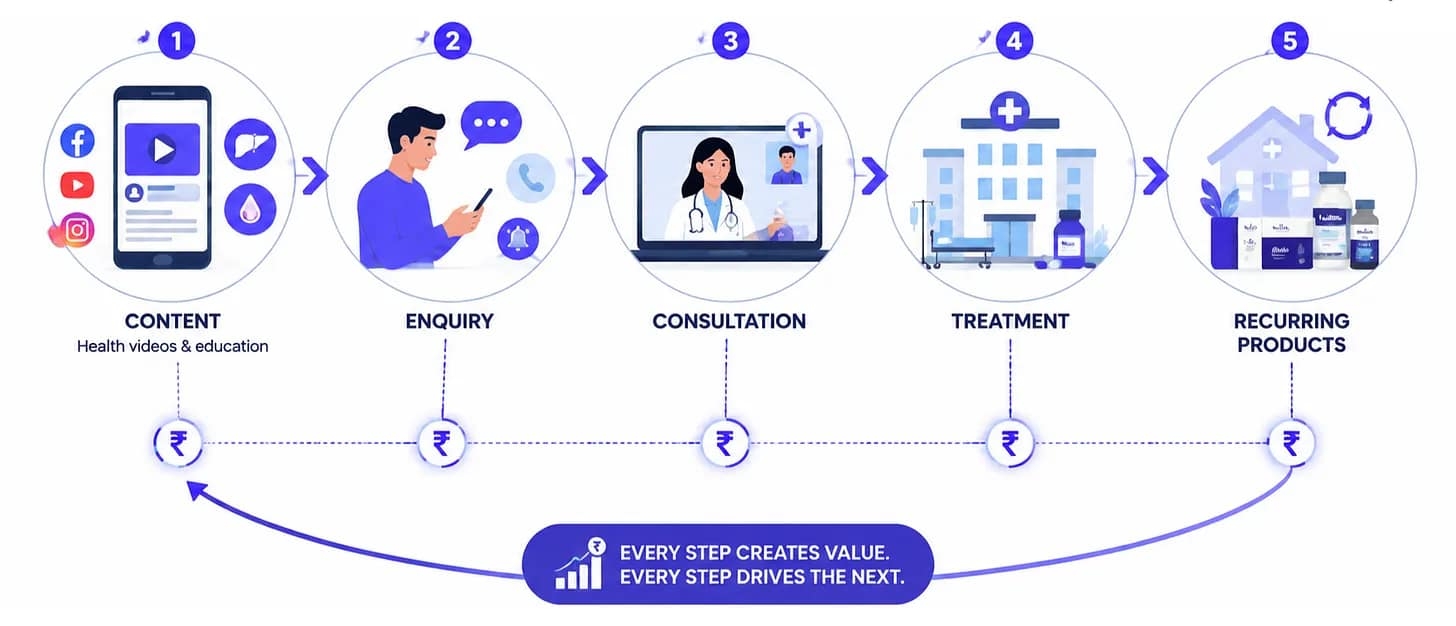
The patient is first attracted through the founder’s content, disease-related claims, testimonials or marketing. The patient then enters the consultation network, receives treatment advice and may subsequently purchase medicines, therapies, dietary programmes and repeat consultations from the same ecosystem.
Commercially, this is an effective funnel. Medically, it is uncomfortable.
Ethica Invest
Serious about long-term investing?
Unlock our professionally managed portfolios.
The same organisation can influence the patient’s beliefs, diagnose the problem, recommend the treatment, supply the medicine and collect revenue at every stage. That creates an obvious incentive to keep the patient inside the ecosystem.
The hospital generates trust and treatment revenue.
The medicine business creates repeat purchases and high gross margins.
Each side feeds the other, increasing the value extracted from every acquired patient.
The model is also capital-light.
Medicines are manufactured by third parties, while many healthcare facilities are leased or operated through partnerships and revenue-sharing arrangements. Management has indicated that a Jeena Sikho bed require only ~Rs. 3-4 lakh of setup cost, compared with Rs. 50 lakh to Rs. 1 Cr for a conventional hospital bed.
Management says, “a facility breaks even near 35% occupancy and pays back its cost in under six months”.
Those economics sound extraordinary, perhaps too extraordinary to accept without knowing what the setup cost excludes and whether the claimed payback captures patient acquisition, doctor compensation, central overheads and brand-building.
Jeena Sikho has also struck two asset-light tie-ups worth watching:
- An exclusive distribution deal that puts Shuddhi products in front of roughly 1.25 lakh pharmacies without the Company spending on its own retail footprint.
- A diagnostics partnership where an outside player funds the labs inside Jeena Sikho’s hospitals in exchange for splitting the revenue.
This is a well-designed commercial machine.
That is why investors must not confuse business-model efficiency with treatment efficacy. The Company may be good at acquiring and monetising patients without its medical claims deserving equal confidence.
Before examining the person who brings patients into this ecosystem, there is a more fundamental question:
How much comfort should an investor take from the word “Ayurvedic” itself?
Ayurveda Is the Opportunity. It Is Also the Due-Diligence Challenge.
Ayurveda is not a fringe category in India. It has government support, recognised practitioners, hospitals, educational institutions and a large consumer base.
None of that is proof that every Ayurvedic claim is scientifically established.
Tradition explains why a practice exists. Popularity explains why it sells. Government recognition explains why it is regulated. None establishes that a treatment reliably works for a specific disease.
That distinction becomes critical when the category moves beyond general wellness and begins speaking about diabetes, kidney disease, liver disease, cancer, addiction, eyesight, infections or other serious conditions.
In such cases, “people have used it for centuries” is not an adequate standard.
The standard should be robust evidence, reproducible outcomes, transparent protocols and known risks.
Indian regulation recognises both classical Ayurvedic medicines and “patent or proprietary” Ayurvedic medicines. The second term may sound like intellectual-property protection or clinical validation. It is neither by default.
It is a regulatory classification.
It does not automatically mean the formulation is patented, clinically superior, difficult to replicate or supported by high-quality trials.
An AYUSH manufacturing licence is necessary.
But a licence is permission to manufacture under the applicable framework. It is not an independent certificate that every disease-specific claim made around the product has been proven to the standard expected from modern clinical medicine.
The familiar belief that natural means safe is commercially useful and medically dangerous.
Natural substances can cause adverse reactions, interact with prescribed medicines, vary in potency, contain contaminants or be inappropriate for particular patients. The Ministry of AYUSH itself operates a pharmacovigilance programme because adverse events and misleading claims are not imaginary risks.
For Jeena Sikho, the quality-control burden is even more important because the Company sells more than 300 medicines and wellness products while outsourcing manufacturing to third parties.
Investors therefore have to rely on the quality of manufacturers, raw-material sourcing, batch consistency, testing standards, contamination controls, traceability and the Company’s willingness to disclose adverse events or recalls.
The Company says it prescribes and monitors required quality standards.
Public disclosures, however, provide limited visibility into the complete manufacturing network, supplier concentration, plant-level certifications, rejected batches, adverse-event reporting, product recalls or independent testing across the portfolio.
That is not a minor gap when medicines form more than half the ecosystem’s economic engine.
Then comes the question of outcomes.
A patient may receive medicines, dietary restrictions, Panchkarma therapies, supplements, counselling and repeated consultations together.
- If the patient improves, the Company can present the overall journey as validation.
- If the patient does not improve, the failure can be attributed to poor adherence, advanced disease or insufficient time.
This makes the model difficult to falsify.
Testimonials are emotionally persuasive and commercially powerful, but cannot show how many patients failed, deteriorated, discontinued treatment, resumed conventional care or experienced adverse effects.
Anecdotes show what happened to someone. Clinical evidence asks what usually happens across a properly observed population.
This is not a neutral debate about two equal systems of medicine.
When serious disease is involved, unsupported confidence can delay diagnosis, interrupt proven treatment or create false hope. The commercial opportunity may be large precisely because patients are vulnerable, frustrated or looking for certainty that conventional medicine cannot honestly promise.
That vulnerability demands more scrutiny, not less.
And in Jeena Sikho’s case, much of the credibility needed to sell this proposition rests on one person.
When the Founder Is Also the Distribution Engine
Manish Grover, publicly known as Acharya Manish Ji, is not merely the promoter. He is the face of the brand, the educator, the lead generator and, to a large extent, the reason patients enter the Jeena Sikho ecosystem.
His social-media presence is vast.
Videos on diseases, food habits, Ayurveda and lifestyle remedies create trust before a patient speaks to a doctor. In a business asking people to believe in an alternative treatment system, that familiarity is commercially invaluable.
It also creates a severe concentration risk.
At the time of our review, his main YouTube channel carried around 1.45 million subscribers, more than 5,500 videos and hundreds of millions of cumulative views.
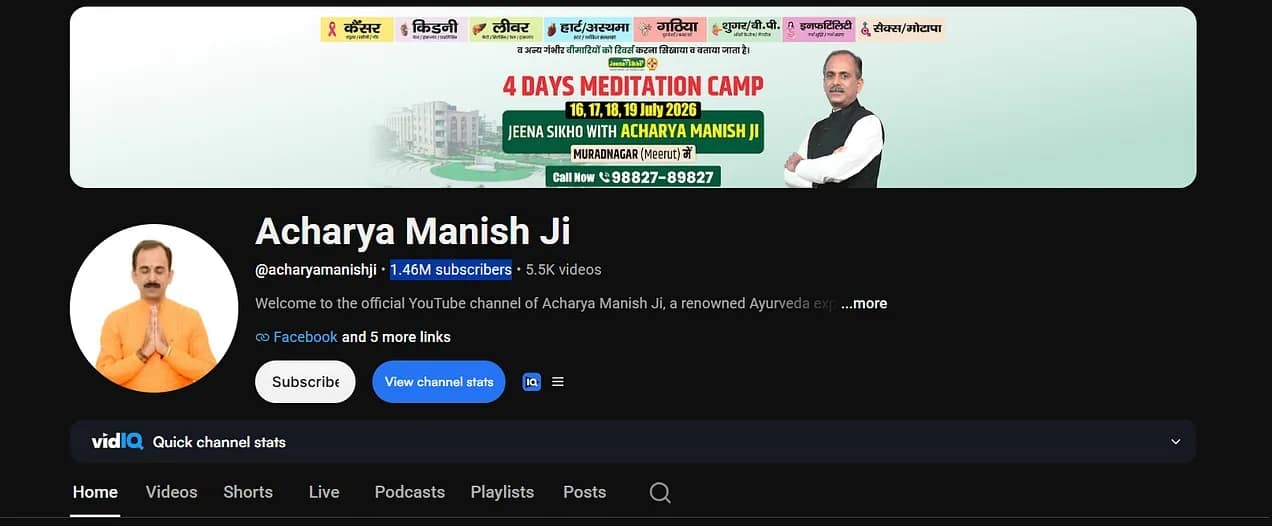
But look past the subscriber count and the picture becomes less impressive.
Several recent long-form videos drew only a few thousand views each. Everyday engagement did not appear proportionate to the headline subscriber number.
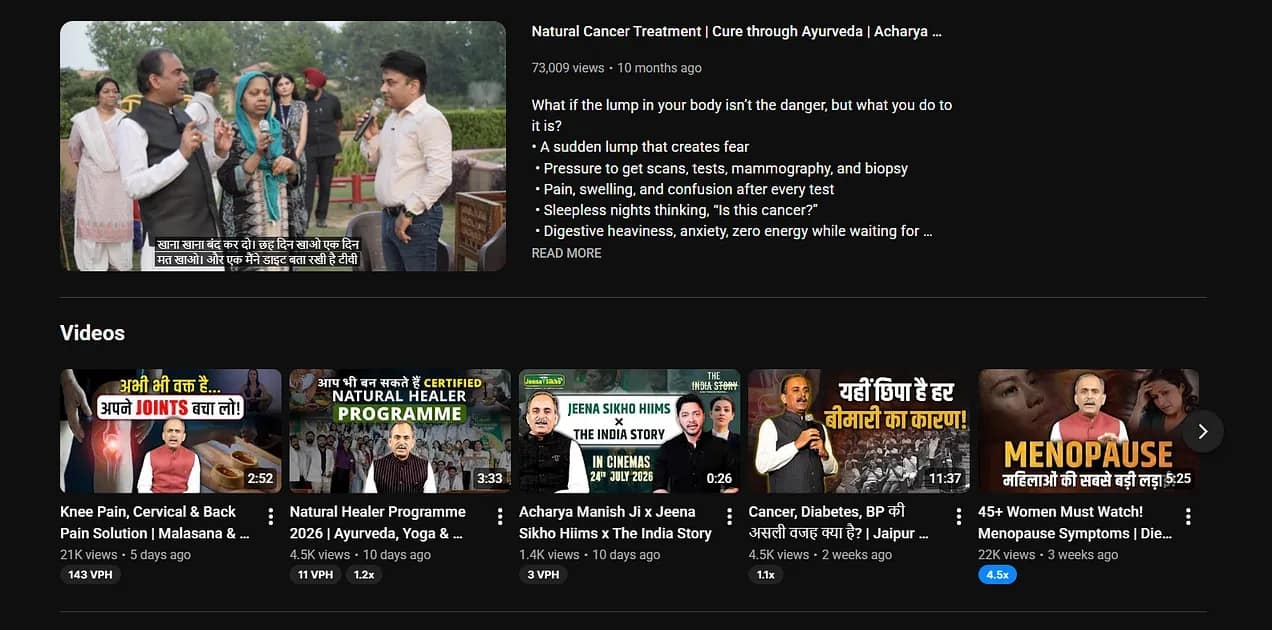
That does indicate artificial subscribers.
Apart from this, the enquiry process also deserves scrutiny.
In one instance, a person seeking an in-person appointment was steered toward a video consultation first, with a physical visit only if the doctor later considered it necessary. The enquiry was not taken forward, yet calls and messages continued almost daily afterward.
We know that one experience cannot represent the entire organisation.
But it illustrates the commercial intensity of the funnel.
When the same ecosystem creates fear or hope around a disease, captures the lead, conducts the consultation, recommends the therapy and sells the medicine, investors should demand evidence that clinical judgement is not being subordinated to sales conversion.
Some claims associated with the founder have also been publicly challenged by doctors and science communicators.
These have included claims relating to alkaline water, diabetes reversal, eyesight improvement, cancer-related remedies and the need for rabies vaccination.
The concern is not that every lifestyle recommendation is wrong.
The concern is that a charismatic founder can speak with medical authority on subjects where bad advice may have irreversible consequences.
A claim about digestion is one thing.
A claim that influences whether someone takes a rabies vaccine, continues prescribed treatment or seeks timely cancer care belongs in an entirely different risk category.
So far, criticism has not visibly dented growth.
That should not comfort investors. It may simply show how powerful the distribution machine has become.
When the promoter is simultaneously the educator, healer, brand and acquisition channel, a controversy does not remain confined to social media. It can move directly into patient trust, product demand, hospital occupancy and valuation.
The business appears not merely founder-led, but founder-dependent.
The Numbers Are Exceptional. The Cash Story Has Been Less Smooth.
A fast-growing network and rising bed count show how quickly the platform has expanded. They do not show how much of the reported growth turned into cash.
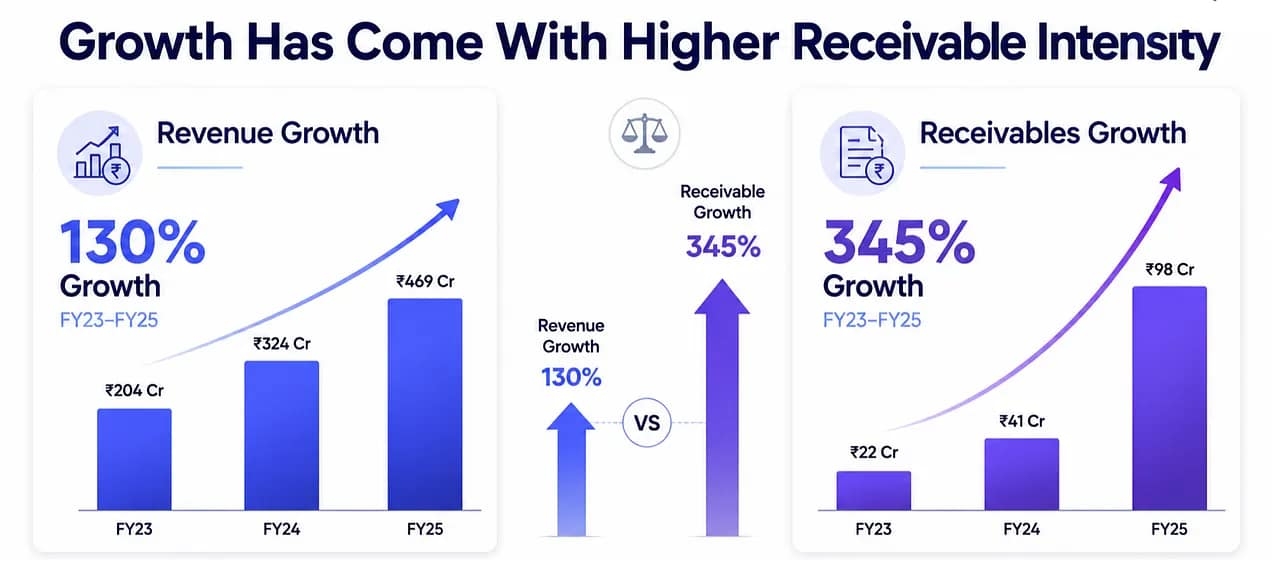
For a business serving a large number of retail patients, the earlier weakening in cash collection while revenue accelerated deserves attention.
Management has offered an explanation.
A large part of the increase came from government-panel business, where payment cycles could extend for three to six months. By FY25, around Rs. 92 Cr of the total Rs. 98 Cr receivables reportedly related to government customers.
The Company later reduced this business because dues were not being cleared on time.
Government Panchkarma revenue fell from around Rs. 118 Cr in FY25 to roughly Rs. 36 Cr in FY26. Year-end receivables also declined to around Rs. 70 Cr despite a much larger revenue base.
That is a positive.
But it does not make the earlier issue irrelevant.
Investors need to distinguish between revenue booked, services actually delivered, claims accepted, cash collected and amounts eventually retained after denials, reversals or provisions.
The FY25 auditor identified revenue recognition as a Key Audit Matter and examined cut-off, sales reversals and recoverability of receivables.
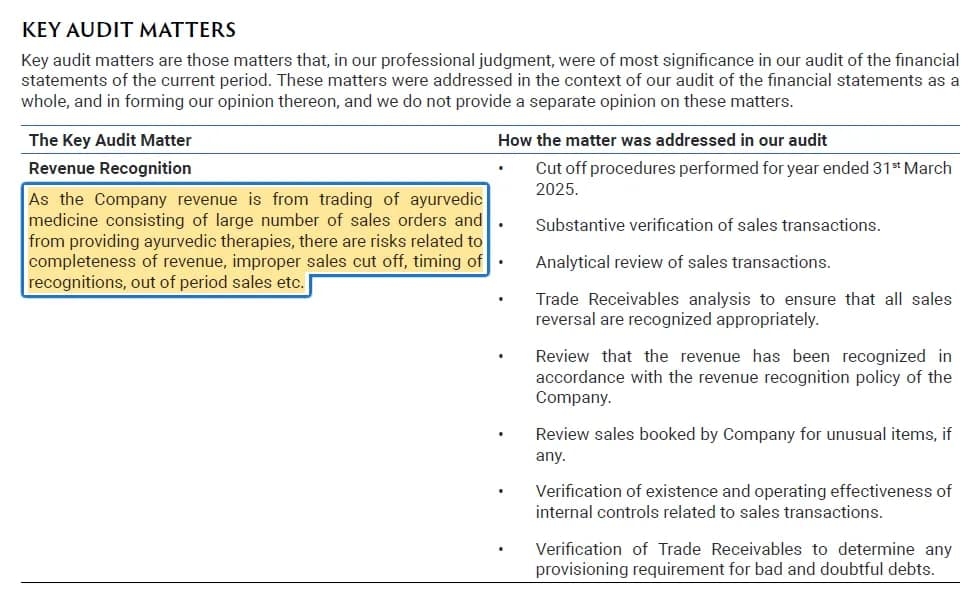
A Key Audit Matter is not a qualification. But neither is it decorative language.
It tells shareholders where the auditor believed the financial statements required significant attention.
In a Company growing this quickly, revenue quality should remain under continuous scrutiny rather than being declared resolved after one strong cash-flow year.
Capital Allocation Reveals What Management Prioritises
How a Company spends cash often reveals more than its presentations.
A few sequences from FY25 stand out.
Jeena Sikho received an interest-free loan of about Rs. 10 Cr from its directors. The loan was unsecured and repayable on demand. During the same year, the Company paid dividends of roughly Rs. 10 Cr.
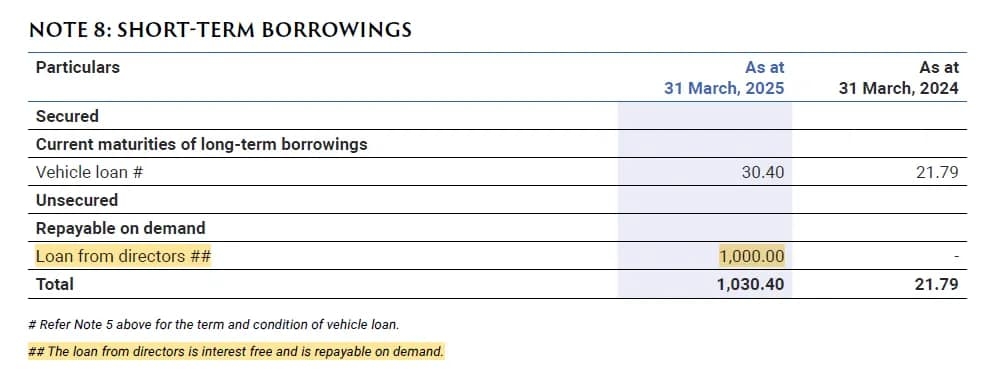
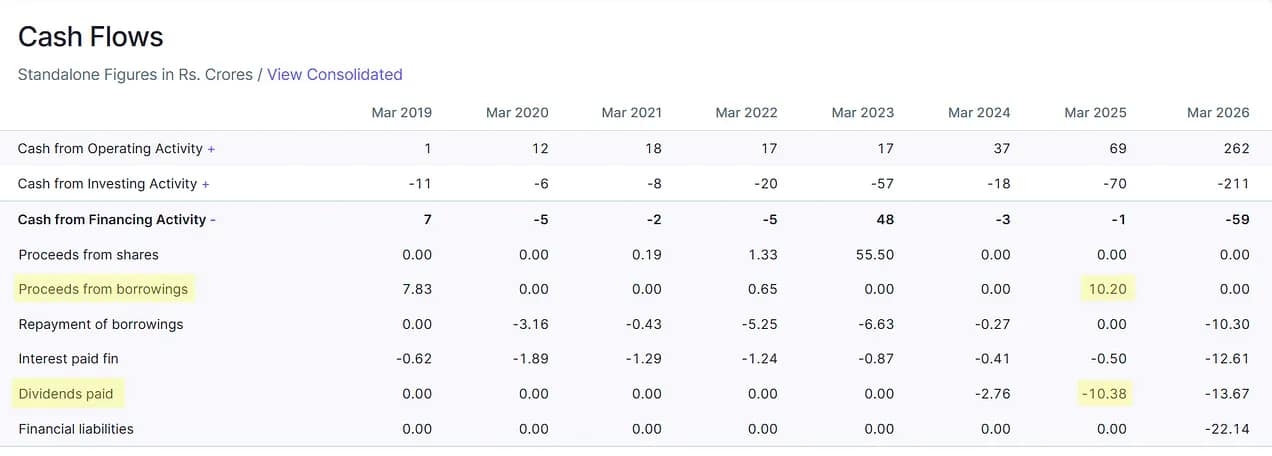
The numbers do not prove the loan funded the dividend, but the capital-allocation logic is difficult to admire.
Why should a rapidly expanding healthcare Company accept callable promoter funding and distribute a nearly equivalent amount as dividends in the same year?
With promoters owning close to 64%, ~Rs. 6-7 Cr of that dividend economically returned to the promoter group.
The loan benefited the Company and the dividend benefited all shareholders. Yet cash extraction and growth funding were occurring uncomfortably close together.
The FY25 Annual Report also shows the Company purchased an ambulance, a Toyota Fortuner and a Jaguar Land Rover.
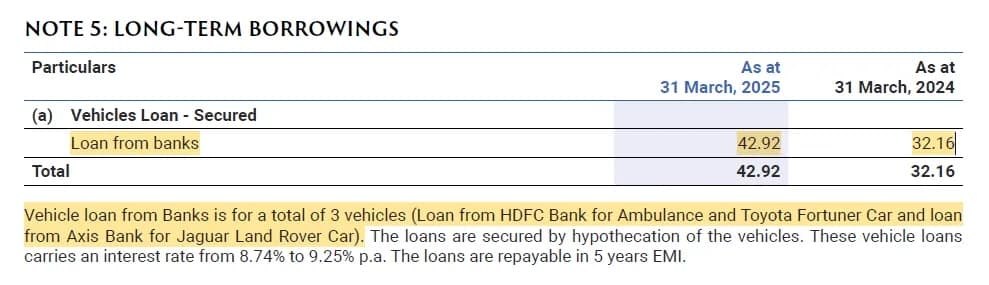
An ambulance is an operational asset.
A Fortuner and a Land Rover require a better explanation than shareholder imagination.
Luxury vehicles do not prove governance failure, but they reveal management’s threshold for corporate expenditure while investors are being asked to trust far larger decisions.
Where Does the Listed Company End?
Jeena Sikho sits within a wider promoter ecosystem that includes Shuddhi Lifecare and other entities connected to Manish and Bhavna Grover.
During FY25, the Company recorded sales of around Rs. 4.98 Cr to related entities. It also had loans and advances involving related parties, apart from rent and remuneration paid to promoters. The Company simultaneously received the Rs. 10 Cr director loan.
None of these transactions is automatically improper.
But disclosure is not the same as comfort.
A transaction can be disclosed and still be unnecessary, poorly priced, weakly secured or structured in a way that favours the promoter ecosystem over the listed Company.
The auditor also flagged an interest-free loan of ~Rs. 2.12 Cr to an erstwhile subsidiary as prejudicial to the Company’s interests.
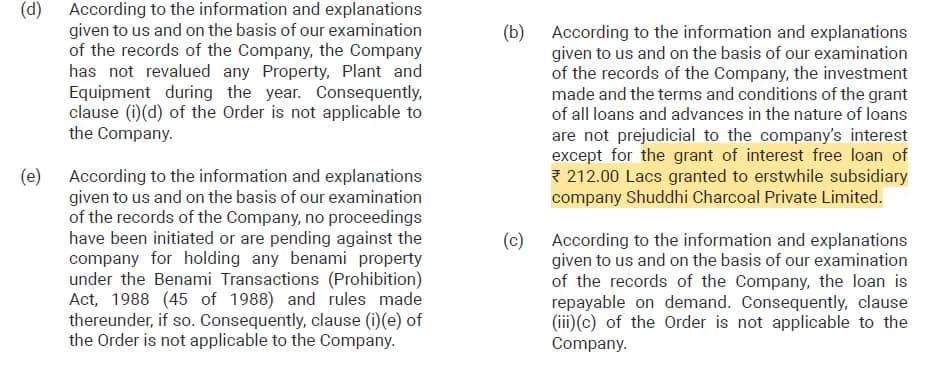
Meanwhile, “advances to others” increased from about Rs. 8.68 Cr to Rs. 15.33 Cr, without every counterparty being clearly visible to an outside shareholder.
The amounts may appear small. Governance habits usually do, until they do not.
The Rs. 70 Cr Question: What Exactly Was Acquired?
In October 2024, Jeena Sikho acquired five Ayurvedic therapy-centre branches from Oregano Life Private Limited through a slump sale for Rs. 70 Cr in cash.
The identifiable net assets acquired were valued at around Rs. 8.20 Cr. Approximately Rs. 61.80 Cr was recorded as goodwill. By March 2026, goodwill of around Rs. 58.12 Cr remained on the balance sheet.
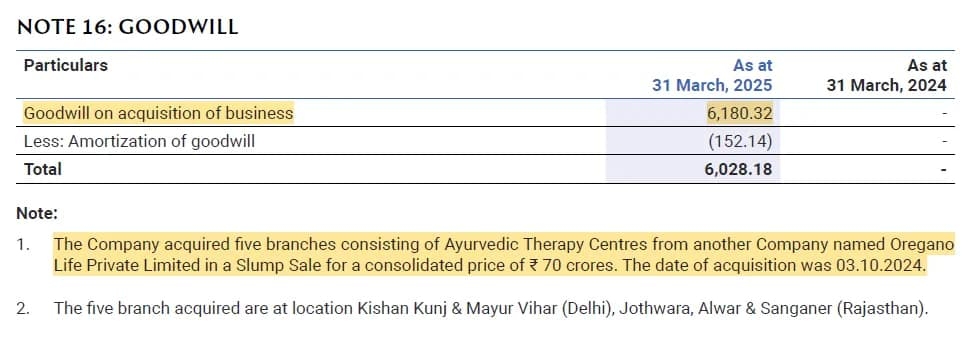
In plain terms, nearly 88% of the price was not supported by identifiable net assets.
It was management’s belief about future earnings.
Goodwill is common in service businesses. But common does not mean unquestionable.
Management says the transaction added five operating centres in Delhi and Rajasthan, around 130 beds and an experienced team. Retaining employees through ESOPs may have supported continuity.
The missing information is more important: the centres’ standalone revenue, occupancy, EBITDA, free cash flow, valuation assumptions and post-acquisition performance.
The purchase price was slightly higher than Jeena Sikho’s entire FY25 operating cash flow of about Rs. 69 Cr.
That is not a small bolt-on.
It was a major deployment of shareholder capital.
Oregano was also a large public shareholder in Jeena Sikho around the transaction period.
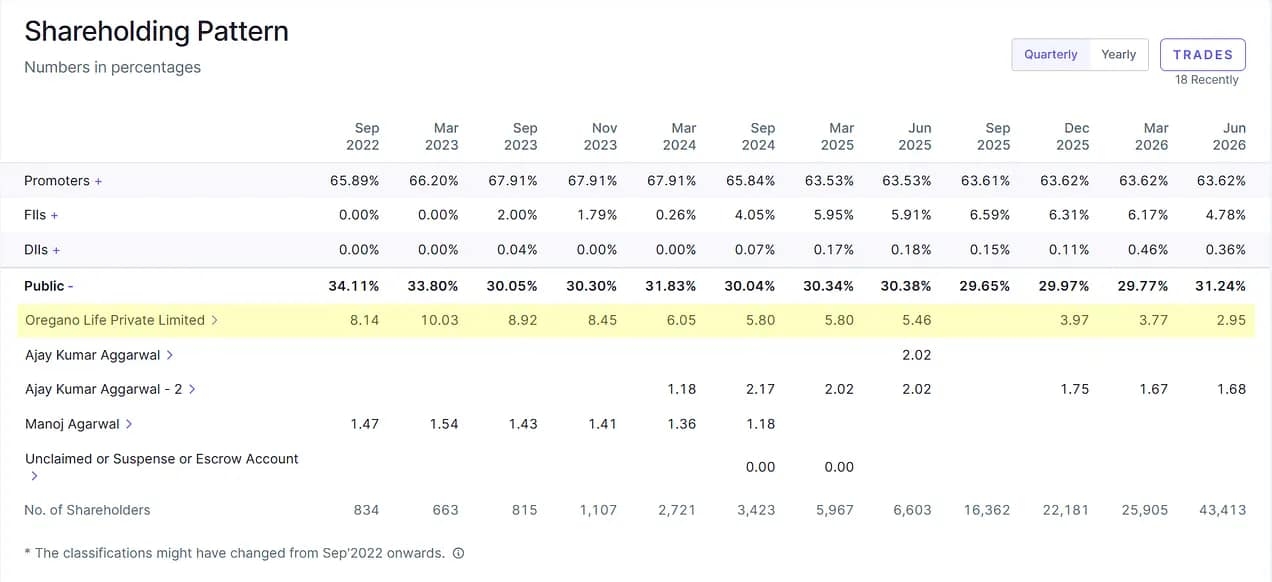
Its holding reduced from about 10% in March 2023 to less than 3% by June 2026.
This does not prove the deal lacked arm’s-length discipline.
But when the seller is also a meaningful shareholder and most of the purchase price becomes goodwill, opacity is not acceptable.
Minority shareholders should not be asked to trust a Rs. 70 Cr valuation without centre-level operating evidence.
When a Promoter-Owned Business Tries to Enter the Listed Company
Jeena Sikho proposed a scheme to bring Shuddhi Lifecare, an entity connected to Manish and Bhavna Grover, into the listed Company.
A valuation report and fairness opinion were prepared.
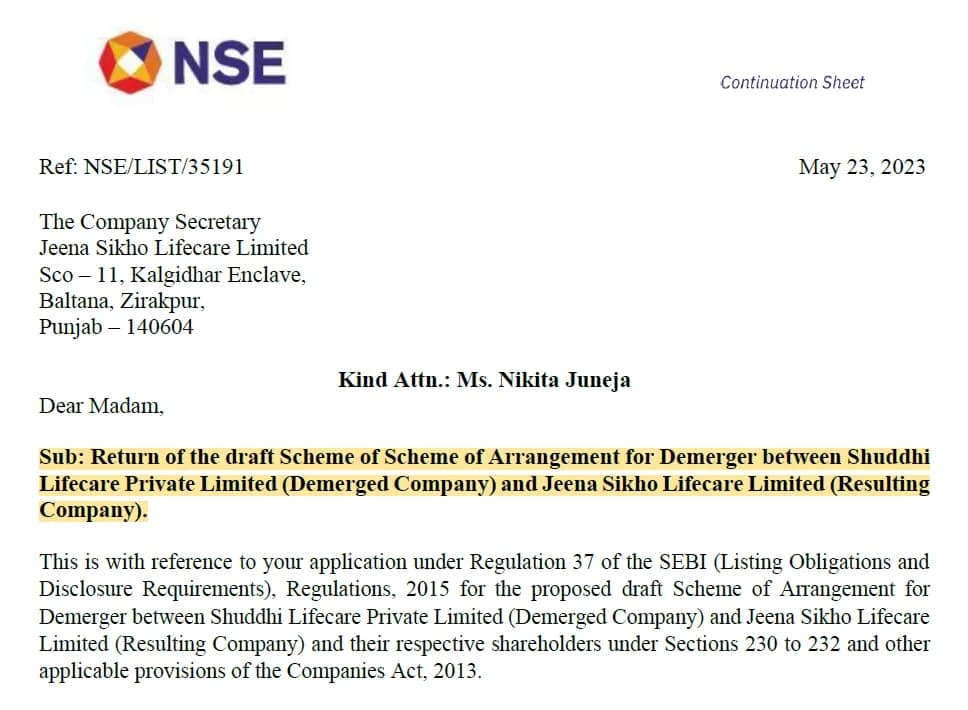
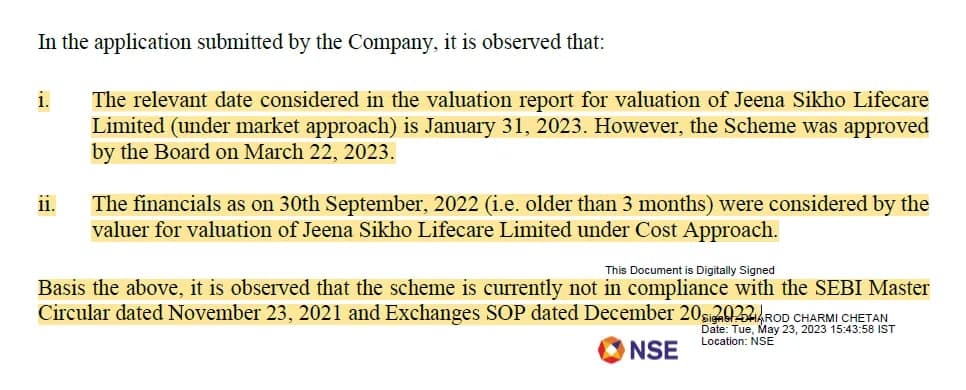
NSE returned the draft scheme after identifying two compliance issues.
The valuation date used under the market approach preceded the board’s approval, while financial statements used under the cost approach were older than permitted under the applicable framework.
This does not prove deliberate overvaluation.
It does show that a promoter-linked transaction of enormous sensitivity reached the exchange with basic valuation-process deficiencies.
That should concern shareholders.
- In a normal acquisition, valuation determines whether management overpaid.
- In a promoter transaction, valuation can also determine how much ownership or economic value minority shareholders transfer to insiders.
Technical discipline is therefore not optional.
If the transaction returns, shareholders should demand complete financials, liabilities, related-party dependence, cash flows, valuation assumptions and the proposed exchange ratio before accepting any claim of strategic logic.
The burden of proof belongs to the promoter.
The Amounts Are Small. The Allegations Are Not.
After a search by the Directorate General of GST Intelligence, the GST department in February 2025 issued an order demanding ~Rs. 5.08 Cr, including a penalty of ~Rs. 2.54 Cr, alleging suppression of turnover and incorrect GST classification on sale of goods.
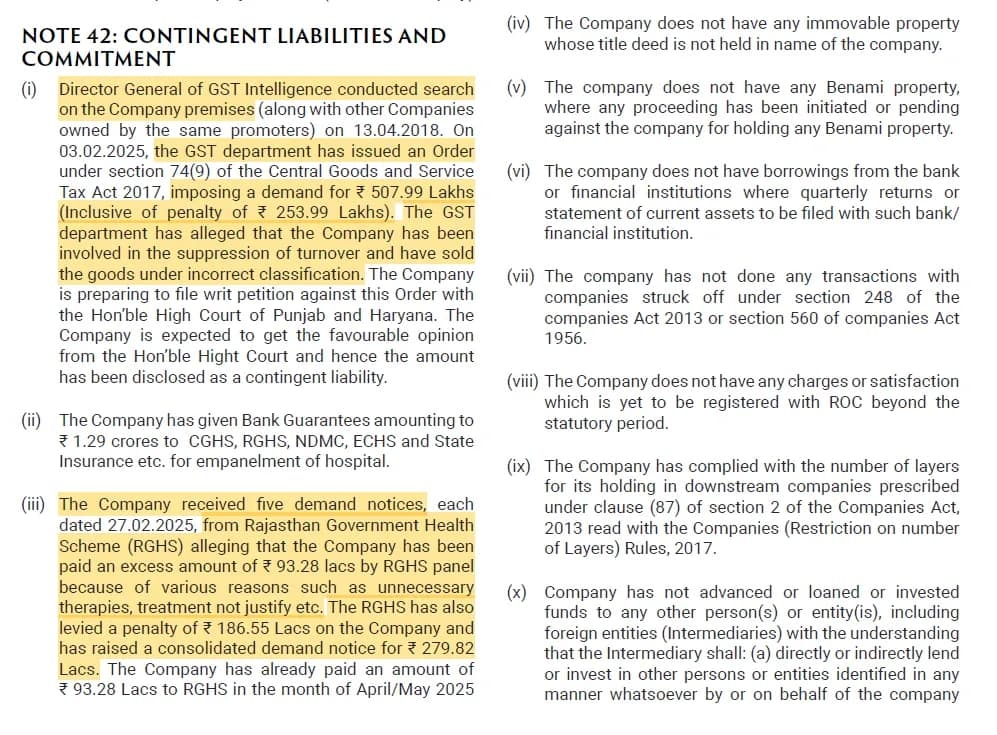
The Company disputes the order and is pursuing legal remedies.
Separately, the Rajasthan Government Health Scheme issued five notices relating to alleged excess payments of ~Rs. 93 lakh.
The stated reasons included unnecessary therapies and treatments that were not adequately justified.
A penalty of about Rs. 1.87 Cr took the total demand to nearly Rs. 2.80 Cr. The Company repaid the excess-payment amount but is contesting the penalty.
Neither dispute threatens solvency.
That is not the point.
One allegation touches turnover reporting and tax classification. The other touches medical necessity, billing and treatment justification.
For a healthcare Company, an allegation that therapies were unnecessary is not merely a reimbursement dispute. It goes directly to the question at the centre of the business:
Is treatment being recommended because patients need it, or because the ecosystem earns from providing it?
The Company may successfully defend itself. Until then, the disputes should not be dismissed merely because the amounts are small relative to profit.
Are We Being Too Harsh?
Perhaps.
Jeena Sikho has built a differentiated model, scaled rapidly, maintained low conventional borrowings and delivered strong returns on capital.
Each concern also has a possible explanation.
High goodwill does not prove overpayment. Related-party transactions do not prove minority abuse. Receivables do not prove fictitious revenue. Weak engagement on some videos does not prove artificial subscribers. A director loan can be genuine support. A regulatory demand can be overturned. One enquiry cannot define the patient funnel.
But “not proven” is not the same as “not concerning”.
Evaluating each red flag separately and accepting a plausible explanation misses the pattern.
The concern here comes from accumulation.
Accumulation across medical claims, evidence standards, outsourced manufacturing, founder dependence, aggressive patient conversion, revenue recognition, capital allocation, luxury vehicles, related-party flows, acquisition goodwill, promoter-linked restructuring and regulatory disputes.
The real question is not whether one item is disqualifying.
It is whether investors are being asked to extend trust across too many areas at the same time, while the valuation rewards the Company as though the risks are already settled.
The Growth Is There. But The Comfort is not.
Jeena Sikho has built one of India’s fastest-growing Ayurveda healthcare platforms. Revenue, profit, beds and patient volumes have multiplied. The commercial model is clear, and FY26 cash generation was strong.
An investor, however, is not buying growth in isolation.
- The investor is also accepting that the founder is the brand, the brand is the primary acquisition channel and a reputational event could move quickly into the operating business.
- The investor is relying on third-party manufacturers, a network of leased and partnered facilities, and a consultation funnel where the boundary between medical advice and commercial conversion is not publicly visible.
- The investor is trusting that more than 300 Ayurvedic products are consistently manufactured, appropriately prescribed and supported by evidence proportionate to the seriousness of the claims around them.
- The investor is trusting that the Rs. 70 Cr Oregano acquisition will generate enough cash to justify the goodwill.
- The investor is trusting that related-party flows remain fair, advances are recoverable, promoter transactions are disciplined and regulatory disputes do not reveal a wider pattern.
Most importantly, the investor is trusting a healthcare proposition in which commercial success appears much easier to observe than clinical success.
Jeena Sikho may be building a powerful business. But a powerful business can still rest on weak evidence, concentrated credibility and uncomfortable incentives.
Founder risk sits underneath almost everything in this piece. Jeena Sikho’s brand is inseparable from Acharya Manish.
Criticism has not visibly hurt the business so far. That shows distribution strength, not that the criticism is irrelevant.
This is a Company whose patient funnel, product demand and public identity depend heavily on one individual’s authority. One sufficiently serious controversy, medical incident or regulatory intervention could move directly into trust, demand, occupancy and valuation.
It may never happen. Investors should not price the possibility as though it cannot.
Jeena Sikho may eventually prove that the institution behind the founder is strong, the clinical standards behind the claims are robust and the governance systems behind the growth are fair.
Until then, the burden of proof should remain with the Company.
Investors should not be required to supply the evidence, fill the disclosure gaps and call that comfort.
About Ethica Invest
Ethica Invest is a principled, Shariah-compliant investment platform that helps investors like you in identifying companies using well-defined criteria for finances, operations, and governance. Though grounded in Shariah guidelines, Ethica’s approach goes beyond any single faith by prioritizing openness, strong balance sheets, and responsible business practices.
Ethica Invest works with SEBI-registered analysts and seasoned investment experts who deliver organized, compliant analysis on stocks and other opportunities. Those interested in seeking more on Shariah-aligned investing, can connect with our Ethica team.
The goal is straightforward: empower investors with decisions based on ethics, solid data, and performance; not just stories.
General Disclaimer and Release: Nothing contained herein constitutes tax, legal, insurance or investment advice, or the recommendation of or an offer to sell, or the solicitation of an offer to buy or invest in any investment product, vehicle, service or instrument.