Emmvee Photovoltaic: Solar Boom, Policy Tailwinds, and the Execution Test Ahead
Electricity.
We usually notice it only in two moments: when a huge bill arrives, or when the power goes off.
And naturally, we want it to do both jobs well. It should be affordable when the bill comes, and reliable when we need it the most.
Now imagine the same problem at India’s scale.
 Ethica Invest
Serious about long-term investing?
Unlock our professionally managed portfolios.
India needs power that is affordable, reliable, and cleaner.
In FY26, India generated ~1,846 billion units of power. But ~71% of that still came from fossil fuels; coal, gas, oil.
So despite years of clean-energy ambition, the country’s electricity backbone remains heavily tied to sources that bring emissions, pollution, and fuel-cost volatility.
Now, you might think: “What’s the alternate to this?”
And the obvious answer is, ‘Solar’.
But the more interesting part is not solar generation anymore. That story is already largely settled. By FY32, India plans to have ~365 GW of solar capacity, making it the largest source of installed power capacity at a 40.5% share. Solar crossed 150 GW of installed capacity by March 2026; and in FY26 alone, India added 44.61 GW of solar capacity, the highest single-year addition in the country’s history.
That is the visible solar boom.
The less visible question is: “Who makes the hardware”?
And that is where “Emmvee Photovoltaic Power Limited” enters.
Now, to understand Emmvee, we first need to understand why India’s solar opportunity is not only about generation, but also about manufacturing.
Why Solar Is Already Obvious, And Why Manufacturing Is Not.
India’s power problem has three dimensions: scale, cost, and carbon.
On scale: per capita electricity consumption has grown from 957 kWh in FY14 to 1,460 kWh in FY25.
Ethica Invest
Serious about long-term investing?
Unlock our professionally managed portfolios.
That is a 52% increase over a decade, and the curve is still rising.
Peak power demand in FY26 stood at 242.49 GW. By FY32, that number is expected to reach 366.4 GW. India is effectively trying to build an entire additional power system within the next six years; one that is larger than most countries’ total systems today.
On cost and carbon: fossil fuel-based power carries import exposure, price volatility, and increasing regulatory cost around emissions.
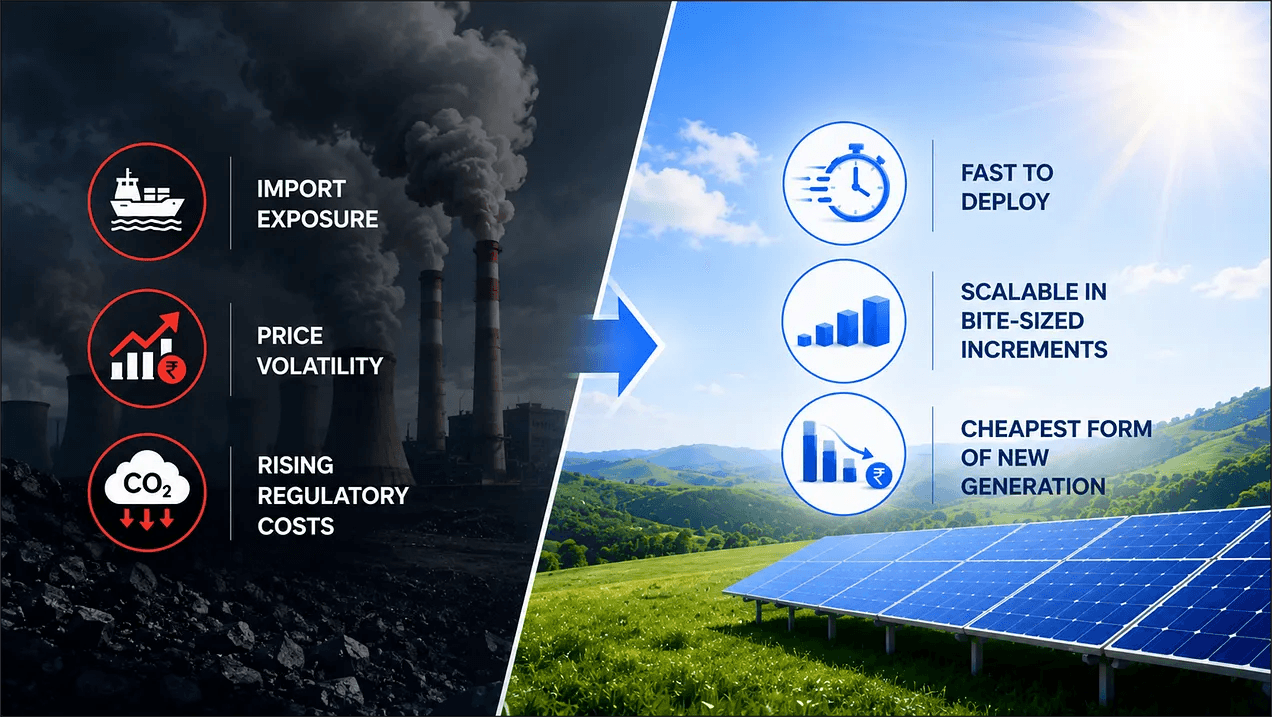
Solar removes the fuel cost entirely. Once installed, the sun charges nothing.
That is why utility-scale solar tariffs in India have repeatedly hit record lows and why governments, industries, and households are all chasing solar simultaneously.
The logic for solar is not complicated. It is fast to deploy, scalable in bite-sized increments, and increasingly the cheapest form of new generation in most Indian geographies.
But here is where the analysis needs to go one level deeper.
If India installs 365 GW of solar by FY32 and imports the majority of the solar hardware to do it, the dependency problem does not disappear.
It only changes form.
Earlier, India imported fuel. In a solar-heavy future without domestic manufacturing, India would import hardware; panels, cells, wafers. The geopolitical and supply-chain exposure shifts, but does not shrink.
This is why domestic solar manufacturing has become strategic policy, not just commercial opportunity.
The numbers show how fast this has moved.
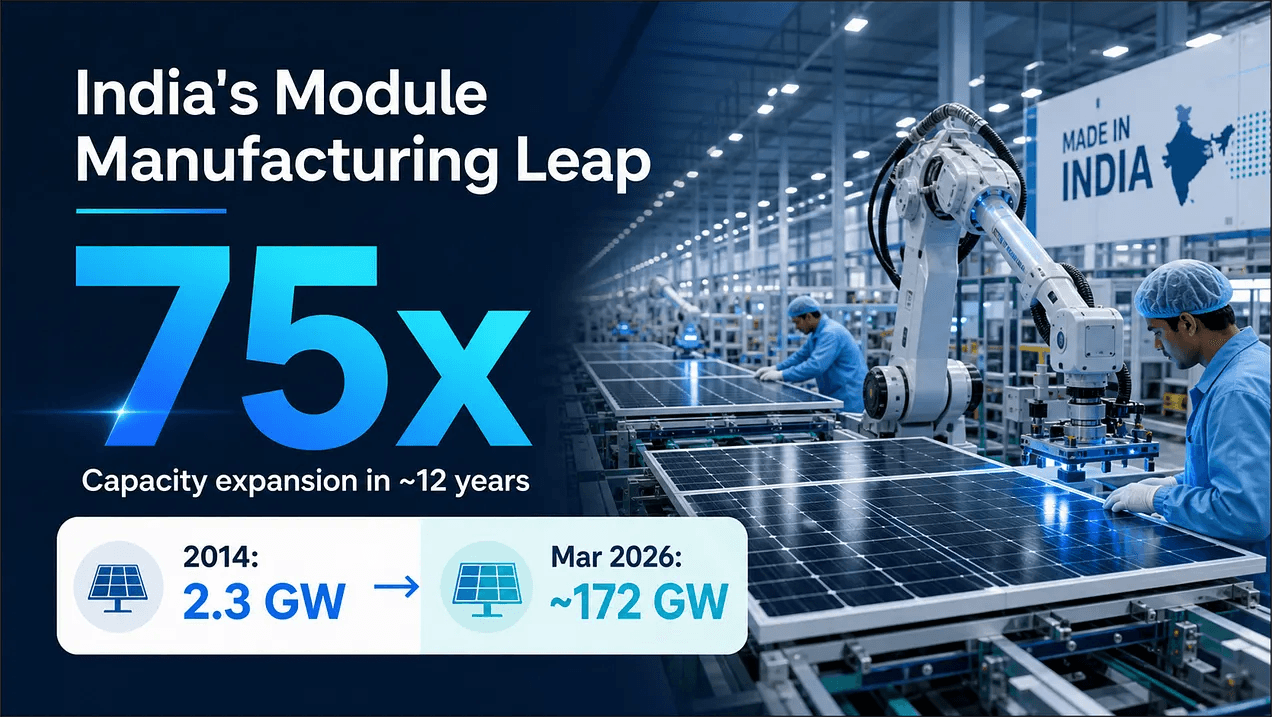
But capacity on paper means very little.
The real question is whether domestic manufacturers can compete; on technology, cost, and product quality; with the global standard set by China.
The China problem is not just about competition. It runs through the cost structure.
Chinese solar manufacturers have achieved dominance through full vertical integration, massive scale, and a supplier ecosystem that took decades to build. They control polysilicon, ingots, wafers, cells, and modules; each step feeding the next at a cost that standalone assemblers outside China simply cannot replicate. This integration gives Chinese manufacturers a structural cost advantage that Indian policy can mitigate, but cannot entirely eliminate.
The upstream chain matters here.

Think of it like a dosa.
Polysilicon is the batter. The ingot is the batter shaped. The wafer is the thin slice. The cell is where the real conversion chemistry happens; where sunlight becomes electricity. The module is the finished plate.
Most Indian manufacturers today sit primarily at the module end; they buy cells and assemble. That is assembly, not deep manufacturing. It captures value at the final step but remains dependent on the upstream chain, which is still largely China-controlled.
The policy framework is now designed specifically to change this structure.
Three terms define the current policy architecture for solar manufacturing in India: ALMM List-I, ALMM List-II, and DCR.
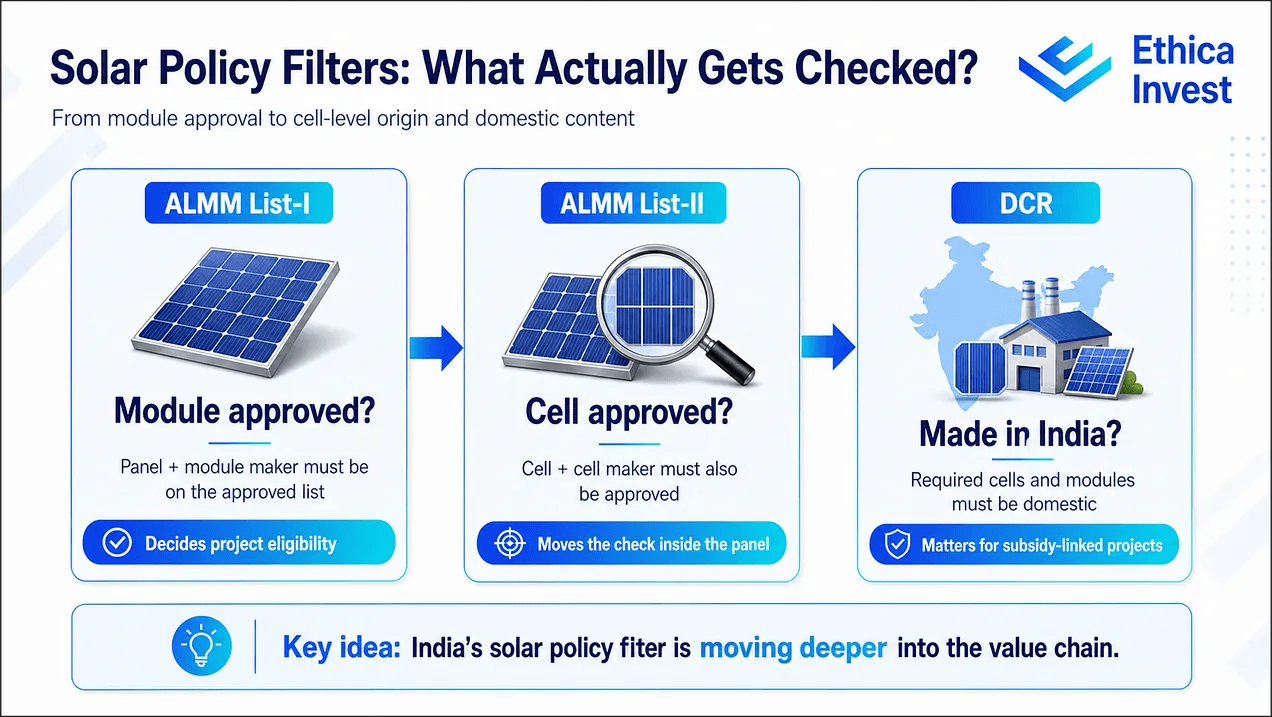
ALMM List-I creates an approved list of solar modules that can be used in government-linked solar projects. This essentially acts as a filter; if your module is not on the list, you cannot sell into large government-backed capacity. That part is understood and has been active for a while.
ALMM List-II goes further. It extends the approved-list requirement to solar cells; the component inside the module.
This is the critical shift.
If ALMM List-I was about who assembles the panel, ALMM List-II is about who makes the heart of the panel. An importer could easily clear List-I by assembling modules in India. Clearing List-II requires actually manufacturing cells domestically.
DCR: Domestic Content Requirements, adds another dimension. Under certain government-linked and subsidy-eligible schemes, projects must use domestically manufactured cells and modules. The buyer cannot simply shop for the cheapest global price. Domestic-content eligibility becomes a purchasing criterion alongside cost.
Together, ALMM List-II and DCR create a structural preference for manufacturers who have moved deeper into the value chain than simple assembly. They reward cell manufacturing. And they set a floor of demand for companies that have invested in building it.
This is precisely the policy architecture that makes Emmvee’s cell-plus-module positioning strategically relevant; not as a story, but as an observable, policy-enforceable competitive advantage.
The technology layer reinforces this.
Solar cell efficiency has been evolving in a clear direction: from conventional BSF (Back Surface Field) cells, to PERC (Passivated Emitter and Rear Contact), and now increasingly to TOPCon (Tunnel Oxide Passivated Contact). Each generation extracts more electricity from the same sunlight and the same physical footprint.
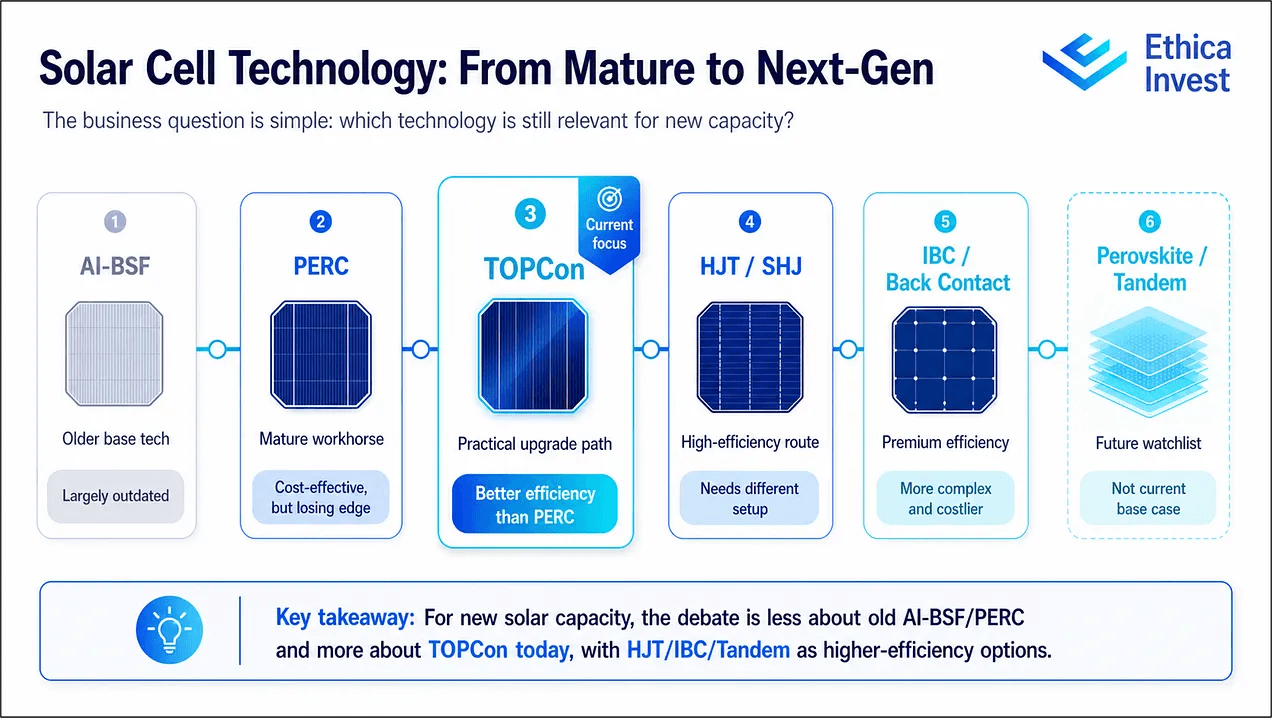
TOPCon matters because it represents the current mainstream technology curve. It offers meaningfully better efficiency than PERC while being manufacturable on production lines that are upgrades of existing PERC infrastructure; unlike HJT or Back Contact cells, which require substantially different equipment. Perovskite and tandem architectures represent the future research frontier, but they are not commercially deployable at scale today.
By FY26, Emmvee had fully transitioned its module capacity to TOPCon.
That is not a trivial milestone.
It means every module the company produces today is on the right side of the current technology preference curve. The 2.94 GW of TOPCon cell capacity it has built adds further depth; it is not merely assembling TOPCon modules from imported TOPCon cells.
It is making the cells.
That combination; domestic cells, TOPCon technology, ALMM List-II eligibility, DCR relevance; is what makes Emmvee worth understanding as more than a module assembler.
The Company Behind the Panels; What the Numbers Actually Say
The business case for solar manufacturing in India is clear. The policy support is real. The technology transition is underway.
Now comes the harder part.
Can Emmvee actually execute?
This is a manufacturing company. That means profitability is not just a function of demand. It depends on plant utilisation, input cost management, product quality, customer terms, working capital discipline, and ultimately, the ability to convert revenue growth into real cash.
The headline numbers from FY26 are striking. But they require careful reading.
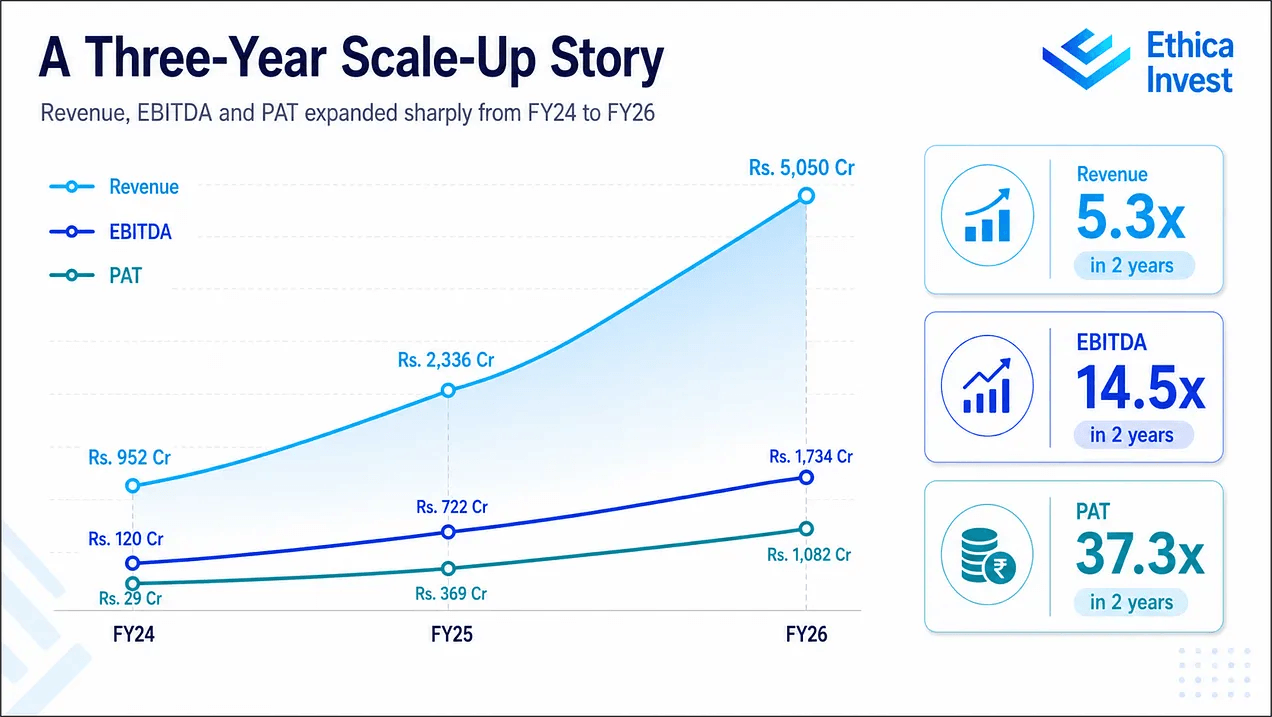
These are not incremental improvements. This is a business that has roughly tripled revenue in two years and grown its PAT by more than 37 times since FY24. Even adjusting for the early-stage base, the trajectory is unusual.
The right question is not whether these numbers are good. They are.
The right question is whether FY26 represents a sustainable operating baseline, or whether it captures an unusually favourable intersection of demand, policy protection, technology premium, and pricing; a period that may normalise as more supply enters the market.
To answer that, we need to look at the mechanics of the business, not just the summary P&L.
Capacity tells one story. Utilisation tells another.
Emmvee’s year-end module capacity in FY26 was 10.3 GW. But the company produced approximately 3.0 GW of modules during the year. Against the headline capacity number, that looks like utilisation in the 29% range.
Management reports effective module utilisation ~43%; because new capacity lines were commissioned progressively through the year, not all available from Day 1 of FY26.
That is a meaningful distinction.
You cannot compare full-year production against exit-capacity as if the entire capacity was running on April 1.
But even 43% effective utilisation on modules is modest. It means more than half of available production time was not generating revenue. In manufacturing, idle capacity is not neutral. It still consumes fixed costs: depreciation, finance cost, maintenance, overheads. Every unit of output produced against that fixed-cost base bears a higher burden when utilisation is low.
The cell picture looks better.
Against 2.94 GW of TOPCon cell capacity, the company produced ~1.52 GW; effective utilisation ~70%. That is a healthier operating rate, and suggests the cell business is being pushed harder, which also makes sense given the 4.5 GW external cell order.
This divergence matters.
The business case for Emmvee improves as module utilisation moves from 43% towards 70–80%. If that happens, the same fixed-cost base generates substantially more revenue and margin without proportional cost increase. But if large-scale capacity addition outpaces demand uptake, utilisation stays stuck and fixed-cost burden per unit rises.
The order book provides comfort, not certainty.
Emmvee’s order book grew from 4.9 GW in FY25 to 9.4 GW in FY26; nearly doubling in a single year. Additionally, the company secured a 4.5 GW order for TOPCon cells from a domestic customer, to be executed over multiple years.
A 9.4 GW order book against roughly 3 GW of FY26 production gives the business visibility spanning multiple quarters of execution.
That is genuinely positive.
It reduces short-term demand risk and suggests customers are committing to Emmvee as a supply partner for medium-term solar project pipelines.
But an order book has limits as an analytical comfort.
A large order book tells you that customers intend to buy. It does not tell you at what margins, on what payment terms, or with what working capital implications.
In the B2B manufacturing world; where Emmvee’s customers include independent power producers, EPC contractors, C&I buyers, and public sector project developers; those terms matter as much as the headline volume.
And the customer concentration data adds texture here.
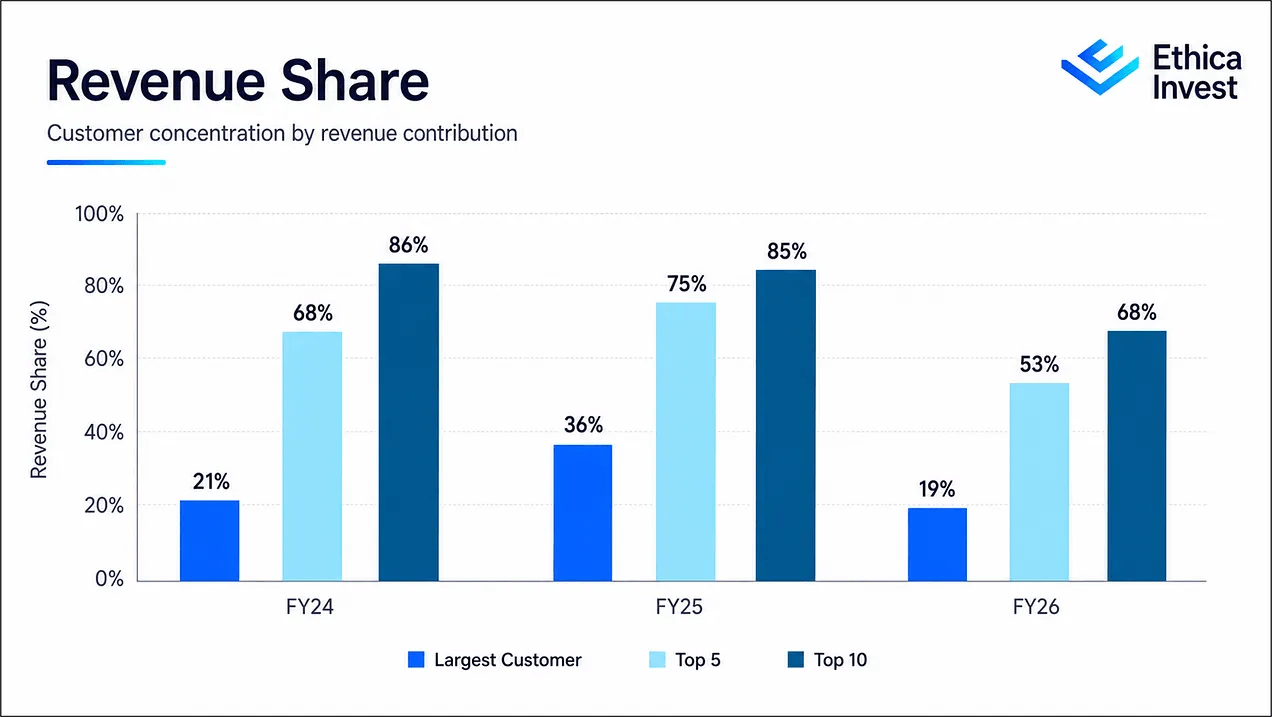
Concentration of this kind has two effects. When orders are flowing and relationships are strong, concentrated customer exposure accelerates revenue ramp. But it also means those same customers carry significant negotiating leverage; on pricing, on payment schedules, and on product specifications.
The working capital data from FY26 makes this point concrete.
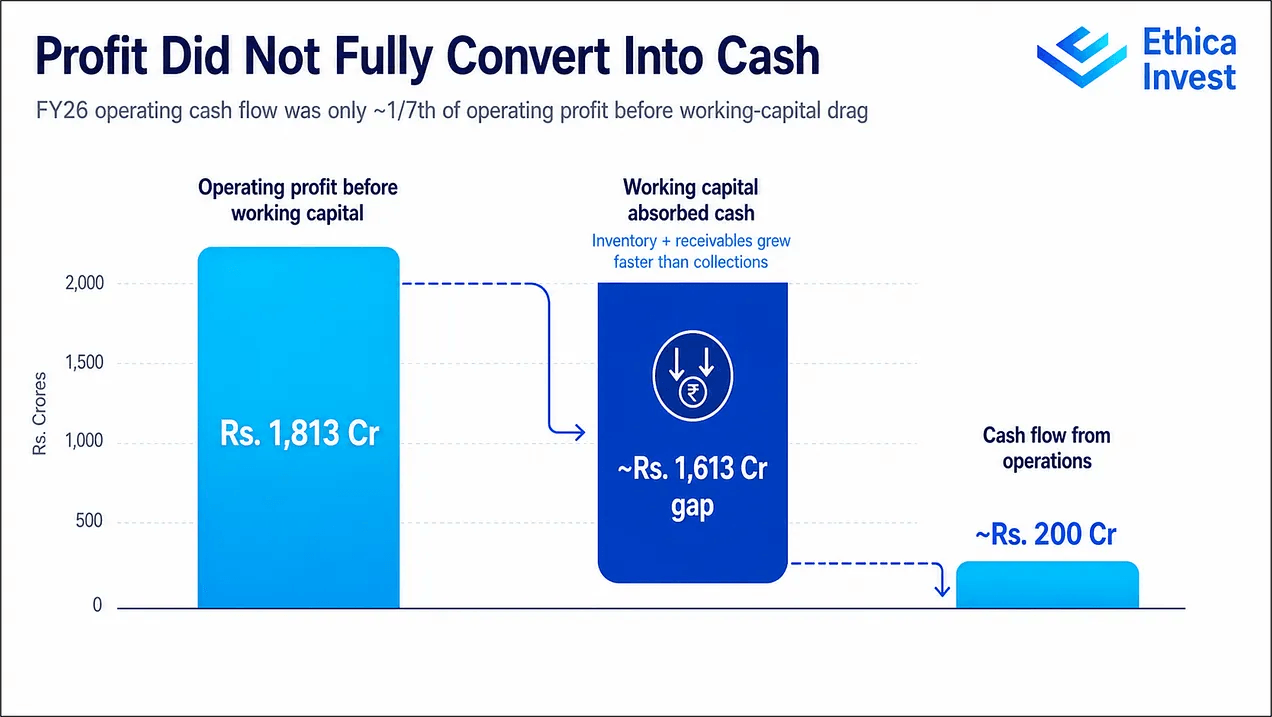
Profit before tax in FY26 was Rs. 1,338 crore. Operating profit before working capital changes was Rs. 1,813 crore. But cash flow from operations for the year came in at approximately Rs. 200 crore; roughly one-seventh of operating profit, before the working capital drag.
That gap; between Rs. 1,813 crore of operating profit and Rs. 200 crore of operating cash; reflects one thing: capital got absorbed into inventory and receivables at a pace that outran collections. The business grew fast enough that the money earned on paper was re-deployed into materials and unpaid invoices before it became actual cash in the bank.
This does not make Emmvee a bad business.
Fast-growing manufacturers almost always consume cash while scaling; that is a structural feature of high-growth manufacturing, not a red flag by itself. But it does mean that PAT is not the right number to lead with when assessing Emmvee’s financial health.
Cash conversion is the number that matters.
And at roughly Rs. 200 crore of operating cash against Rs. 1,082 crore of PAT, the conversion gap is significant and must narrow over the next two to three years for the quality thesis to hold.
The cost structure underscores just how material-intensive this business is.
In FY26, Emmvee’s cost of materials consumed was Rs. 3,412 crore against revenue from operations of Rs. 5,050 crore. That is a material cost ratio of ~67.6%. Add manufacturing overhead, depreciation, and finance cost, and the operating margin that looks attractive in EBITDA terms gets tested harder at the net level whenever pricing softens.
This is the structural risk in solar module manufacturing that no amount of demand optimism can eliminate: the product is heavily input-driven, and inputs; especially wafers and glass; are priced in international markets with Chinese cost structures as the reference. If module realisations fall and raw material costs do not fall equally, or if freight rises, the margin can compress quickly. The business does not have the pricing power of a brand or a service. It is a component manufacturer in a market where customers are highly cost-conscious.
The balance sheet looks clean today. The next cycle will test it.
Post-IPO, Emmvee carries a debt-to-equity ratio of just 0.10x as of March 2026.
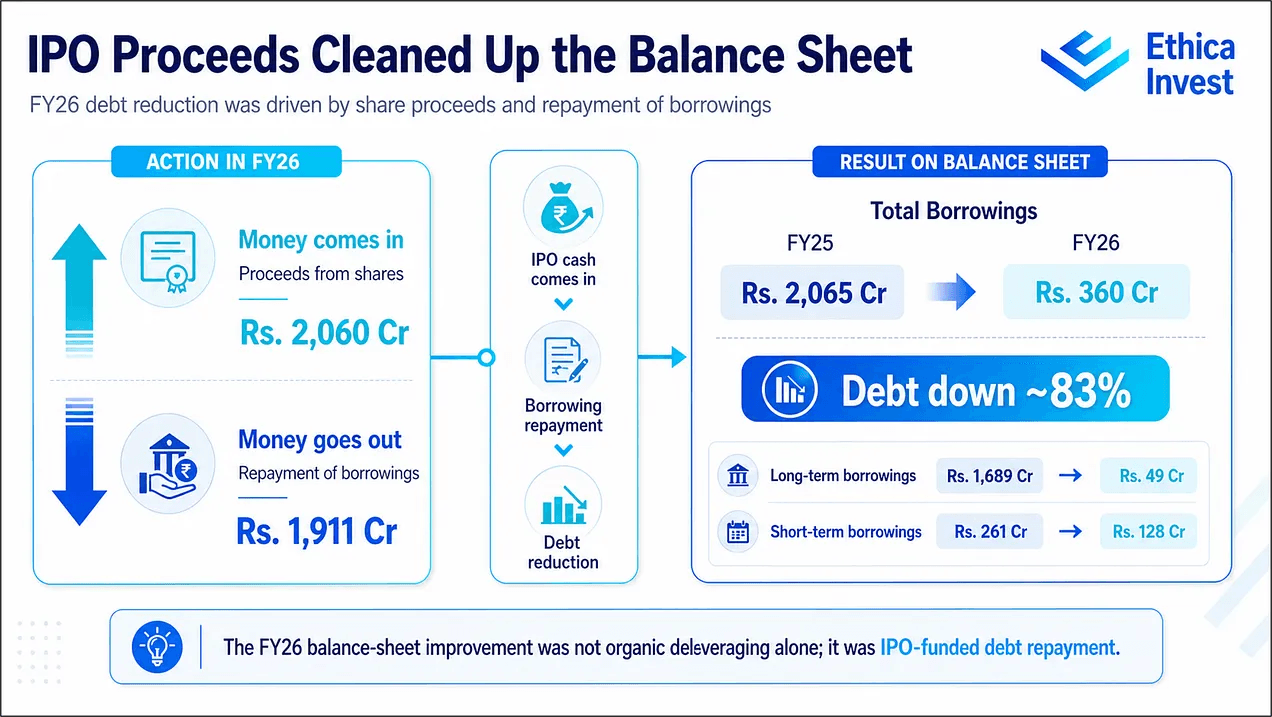
After clearing down debt with IPO proceeds, the balance sheet has genuine capacity for the next investment phase.
And that next phase is planned.
The company targets 16.3 GW of module capacity and 8.94 GW of cell capacity by FY28; ~1.6x the current module capacity and 3x the current cell capacity. A large term loan has already been sanctioned to fund part of this expansion.
This is where the risk calculus becomes important.
If the industry moves into overcapacity as multiple players; Waaree, Premier Energies, Vikram Solar, Adani Solar, Tata Power Solar, and others; simultaneously expand capacity chasing the same policy and demand tailwinds, pricing power can erode well before the next wave of capacity earns back its cost.
India’s module manufacturing capacity has already grown from 2.3 GW in 2014 to approximately 172 GW by March 2026. Annual solar installations in FY26 were approximately 44–45 GW.
The arithmetic is blunt: installed manufacturing capacity is roughly 3–4 times current annual installation capacity. Even accounting for export ambitions and future demand growth, the supply-demand balance is not tight. If anything, it is already loose and moving looser.
In this environment, the manufacturers that survive compression cycles are the ones with the lowest cost structures, the highest utilisation, and the cleanest balance sheets.
Emmvee enters the next expansion phase with balance-sheet advantage.
Whether it can maintain cost discipline and capture utilisation at the scale it is building toward is the execution test that will define the next chapter.
Closing: The Question That Matters
Emmvee is a genuine contender in India’s solar manufacturing space. The revenue trajectory, EBITDA growth, TOPCon technology alignment, cell manufacturing depth, policy eligibility, and growing order book all point in the right direction.
But the investment case is not simply about solar demand being strong. That is obvious and already priced into the sector’s optimism.
The real question is narrower and harder: can Emmvee convert its capacity into consistently profitable production, improve cash conversion from the Rs. 200 crore level seen in FY26, sustain margins through a market that already shows signs of oversupply pressure, and execute a near-doubling of cell capacity without repeating the leverage and working-capital traps that have historically caught manufacturing companies mid-expansion?
If the answer is yes, Emmvee is sitting at a genuinely powerful intersection; power demand, clean energy policy, manufacturing depth, and technology relevance all running in the same direction at the same time.
If the answer is no, or even partially no; the story can survive but the returns won’t keep up with the excitement.
This is still manufacturing. Panels have to be made. Costs have to be controlled. Cash has to follow profits. And discipline has to outlast the cycle.
That is the test. FY26 passed the first exam with strong marks. The next two years are the real evaluation.
About Ethica Invest
Ethica Invest is a principled, Shariah-compliant investment platform that helps investors like you in identifying companies using well-defined criteria for finances, operations, and governance. Though grounded in Shariah guidelines, Ethica’s approach goes beyond any single faith by prioritizing openness, strong balance sheets, and responsible business practices.
Ethica Invest works with SEBI-registered analysts and seasoned investment experts who deliver organized, compliant analysis on stocks and other opportunities. Those interested in seeking more on Shariah-aligned investing, can connect with our Ethica team.
The goal is straightforward: empower investors with decisions based on ethics, solid data, and performance; not just stories.
General Disclaimer and Release: Nothing contained herein constitutes tax, legal, insurance or investment advice, or the recommendation of or an offer to sell, or the solicitation of an offer to buy or invest in any investment product, vehicle, service or instrument.