Rajesh Exports: The ₹15 Lakh Crore Question Nobody Asked
For the last few days, one name has dominated Indian stock market discussions. Rajesh Exports.
Not because of a breakthrough product. Not because of record profits. But because of one shocking allegation from SEBI. According to SEBI’s interim order, nearly 99.8% of the revenue reported by certain overseas subsidiaries over several years could not be substantiated with adequate supporting evidence.
The number being discussed? ₹15 lakh crore. To put that in perspective, that is larger than the annual revenues of many of India’s biggest listed companies combined.
SEBI has issued an interim order. Rajesh Exports has denied wrongdoing and says the regulator has misunderstood parts of its accounting and business structure. The final outcome will only be known after the investigation and legal process are complete.
 Ethica Invest
Serious about long-term investing?
Unlock our professionally managed portfolios.
But regardless of how this case eventually ends, it offers some powerful lessons for investors.
The Rise of Rajesh Exports
The story of Rajesh Exports was once one of the most inspiring business stories in India. Founded by Rajesh Mehta, the company grew from a small jewellery trading operation into one of the world’s largest gold processors. Over the years, it built manufacturing operations, expanded exports, and eventually acquired a major Swiss gold refinery.
At its peak, Rajesh Exports was often presented as a global leader in gold refining and jewellery exports. For many investors, it looked like a classic Indian success story. And that’s exactly why this case deserves attention. Because some of the biggest corporate disasters begin with some of the best corporate stories.
The Email That Started Everything
Interestingly, this wasn’t uncovered by a famous fund house. It wasn’t exposed by an international investigative firm. According to reports, concerns were first raised by a shareholder who noticed something unusual.
Receivables were staying outstanding for unusually long periods. That might sound boring. But receivables are often where financial red flags first appear. Imagine a company claims sales are growing rapidly. But if customers are not paying and receivables keep piling up, investors need to ask a simple question: Are these sales real?
Revenue Growth vs Cash Collection
One of the simplest checks investors can perform is comparing:
- Revenue growth
- Receivable growth
For example, if revenue doubles but receivables grow 5x or 7x, something deserves investigation. It doesn’t automatically mean fraud. But it does mean investors should start asking questions. Because genuine sales eventually convert into cash. Fake sales often become receivables that never get collected.
The Black Box Problem
One aspect of the Rajesh Exports case that deserves attention is the difference between standalone and consolidated financial statements (can be seen in the attached screenshots). When comparing the standalone and consolidated profit & loss statements, a massive gap becomes apparent. The consolidated business reported revenues running into lakhs of crores, while the listed Indian entity generated only a small fraction of that revenue on a standalone basis. For several years, a very large portion of reported revenue came from overseas subsidiaries. Again, this is not illegal. Many multinational businesses operate this way. The problem begins when investors have limited visibility into those subsidiaries.
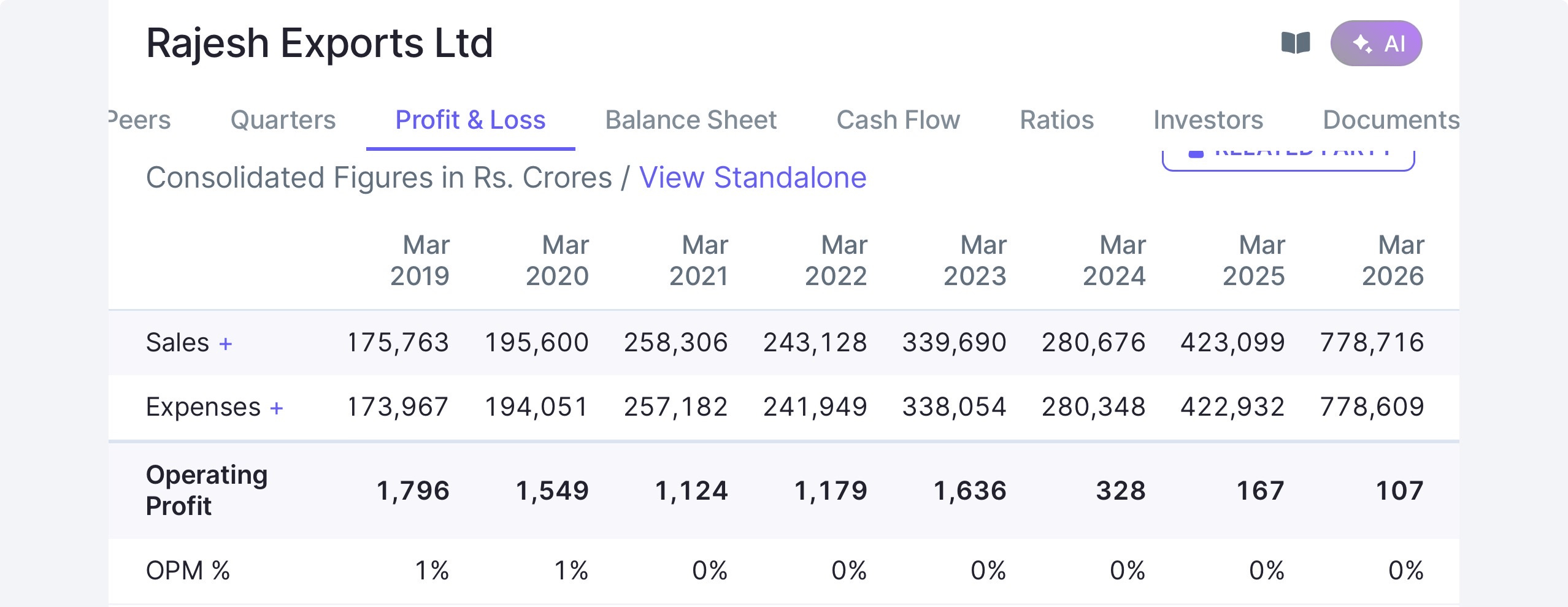
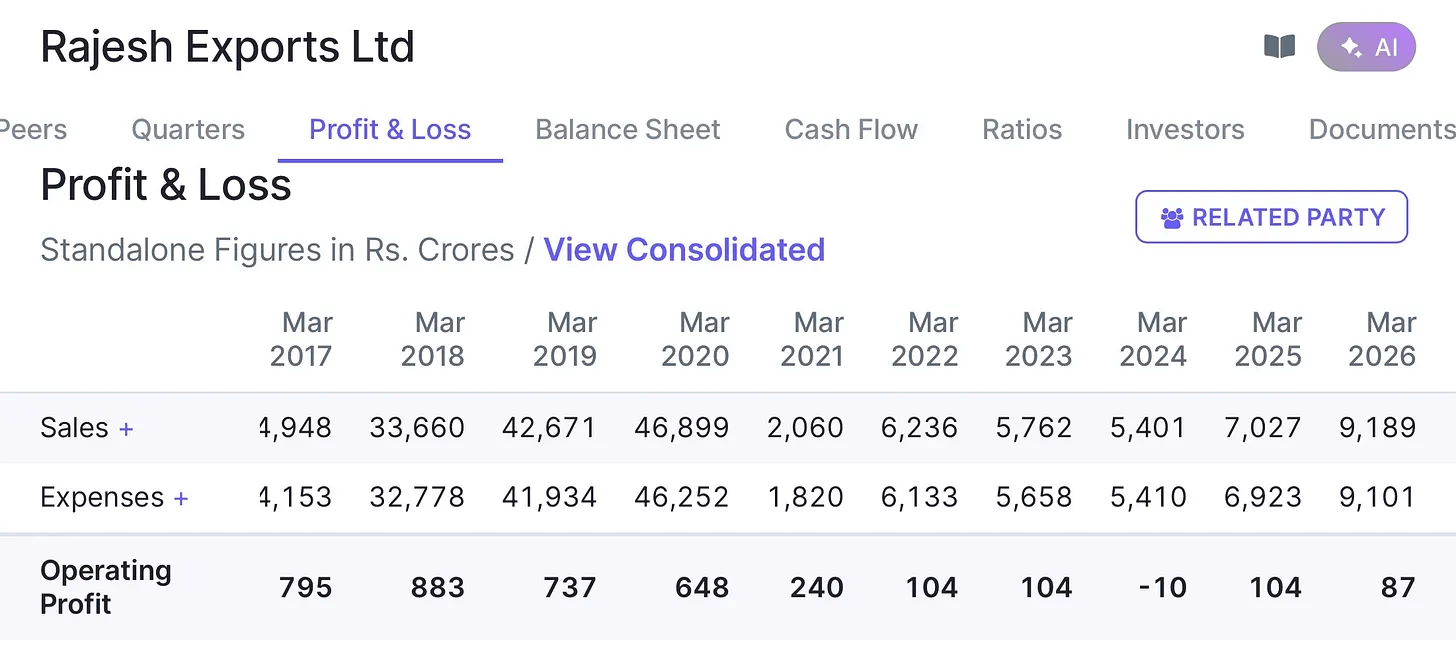
Imagine investing in a listed company whose own operations account for only a tiny portion of total group revenue. Most of the business happens overseas. Most of the numbers come from subsidiaries. Most investors cannot independently verify what is happening there. At that point, the business becomes a black box. And investing in a black box requires a very high degree of trust.
The OPM Puzzle
Another metric that should have raised eyebrows was the company’s operating margin. Despite reporting enormous revenues, Rajesh Exports’ Operating Profit Margin (OPM) remained close to 0% for most of the period after FY22. At first glance, that might appear normal for a commodity-linked business. However, investors should always ask a simple question: Why is a company generating lakhs of crores in revenue but retaining almost none of it as operating profit? A low-margin business is not necessarily a bad business. But when margins remain extremely thin year after year, investors should dig deeper into:
- The quality of revenue
- The economics of the business model
- Cash flow generation
Revenue alone does not create shareholder value. Profits do. Cash flows do. Returns on capital do. A company can report massive sales numbers and still create very little value if those sales are generating negligible operating profits. One of the easiest traps to fall into is being impressed by large revenue numbers. But revenue without profitability tells only half the story.
Thanks for reading! Subscribe for free to receive new posts and support my work.
Ethica Invest
Serious about long-term investing?
Unlock our professionally managed portfolios.
The Allegation of Circular Transactions
One of SEBI’s major allegations involves transactions that appear economically questionable. The regulator alleges that certain entities showed very large purchases and sales with each other, with little apparent value creation.
Think of it like this, I sell you goods worth ₹10,000 crore. You sell me goods worth ₹10,000 crore. Both of us report massive revenues. But has any real economic activity occurred? Not necessarily. This is why regulators closely examine circular transactions. Because revenue should represent genuine business activity, not merely money moving in circles.
The Mysterious Assets
SEBI has also questioned certain reported assets, including claims relating to overseas mining interests. The principle here is broader than this specific case. As investors, we should always be cautious when companies derive large portions of their valuation from assets that are difficult to independently verify. Examples include Overseas mines, Foreign subsidiaries, Complex holding structures, Unlisted investments, Hard-to-value intellectual property. The harder something is to verify, the higher the disclosure standards should be.
What Rajesh Exports Says
To be fair, every story has two sides. Rajesh Exports has strongly denied the allegations. The company has stated that Its revenues are genuine, Supporting documentation exists. SEBI has misunderstood certain accounting treatments. An interim order is not the same as a final verdict.
The Real Lesson For Investors
The most valuable lesson from this is not about gold. It is not about accounting. It is not even about Rajesh Exports. It is about investor behaviour. Many investors spend hours searching for the next multi-bagger. Very few spend time eliminating potential disasters. But avoiding one fraud can improve long-term returns more than finding one winning stock. Sometimes the best investment decision is not buying a stock. It is walking away from a stock you do not fully understand.
A Simple Red Flag Checklist
Whenever you analyse a company, ask yourself:
- Are receivables growing faster than revenue?
- Are cash flows matching reported profits?
- Is management transparent and accessible?
- Are related-party transactions reasonable?
- Can major assets be independently verified?
- Do standalone and consolidated numbers tell a consistent story?
- Is growth supported by real business activity?
If multiple answers make you uncomfortable, move on. The stock market has thousands of companies. You do not need to own every story.
Whether SEBI ultimately proves its case or not, the Rajesh Exports episode is already an important reminder for Indian investors. Stories can be exciting. Narratives can be powerful. But investing is not about stories. It is about verification. In markets, trust is valuable. But trust without verification can be extremely expensive. And sometimes, the biggest red flag is not what a company tells you. It’s what it cannot explain.
Technical Analysis: The Market Saw Trouble Long Before SEBI
One of the biggest mistakes investors make is believing that a great business story automatically makes a great stock. Rajesh Exports is a reminder that the market often starts discounting problems long before they become front-page news.
Weekly Chart Tells the Story
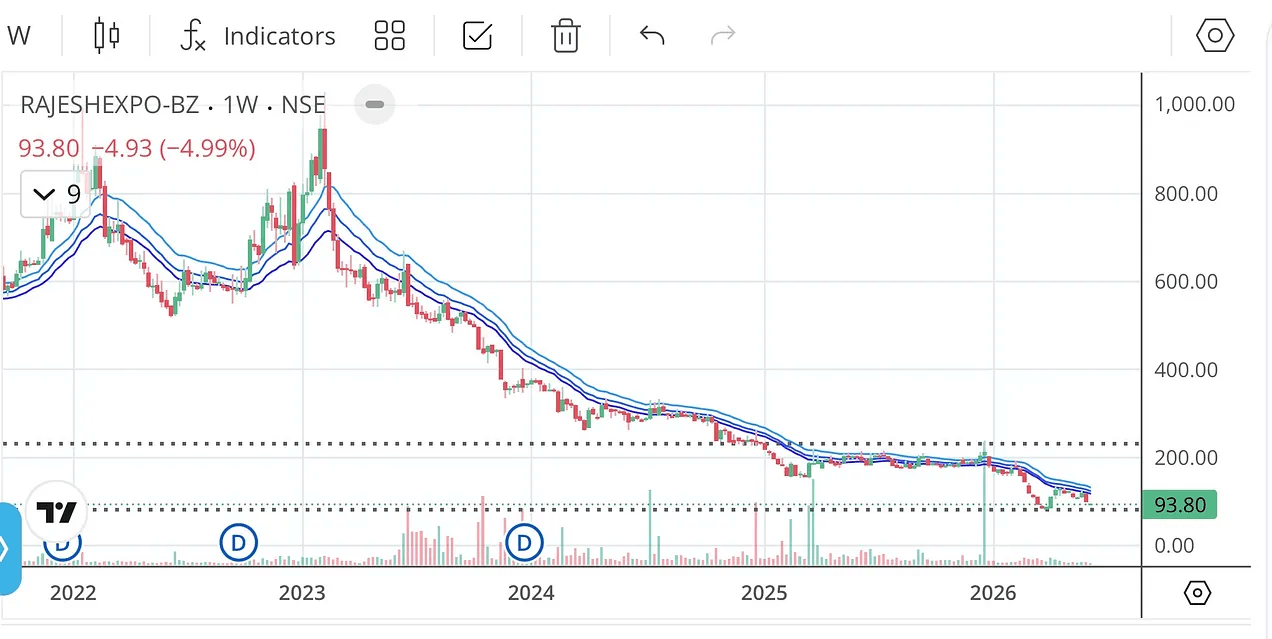
Looking at the weekly chart, Rajesh Exports lost its long-term trend structure in early 2023 when the price decisively broke below its 20 EMA band. From that point onward:
- The 20 EMA band turned downward.
- Every rally failed near the moving averages.
- Price consistently made lower highs and lower lows.
- The stock remained below the 20 EMA band for more than two years.
While investors continued debating the business story, the market was already voting with its money. The trend was clearly negative.
Don’t Try to Catch a Falling Knife. Many investors are tempted to buy stocks after large corrections. The logic sounds reasonable: “The stock has already fallen 50–60%. How much lower can it go?” Unfortunately, some of the worst investments begin with that thought. A stock trading significantly below a falling 20 EMA band is often signalling that institutional money is exiting rather than accumulating. Trying to buy such stocks usually means fighting the trend. And in the market, trends can persist much longer than investors expect.
A Simple Rule That Could Have Saved Investors
You don’t need to predict frauds. You don’t need insider information. You don’t need complex forensic accounting. Sometimes a simple risk-management rule is enough:
Avoid stocks trading below a falling 20 EMA band on the weekly chart.
This rule will never catch the exact bottom. But it can help investors avoid becoming trapped in prolonged wealth-destroying downtrends.
Technical analysis is not a substitute for fundamental analysis. But it can act as a powerful filter. If the fundamentals look great but the stock has been below a declining 20 EMA band for years, investors should pause and ask: “What does the market know that I don’t?”
In the case of Rajesh Exports, the chart started deteriorating years before SEBI’s allegations became public. The lesson is simple: Respect the trend.
No matter how attractive the story sounds, avoid fighting a long-term downtrend. Capital preservation is more important than trying to buy the absolute bottom.