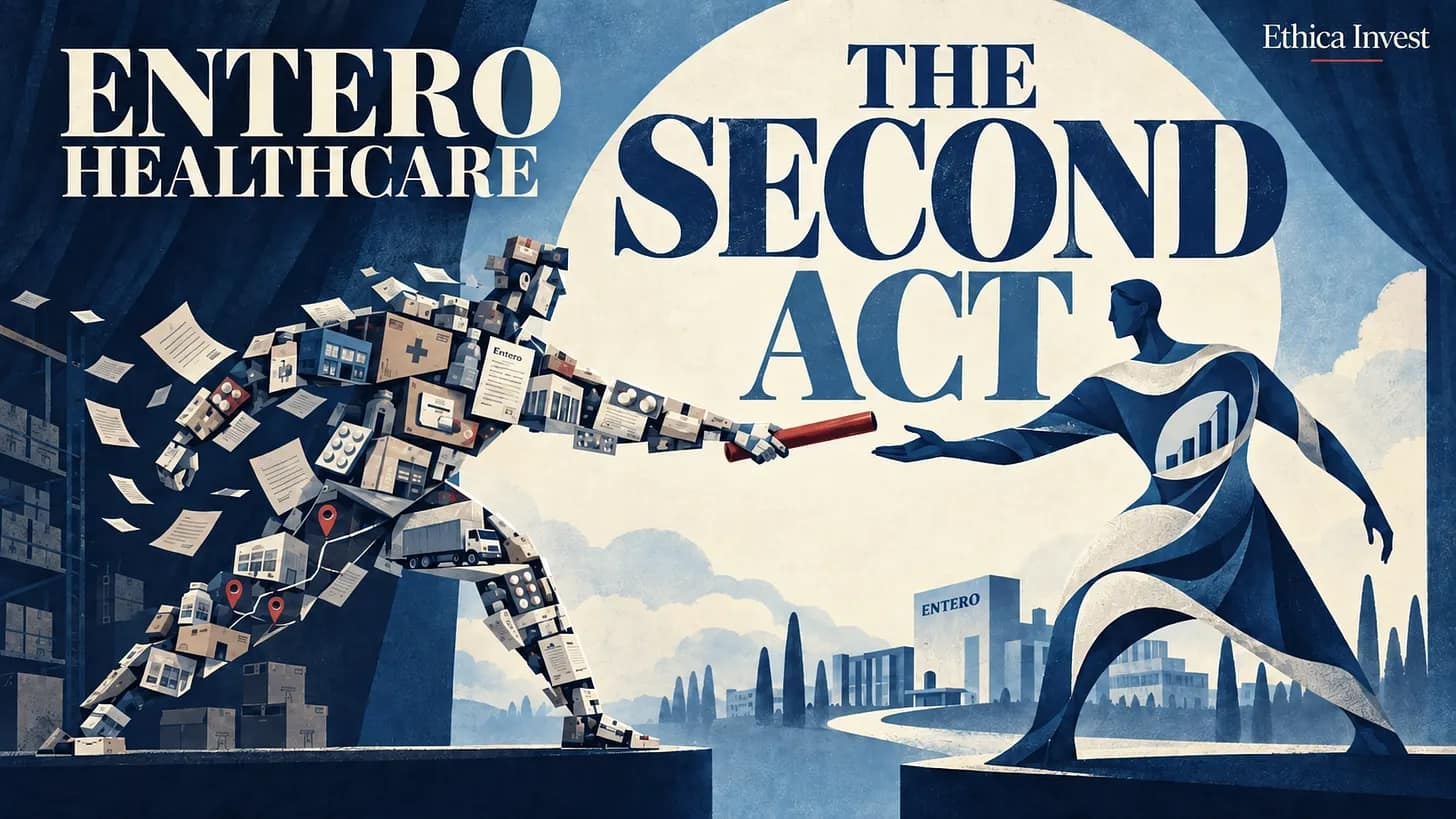
Entero Healthcare: The Second Act
Go to any shop near your house. Doesn’t matter what it sells.
Count how many products sit on those shelves. A grocery store, stocked with everyday items from dozens of brands. A hardware store, with tools from a dozen different manufacturers.
Now do the same at your local medical store.
Take a doctor’s prescription, and you walk out with almost every medicine on it.
 Ethica Invest
Serious about long-term investing?
Unlock our professionally managed portfolios.
Different medicines, manufactured by different companies, sitting on the same shelf.
But the pharmacist isn’t connected to hundreds of manufacturers to get all those medicines. He obviously isn’t calling hundreds of pharmaceutical companies every morning, and maintaining hundreds of different relationships.
He is simply connected with one person. Or maybe a few.
And that person is a ‘distributor’.
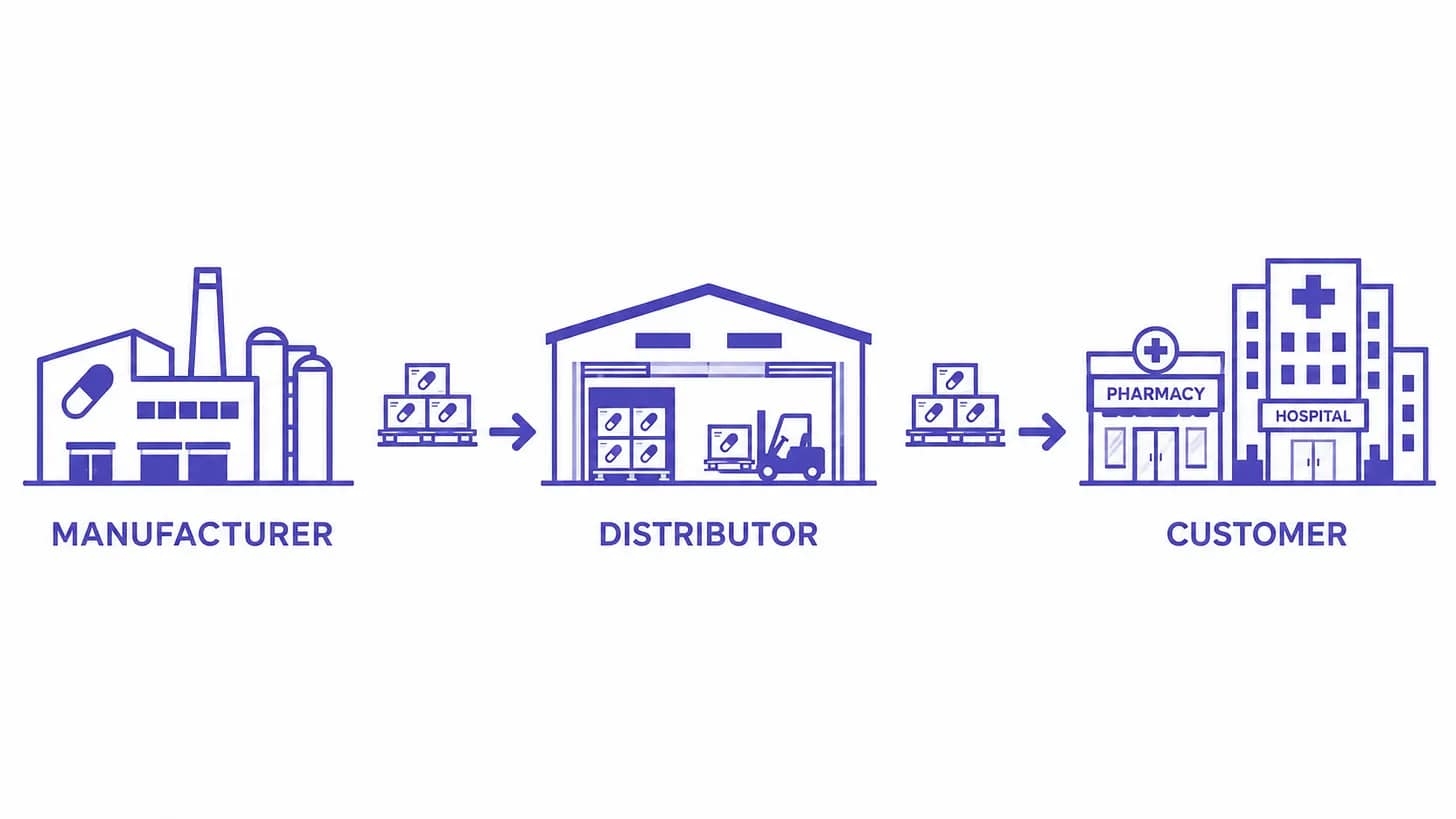
The business sounds almost boring. Buy medicines from manufacturers, store them in warehouses, deliver them to pharmacies and hospitals when needed.
No patented molecule. No glamorous factory. No cutting-edge drug discovery.
Just buying, storing and delivering medicines.
But sometimes the most interesting businesses hide in industries where the product itself never changes.
What changes is the structure around it; who’s doing the buying, storing, and delivering, and how many of them there are.
And pharmaceutical distribution has gone through exactly that transformation in several large markets globally.
That brings us to “Entero Healthcare”.
Entero is building one of India’s largest healthcare distribution platforms in an industry that, even today, remains dominated by thousands of regional and local players.
Ethica Invest
Serious about long-term investing?
Unlock our professionally managed portfolios.
To understand why that opportunity exists, however, we first need to travel outside India to answer this:
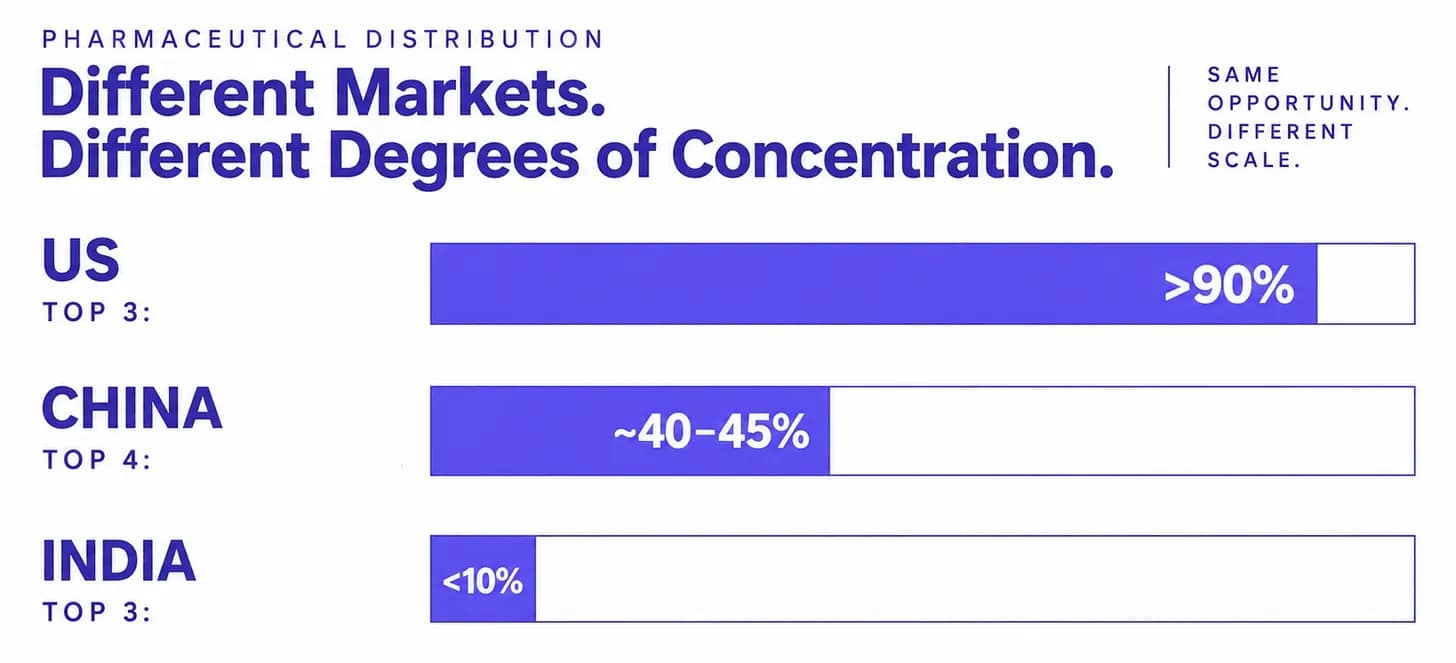
When the buyers became bigger, the distributors had to become bigger too
Today, three Companies control more than 90% of pharmaceutical distribution in the US.
But the more interesting question is not “what happened”.
It is “why”.
Because over time, the American healthcare system itself became more concentrated.
Large pharmacy chains emerged. Hospital systems became larger. Procurement became increasingly centralised.
Imagine a hospital group operating hundreds of hospitals across the country.
Would it rather coordinate with hundreds of small distributors in different states, or work with a handful of Companies capable of servicing the entire network?
This is where the economics began changing.
As purchasing became concentrated, distribution followed.
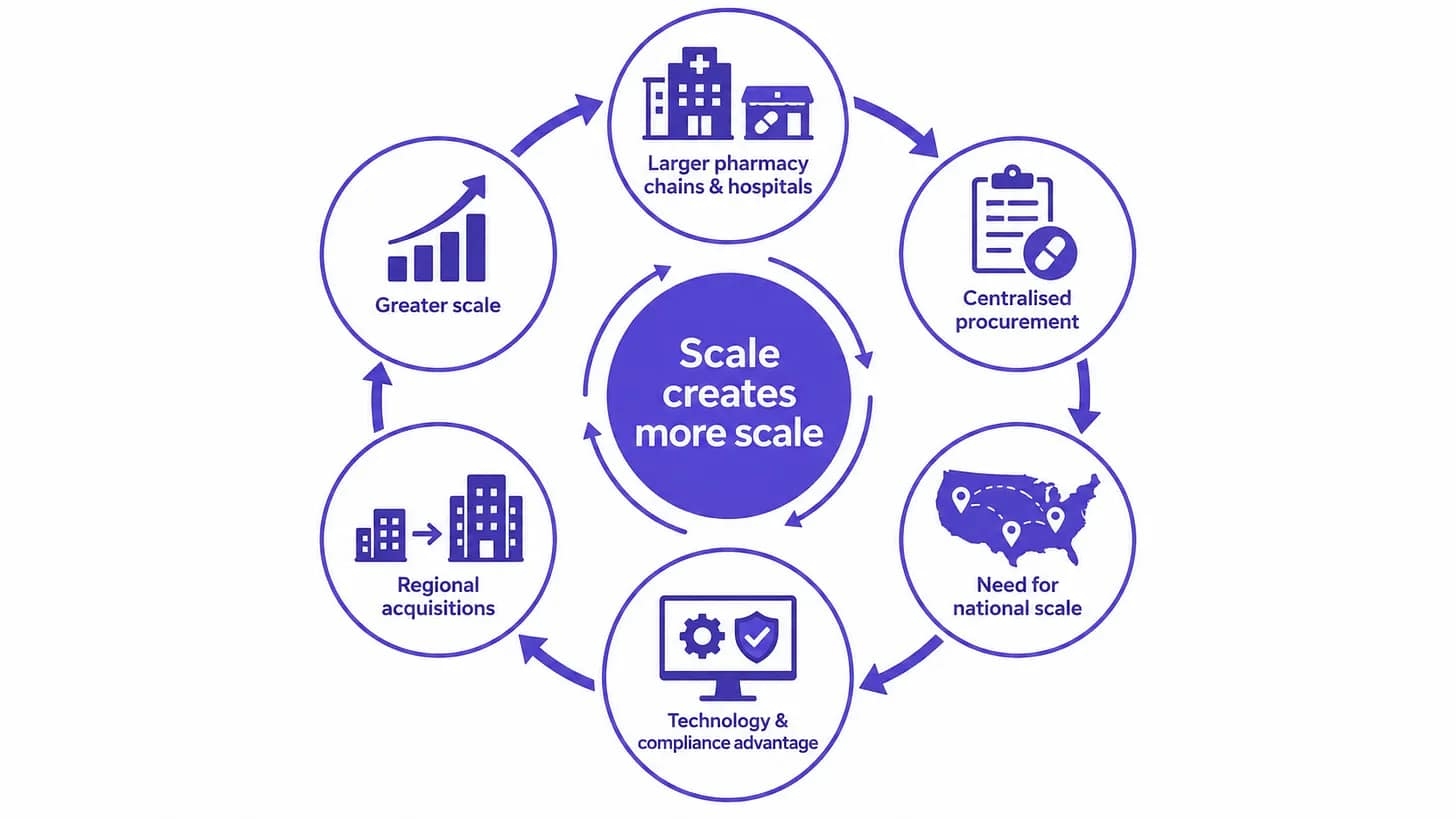
Because the larger distributors could serve national customers, invest more in technology and compliance, negotiate better with manufacturers and gradually acquire regional wholesalers.
So basically, Scale started creating more scale.
And eventually, that loop continued till the top three players — McKesson, Cencora and Cardinal Health — came to dominate the industry.
China took a different road to the same idea
China consolidated too, but through a very different route.
China started with a deeply fragmented distribution network, perhaps structurally closer to India than America.
But there, government policy itself became an important force behind consolidation.
Compliance became tighter. Hospital procurement became more centralised. And through reforms such as the Two-Invoice System, China deliberately reduced the number of intermediaries through which a drug could pass before reaching a hospital.
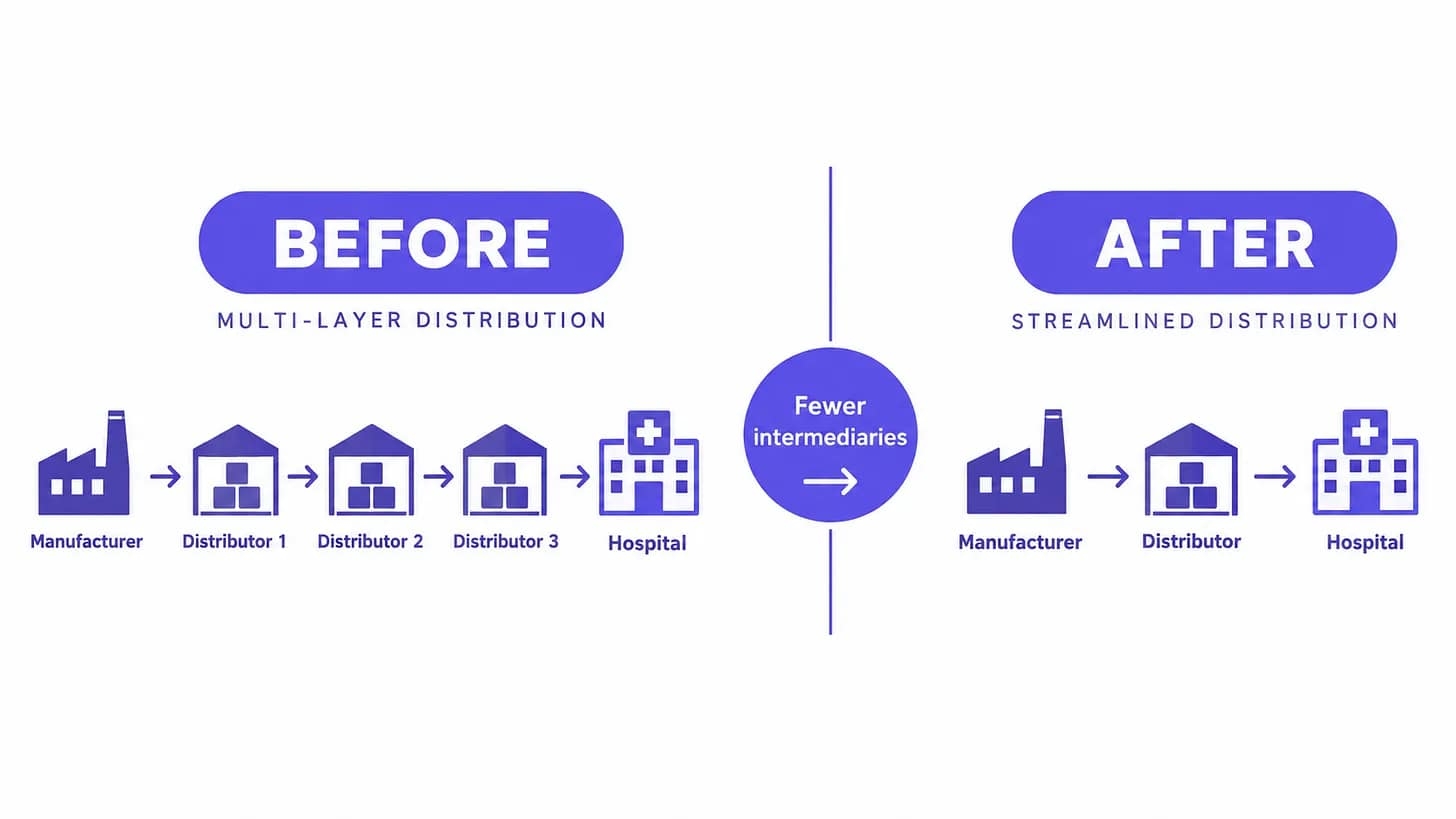
In simple words, the Chinese government itself said: “fewer middlemen’“.
Yet here is the interesting part.
Even after years of policy-backed consolidation, China’s largest distributors still did not reach American levels of concentration. Combined, the top 4 players have a market share of 40–45%.
That tells us something important.
There is no universal rule that every pharmaceutical distribution market will be controlled by a few players.
The final structure depends on how customers buy, how regulations work, how important local relationships remain and how easily a national player can replace regional networks.
Which brings us back to India.
India will consolidate. But probably in an Indian way.
India remains one of the most fragmented large pharmaceutical distribution markets.
There are national players today, with the top three players commanding less than 10% of the market, and the overwhelming majority of the market is still serviced through regional and local distributors.
And there are good reasons why these businesses have survived.
A distributor in Surat or Jaipur may have spent decades building relationships with pharmacies, hospitals and pharmaceutical Companies.
He knows which retailer pays on time. He knows which products move in his local market. He may deliver several times in a single day. He extends credit based not on an algorithm, but on relationships built over years.
A national Company cannot simply rent a warehouse and recreate all of that overnight.
This is also why we do not believe India will automatically become another US.
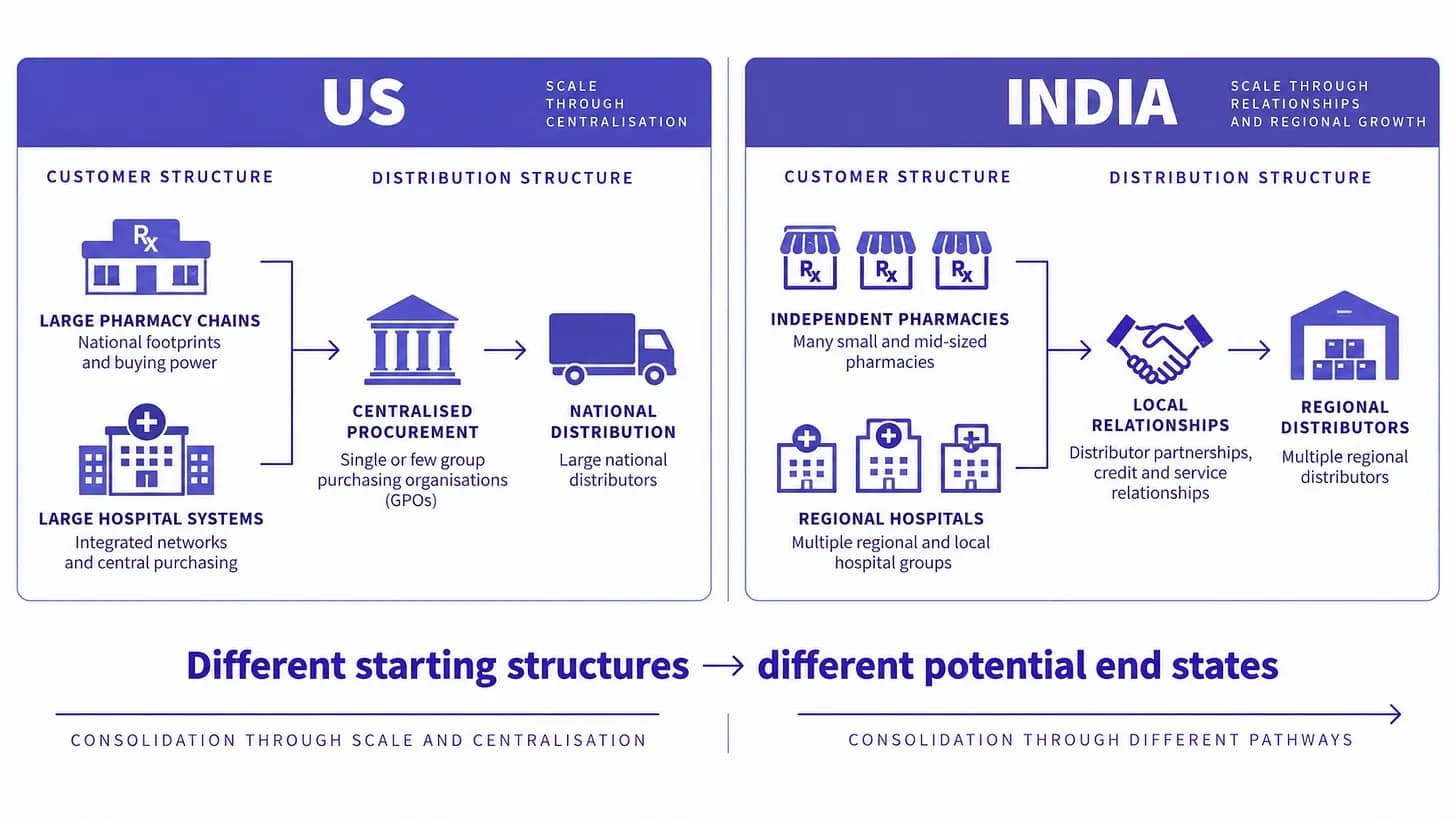
India does not yet have America’s level of concentrated pharmacy and hospital purchasing. Nor does it have a Chinese-style policy forcing layers of distribution to disappear.
But consolidation is still moving in one direction.
GST has made national operations easier. Technology and compliance requirements increasingly favour organised players. Pharmaceutical manufacturers benefit from dealing with larger distribution partners. Many family-owned distributors face succession issues.
And over time, another force could become increasingly important.
The demand side itself may start consolidating.
As organised pharmacy chains and corporate hospital groups become larger, their procurement can become more centralised.
And when the customer becomes large, the distributor servicing that customer may eventually need to become large as well.
That is exactly what happened in the US.
We may never reach American levels of concentration. We do not need to.
Even a meaningful shift from today’s fragmented market toward a much larger organised distribution pool creates a long runway for Companies capable of operating nationally.
And Entero is trying to become one of them.
The interesting thing is, growth is probably not the hardest part of the Entero story anymore.
Entero did not build a national network. It bought one.
Entero was founded in 2018 with a relatively simple observation.
India had thousands of good regional healthcare distributors, but very few had national reach.
Building those relationships organically, city by city and state by state, could take decades.
So Entero chose a different route.
It started acquiring regional distributors.
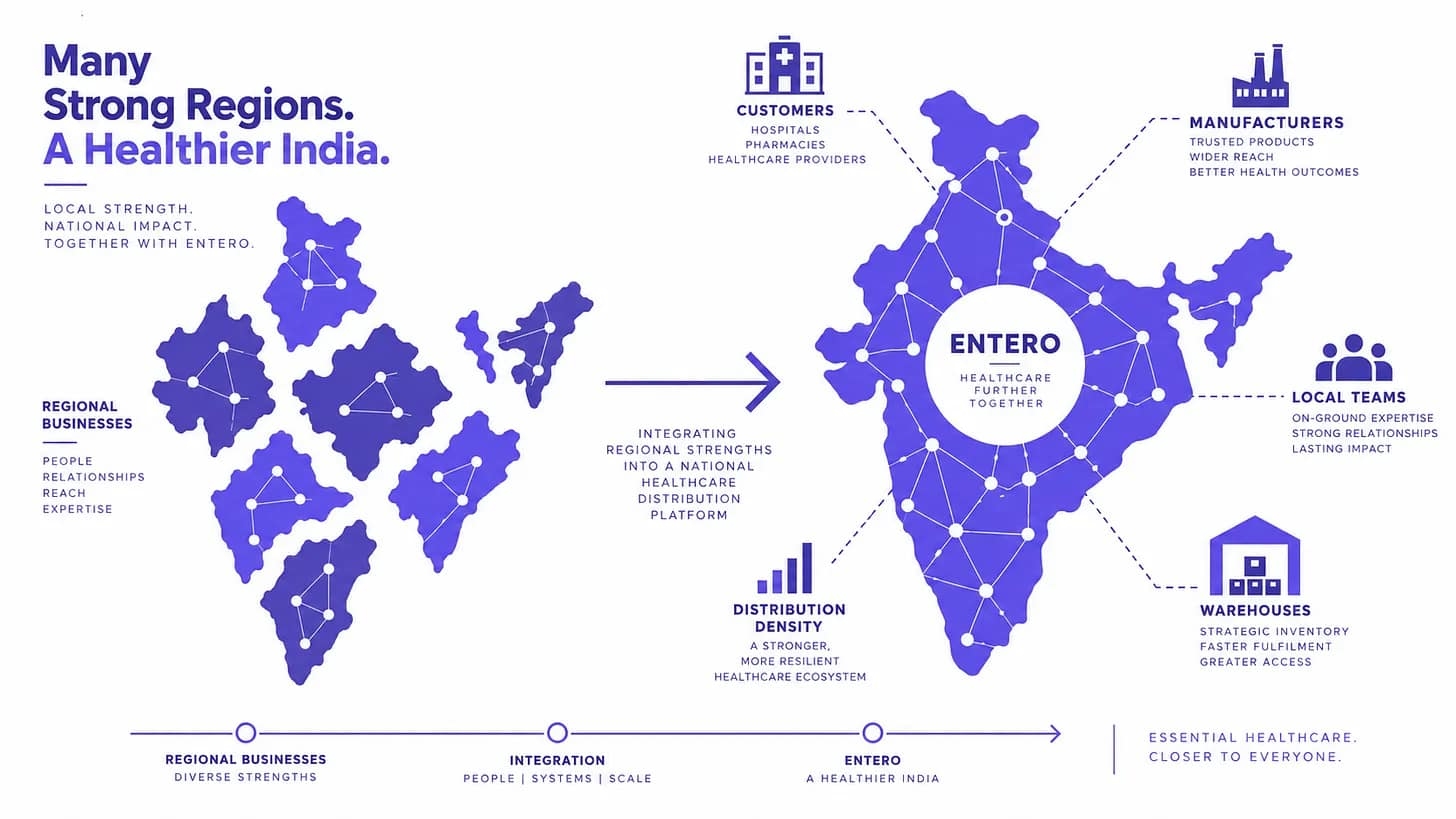
Here’s why that’s not just a technicality.
When Entero acquires a distributor, it is not really buying warehouses.
Warehouses are easy to rent.
What it is buying is much harder to recreate: customer relationships, manufacturer relationships, local teams, distribution density and years of operating knowledge.
The local distributor brings the relationships.
Entero brings capital, technology, procurement scale, a much wider product catalogue and access to a national network.
In a way, Entero’s strategy can be summarised in one line: Buy the local relationship, centralise the economics.
That is the logic behind the Company’s acquisition-led expansion.
So how does Entero actually make money?
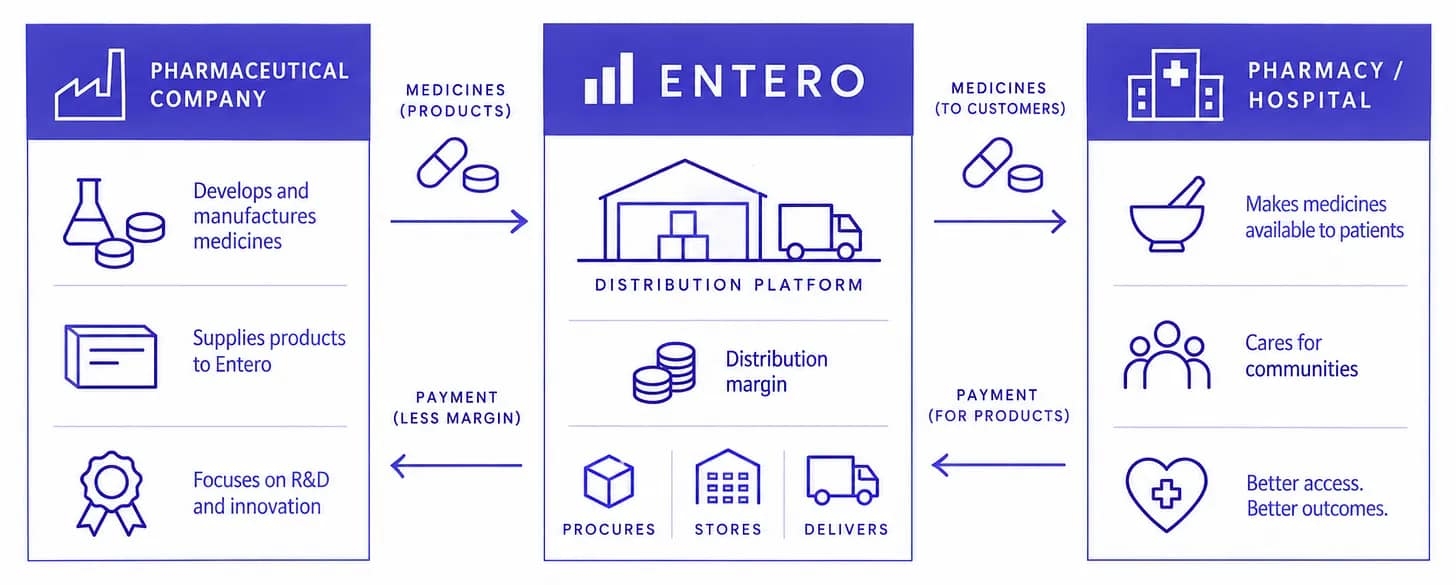
The core business is simple.
A pharmaceutical Company manufactures a medicine → Entero buys and stores it → A pharmacy or hospital places an order → Entero delivers the medicine and earns a small margin for sitting between the two.
The advantage for the customer is convenience.
Instead of a pharmacy dealing with dozens of different distributors to source thousands of medicines, a larger distributor can increasingly fulfil a greater portion of its requirement through one relationship.
Manufacturers benefit too.
A Company can use Entero’s network to reach a large number of pharmacies and hospitals without having to recreate the same infrastructure itself.
The problem is that this remains a distribution business.
And distribution businesses generally do not earn extraordinary margins.
A few years ago, Entero was making only 1-2% of operating profit for every ₹100 of revenue.
Today, that number is 5%.
Not because the business changed. Because the scale finally did.
Scale has helped procurement. Costs have not grown as quickly as revenue.
Entero has also started walking away from some low-margin business where the capital employed was not earning enough.
But there is another development that could take margins somewhat further.
Entero is slowly moving beyond delivering medicines
Traditional pharmaceutical distribution is largely about fulfilling demand.
A doctor has already prescribed the medicine. The pharmaceutical Company has already built the brand.
Demand already exists.
Entero largely needs to make sure the product reaches the right pharmacy or hospital.
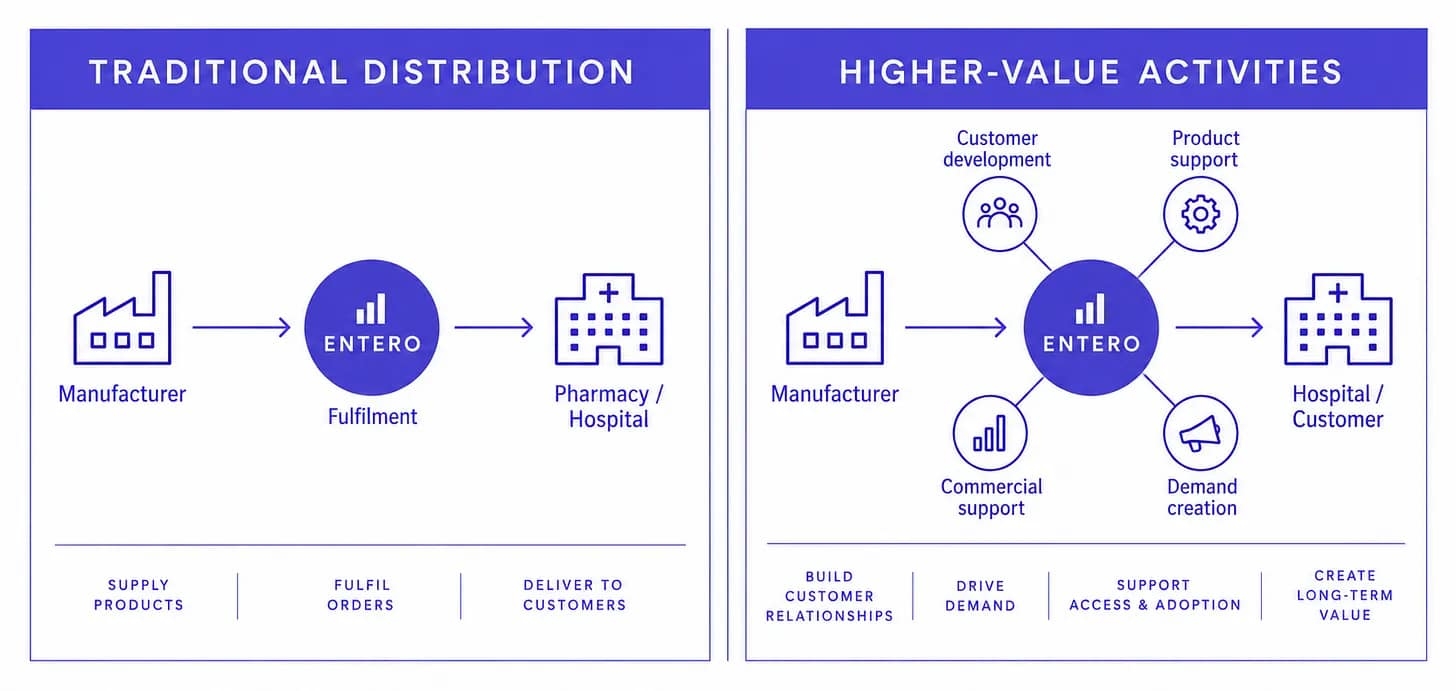
In parts of MedTech, diagnostics and other commercial arrangements, the role can be very different.
Entero may participate more actively in selling the product, developing customers, supporting hospitals and helping the manufacturer create demand.
That is a more valuable role than simply moving a box from one warehouse to another.
And naturally, the margins can be better.
This is why Entero’s expansion into MedTech is interesting to us.
It does not merely add another category of revenue. It can slowly change the economics of the Company.
We believe consolidated margins can move above today’s levels if MedTech and other higher-value activities become a larger part of the business.
But we would be careful about assuming that ordinary pharmaceutical distribution itself suddenly becomes a high-margin business.
And this is where the Entero story becomes much more interesting.
Because until here, everything looks fairly straightforward.
India is consolidating. Entero is gaining scale. Revenue is growing. Margins are improving.
So what exactly is the problem?
Growth is not the same as value creation
Imagine you put ₹100 into a business. That business earns ₹5 every year.
If you want your return to improve, there are broadly two ways to do it.
You can earn more profit from the business. Or you can make that same ₹100 work harder.
Entero has already made significant progress on the first. The second is where we believe the next phase of the story lies.
Because Entero does not need giant factories.
Most of its money gets stuck somewhere far less visible. Inside medicines sitting in warehouses. And inside bills that customers have not yet paid.
Suppose Entero buys medicines today, stores them, delivers them to a hospital and then waits several weeks for the hospital to pay.
During that entire period, Entero’s money is stuck. The faster Entero can sell inventory and collect cash from customers, the sooner it can reuse the same money.
This is what investors call working capital efficiency.
And for Entero, it is critical. Because the faster the Company grows, the more inventory it needs to carry and the more receivables it can accumulate.
That creates an unusual situation.
The income statement may say the Company made a profit. But a large part of that profit may never reach the bank account because the cash has already gone back into funding the next round of inventory and customer credit.
This is why Entero historically struggled to consistently generate positive operating cash flow despite growing rapidly.
FY26 finally marked an improvement, and working-capital efficiency has also started moving in the right direction.
For us, this is now far more important than simply watching another quarter of 20% revenue growth.
There is another place where money goes
‘Acquisitions’.
Entero has spent significant capital buying regional businesses.
And when a Company buys another business, it often pays much more than the value of the physical assets sitting inside it.
Why?
Because relationships have value. Customer networks have value. Manufacturer relationships have value. Local market position has value.
That excess acquisition value ultimately shows up largely as goodwill on the balance sheet.
So Entero has two separate jobs.
It needs to make the businesses it already owns more capital efficient. And it needs to make sure it does not pay too much for the next business it acquires.
A bad acquisition can still increase revenue. It can even increase EBITDA.
But if Entero paid too much for those earnings, shareholder value may not actually increase.
This is where funding enters the picture.
If internally generated cash is not enough to fund acquisitions, Entero has two broad choices.
Borrow money. Or issue shares.
Neither is inherently bad.
Debt works when acquisitions earn comfortably more than the financing cost. But if acquisitions disappoint, interest costs remain while the expected profits do not.
Equity avoids that interest burden, but creates dilution.
The Company can grow revenue and total profit while shareholders see much lower growth in profit per share if too many new shares are continuously issued.
So the ideal Entero is not a Company that never raises external capital again.
That would be unnecessarily restrictive.
The better outcome is one where external capital gradually becomes a choice to accelerate attractive opportunities rather than a necessity to keep the growth engine running.
Because a company that grows only because it keeps raising money isn’t compounding. It’s borrowing time.
So how are we looking at Entero?
We started studying Entero as an industry-consolidation story.
And to an extent, it still is.
India’s pharmaceutical distribution market remains fragmented, organised players have a long runway and Entero has already built one of the few national platforms capable of participating in that shift.
We are also comfortable that growth itself is not the biggest question today.
The Company has demonstrated strong growth, gained share and materially improved margins.
The question now moved.
Can Entero make every rupee of growth consume less capital over time?
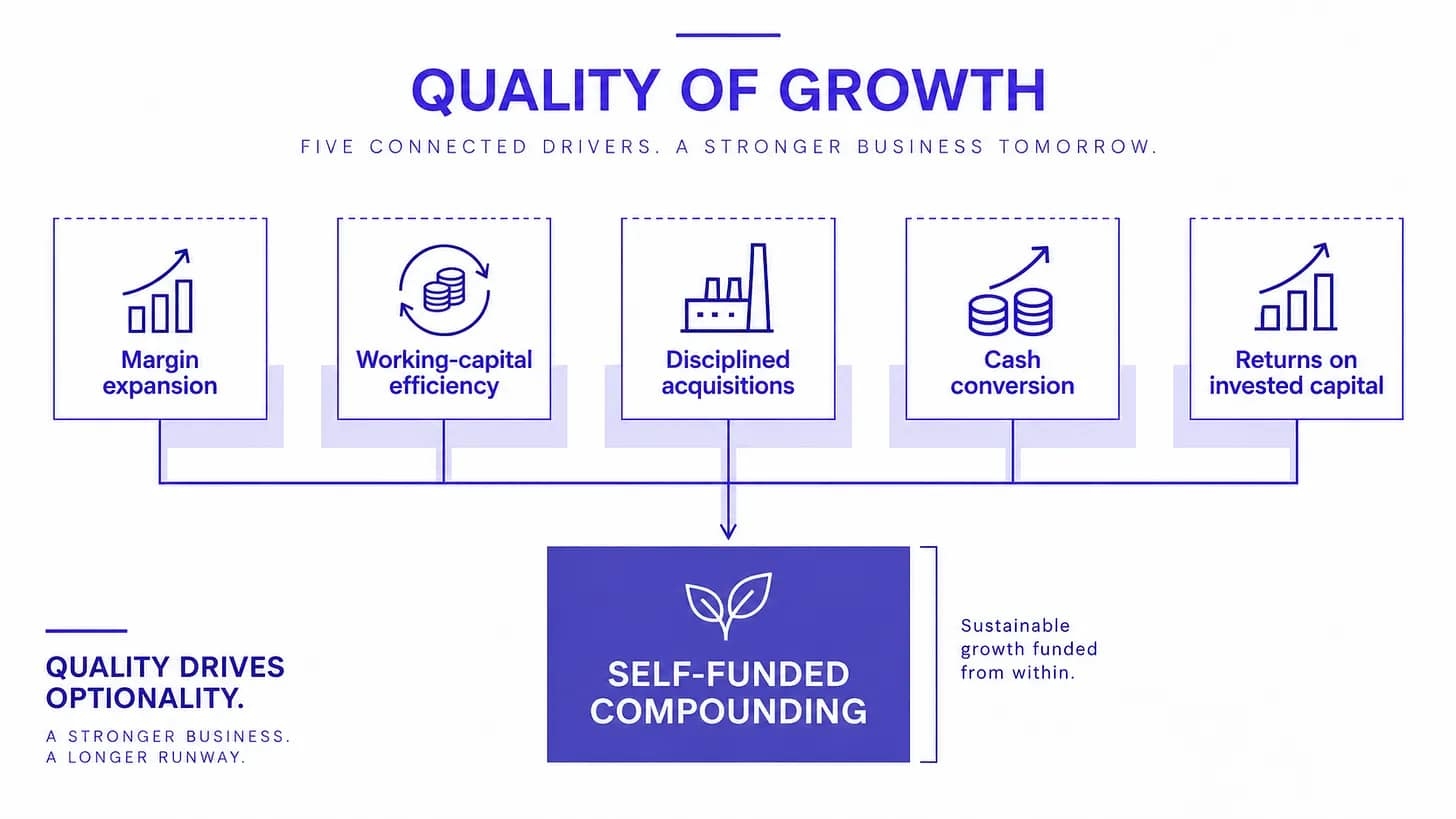
That, in our view, will decide the quality of this business.
If MedTech and other higher-value activities improve profitability, working-capital intensity keeps falling, acquisitions continue to be made at sensible prices and more accounting profit starts appearing as actual cash, Entero can become a very different Company from the one it was a few years ago.
It can move from being a consolidator that needs capital to grow into a consolidator whose own operations increasingly help fund the next round of growth.
That is a much stronger compounding model.
And the market is already asking Entero to prove it
Entero today is not being valued like an ordinary low-margin distributor.
The market is already giving the Company credit for future growth, consolidation and improvement in profitability.
Which means simply becoming larger may no longer be enough.
From here, Entero needs to become better.
If margins improve further, cash conversion strengthens and returns on the money invested in acquisitions rise, today’s valuation becomes easier to justify.
But if revenue keeps growing while cash remains trapped in working capital, acquisitions continuously require fresh debt or equity and capital returns remain mediocre, the Company may still become much larger without creating equivalent value for shareholders.
And that is ultimately how we look at Entero today.
The first phase was about proving that Entero could build scale.
It has largely done that.
The second phase is about proving that scale can generate cash, and that cash can increasingly finance the next leg of growth.
For us, that is now the story worth watching.
About Ethica Invest
Ethica Invest is a principled, Shariah-compliant investment platform that helps investors like you in identifying companies using well-defined criteria for finances, operations, and governance. Though grounded in Shariah guidelines, Ethica’s approach goes beyond any single faith by prioritizing openness, strong balance sheets, and responsible business practices.
Ethica Invest works with SEBI-registered analysts and seasoned investment experts who deliver organized, compliant analysis on stocks and other opportunities. Those interested in seeking more on Shariah-aligned investing, can connect with our Ethica team.
The goal is straightforward: empower investors with decisions based on ethics, solid data, and performance; not just stories.
General Disclaimer and Release: Nothing contained herein constitutes tax, legal, insurance or investment advice, or the recommendation of or an offer to sell, or the solicitation of an offer to buy or invest in any investment product, vehicle, service or instrument.