From Mauritius to Singapore
In the financial world, if the first three alphabets: A, B, and C; were to spell, then they would be:
- A for Assets,
- B for Business, and
- C for Capital.
And among the three, C for Capital; is the most important one.
Because without capital, no one can buy an asset, no one can start a business; and, neither wealth creation nor ownership even begins.
So basically, capital is what makes everything else (A & B) possible.
 Ethica Invest
Serious about long-term investing?
Unlock our professionally managed portfolios.
And it never exists in isolation.
It is always moving; from one country to another, from one market to another, from one investor to another. And for this to happen, there is always a mediator that makes it easier for capital to move across borders, markets, and hands.
So when we look at India, and ask a simple question: who is that mediator that helps global investors deploy their capital in India?
The answer is “Singapore”.
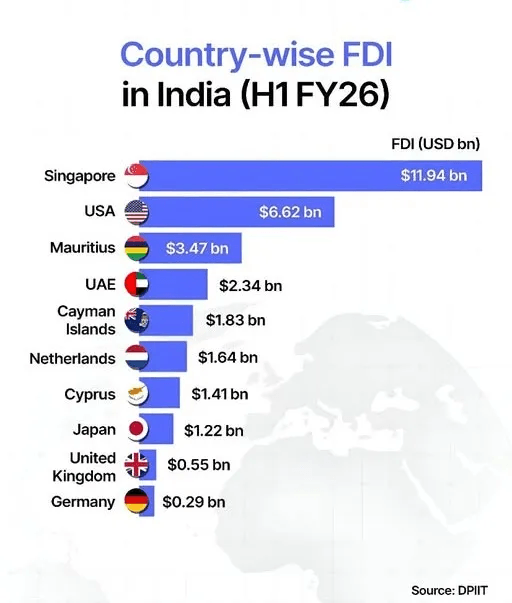
In H1 FY26, Singapore sent $11.94 billion into India. The United States, the world’s largest economy and the home of most major global investment institutions, managed $6.62 billion. And, Mauritius contributed $3.47 billion.
And, over the last two decades, roughly one quarter of all foreign investment into India has been routed through this city-state.

Most people read that statistic and move on.
They shouldn’t.
Because the number doesn’t just tell you how much capital came in. It tells you something more important:
“How global capital actually moves, how it gets organised, and how it gets deployed”.
Capital Has a Logistics Problem.
Moving large sums of money across borders sounds simple in the age of digital finance.
In practice, it is deeply complicated.
Ethica Invest
Serious about long-term investing?
Unlock our professionally managed portfolios.
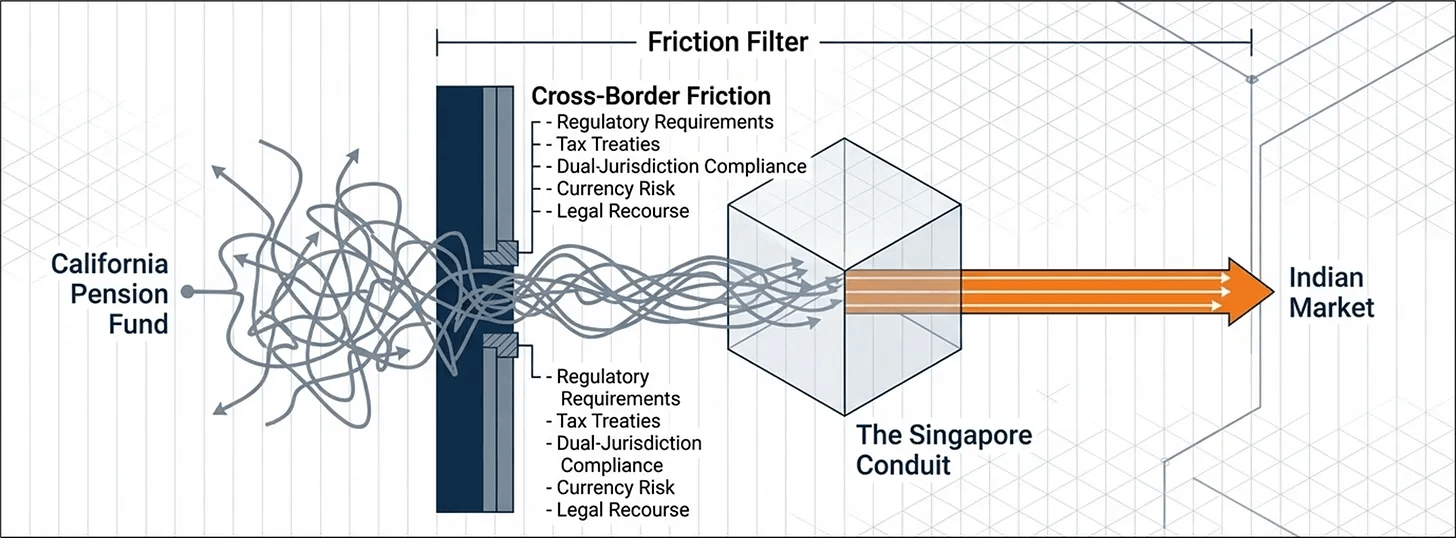
A pension fund in California that wants to invest in India must navigate Indian regulatory requirements, tax treaties, compliance frameworks in both jurisdictions, currency risk, and legal recourse if something goes wrong. The pension fund cannot do that efficiently on its own, from a standing start, in every market it enters.
This is why financial hubs exist.
Not as abstract concepts, but as practical solutions to a real problem.
They provide the legal infrastructure, the regulatory clarity, the tax treaties, and the fund structures that make cross-border capital deployment workable at scale.
Singapore solved this problem better than almost anyone else in Asia.
And it did so deliberately, over several decades, through a combination of regulatory discipline, tax policy, legal design, and institutional credibility.
That the result;
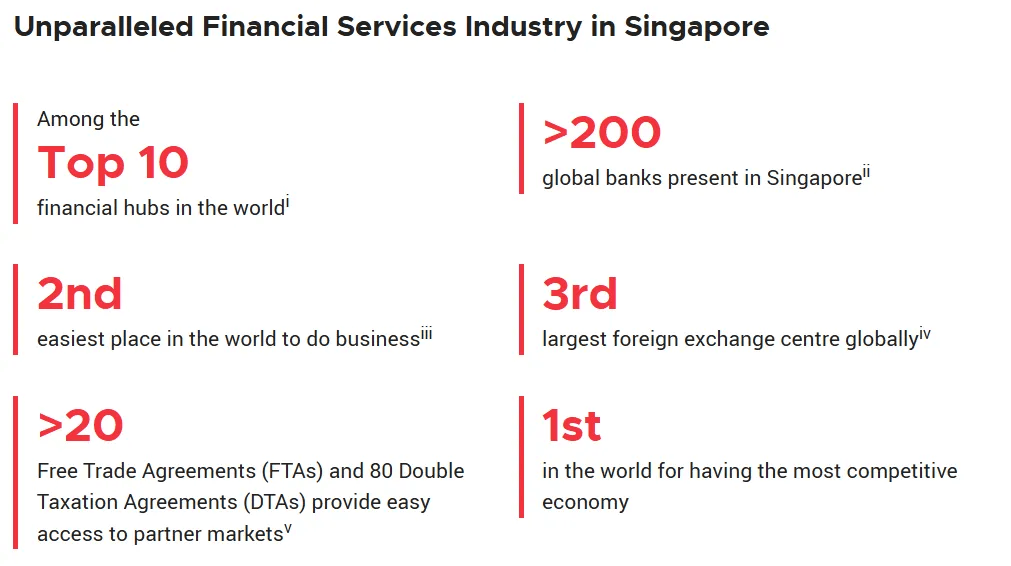
It is a city where more than 200 global banks operate, where around 7,000 multinational firms maintain regional headquarters, and where the world’s 3rd foreign exchange centre operates.
And none of that happened by accident.
What Singapore Actually Offers?
To understand why capital routes through Singapore, you need to understand what Singapore’s financial ecosystem actually contains.
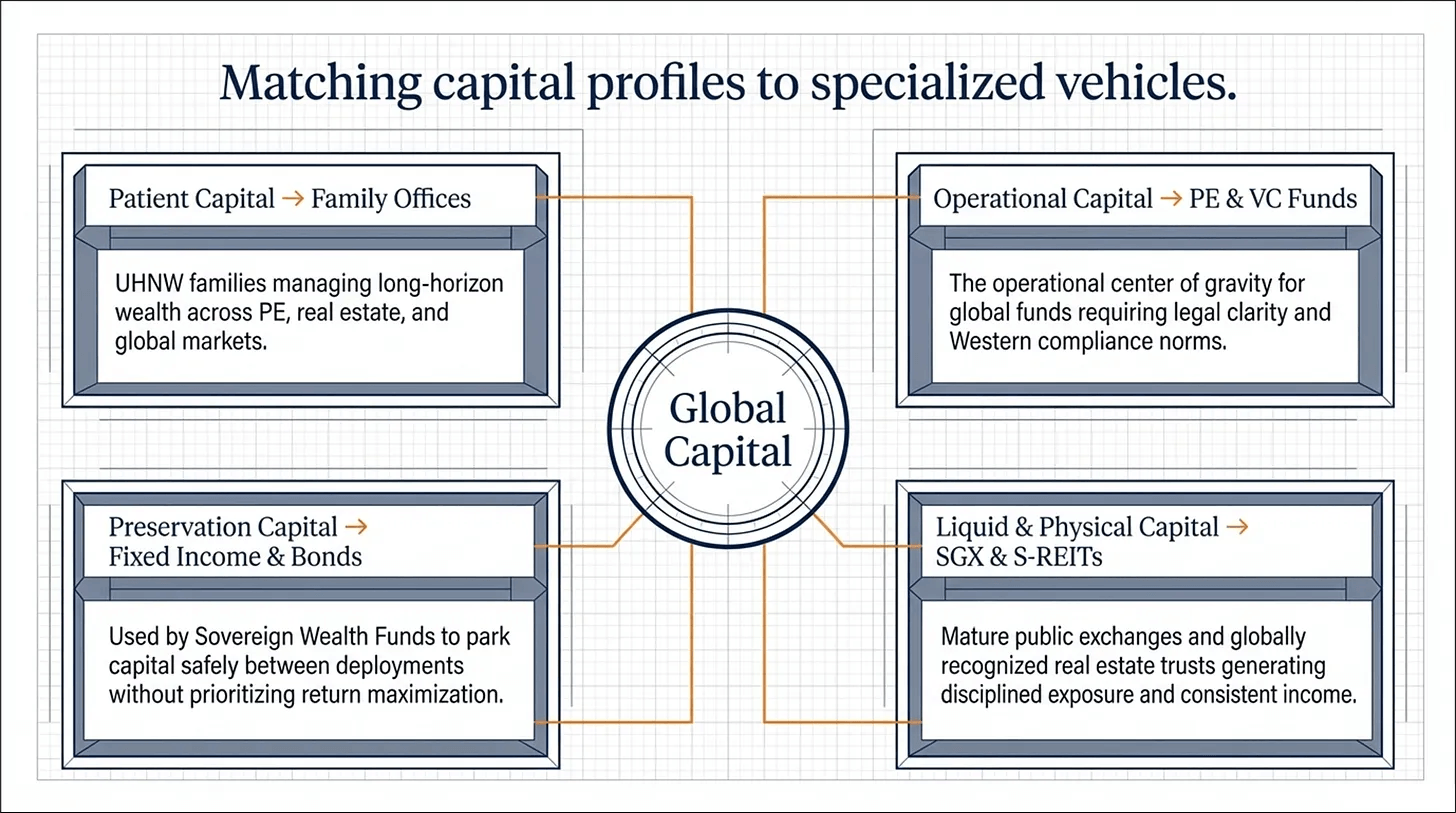
Public markets are anchored by the Singapore Exchange, or SGX.
It lists equities, ETFs, and derivatives. SGX is actually a mature, stable exchange that attracts institutional investors who want disciplined exposure to Asian markets rather than volatility.
Real estate is where Singapore has built its most globally recognised product.
Singapore Real Estate Investment Trusts, known as S-REITs, are listed vehicles that hold income-generating properties; logistics parks, data centres, hospitals, retail malls; and distribute rental income to investors. They are transparent, liquid, and governed by strict disclosure rules. For a global investor seeking consistent income backed by physical assets, S-REITs are among the most credible instruments available in Asia.
Fixed income and bond markets serve a different purpose.
Sovereign wealth funds and large institutional investors use Singapore’s debt markets to park capital safely between deployments. The goal here is preservation and accessibility, not return maximisation.
Private equity and venture capital are where the operational centre of gravity lies.
Sequoia, Accel, Warburg Pincus, Tiger Global, and dozens of other major global funds either base their Asian operations in Singapore or maintain a significant presence there. Singapore gives these funds legal clarity, a deep talent pool that is familiar with both Western compliance norms and Asian market realities, and; critically; a fund structure that works.
Now, this last point matters more than it might seem.
In 2020, Singapore launched the Variable Capital Company framework, or VCC.
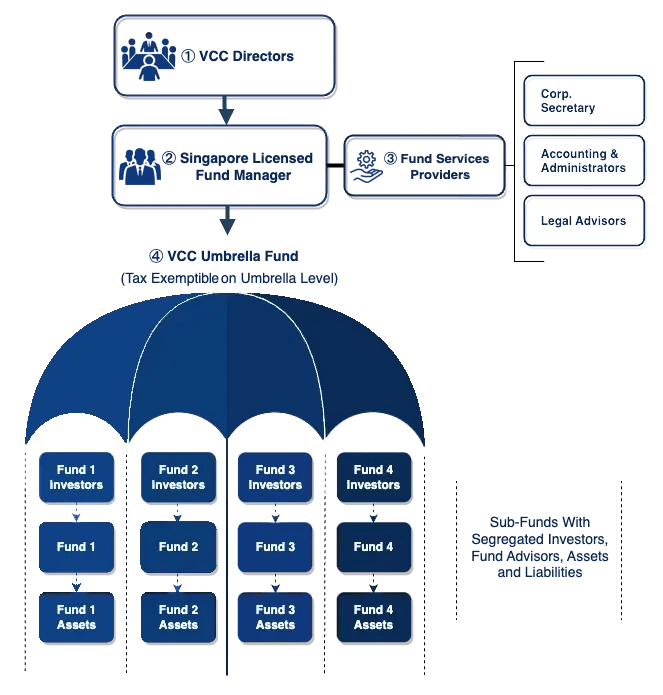
This is a fund structure specifically designed for investment funds, allowing multiple sub-funds to sit under a single legal entity, sharing operational costs while maintaining segregated assets and liabilities.
Before the VCC, fund managers in Asia were largely using structures borrowed from other jurisdictions; Cayman Islands limited partnerships, for instance; because no Asian domicile offered a purpose-built, internationally recognised fund vehicle.
The VCC changed that.
It gave Singapore a technical edge that goes beyond tax rates or regulatory reputation. It gave fund managers a reason to domicile their funds in Singapore rather than merely operating from there.
Family offices round out the ecosystem.
Ultra-high-net-worth families from across Asia, and increasingly from India, have established family offices in Singapore to manage long-term capital across Private Equity, real estate, and global markets. They add patient, long-horizon capital to a system that already has institutional depth.
Why Singapore and Not Somewhere Else?
Four structural advantages explain Singapore’s position. Together, they reinforce each other in a way that is genuinely difficult for others to replicate quickly.
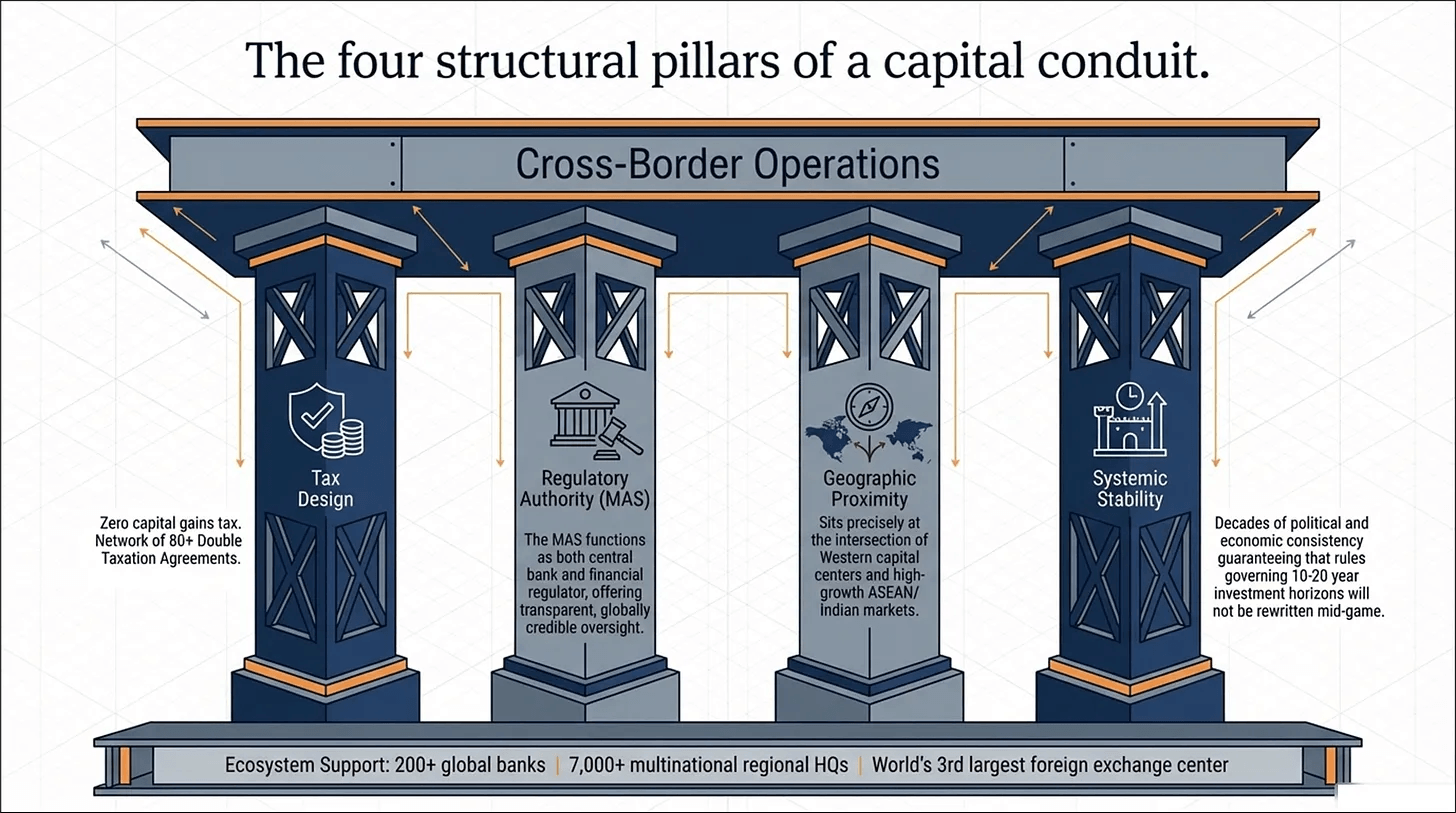
The first is tax design.
Singapore levies no capital gains tax. It also maintains a corporate tax rate of 17%, which is competitive against regional peers like Malaysia at 24% and Indonesia at 22%.
And its network of over 80 Double Taxation Agreements; including a significant one with India; reduces friction on cross-border income flows.
The second is the Monetary Authority of Singapore, or MAS.
The MAS functions as both central bank (as RBI) and financial regulator (as SEBI). More importantly, it functions with consistency, credibility, and transparently. So, when a fund carries MAS regulation as part of its credentials, institutional investors in New York and London take that seriously.
The third is political and economic stability.
This is underrated in conversations about financial hubs, but it is foundational. Investors deploying capital over ten or twenty year horizons need to know that the rules governing their investment will not be rewritten mid-game. Singapore has delivered that consistency in a region where political volatility is not uncommon.
The fourth is geography.
Singapore sits at the intersection of Western capital and Asian growth markets. From Singapore, a fund manager can reach India, Indonesia, Vietnam, and the broader ASEAN region with relative ease. It is a practical advantage, not just a symbolic one.
How Capital Gets to India?
The mechanism through which Singapore connects global capital to Indian assets is worth understanding in detail, because it is widely misread.
When the FDI data shows Singapore as India’s largest source of foreign investment, it does not mean that Singapore’s institutions are the primary investors. It means that Singapore is the country through which global capital is structured before it enters India.
The typical flow looks like this:
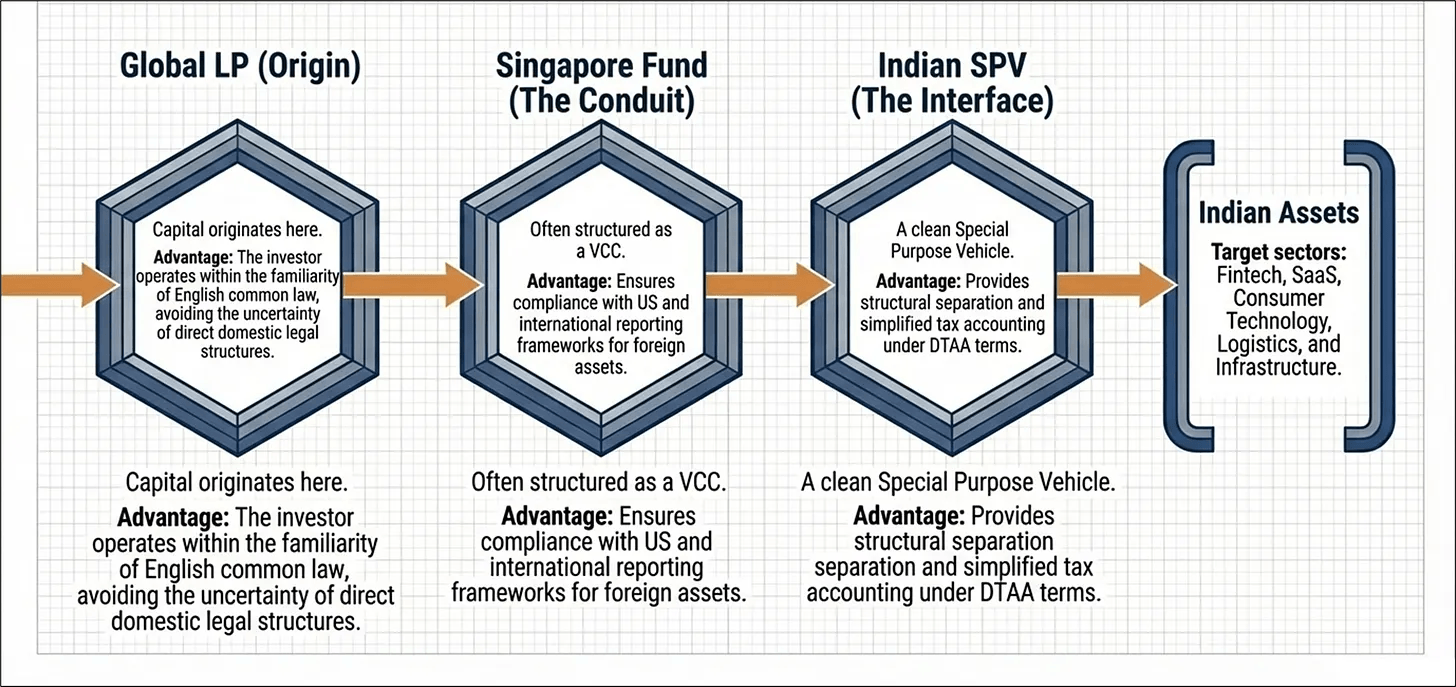
A global Limited Partner, or LP, commits capital to a Singapore-based fund. That fund, governed under Singapore law and often structured as a VCC, then deploys into Indian companies either directly or through an Indian Special Purpose Vehicle. The SPV is a clean legal entity created specifically for the investment, which provides structural separation and simplifies tax accounting.
Three features make Singapore the preferred country for this structure.
The India-Singapore Double Taxation Avoidance Agreement, or DTAA.
It actually reduces the tax when money moves between borders. Dividends from Indian companies face a withholding tax of 10% under the treaty, compared to 20% under standard Indian domestic rates. For infrastructure debt, the effective rate can fall to 5%.
When hundreds of millions of dollars are in motion, those differences are material.
Legal familiarity matters as well.
Singapore’s legal system is rooted in English common law, which is the same tradition that governs most Western institutional investors’ home jurisdictions.
So, what happens is a global LP investing through a Singapore fund is operating within a legal framework it understands.
Otherwise, Investing directly into India, through Indian legal structures, introduces unfamiliarity and uncertainty that many institutional investors are not equipped to manage.
Fund structuring efficiency completes the picture.
Singapore-based funds can be built to comply with the US and international frameworks that govern how investors report foreign assets, without the complications that arise when investing directly through jurisdictions with less developed compliance infrastructure.
The sectors that receive this capital tell their own story about India’s growth priorities:
- Fintech,
- SaaS,
- Consumer Technology,
- Logistics, and
- Infrastructure.
These are the areas where foreign institutional capital has concentrated, and a huge proportion of it arrived having been organised in Singapore first.
The Mauritius Comparison Is Important.
Singapore did not always hold this position.
For most of the 2000s, Mauritius was India’s largest FDI source.
And the reason was straightforward:
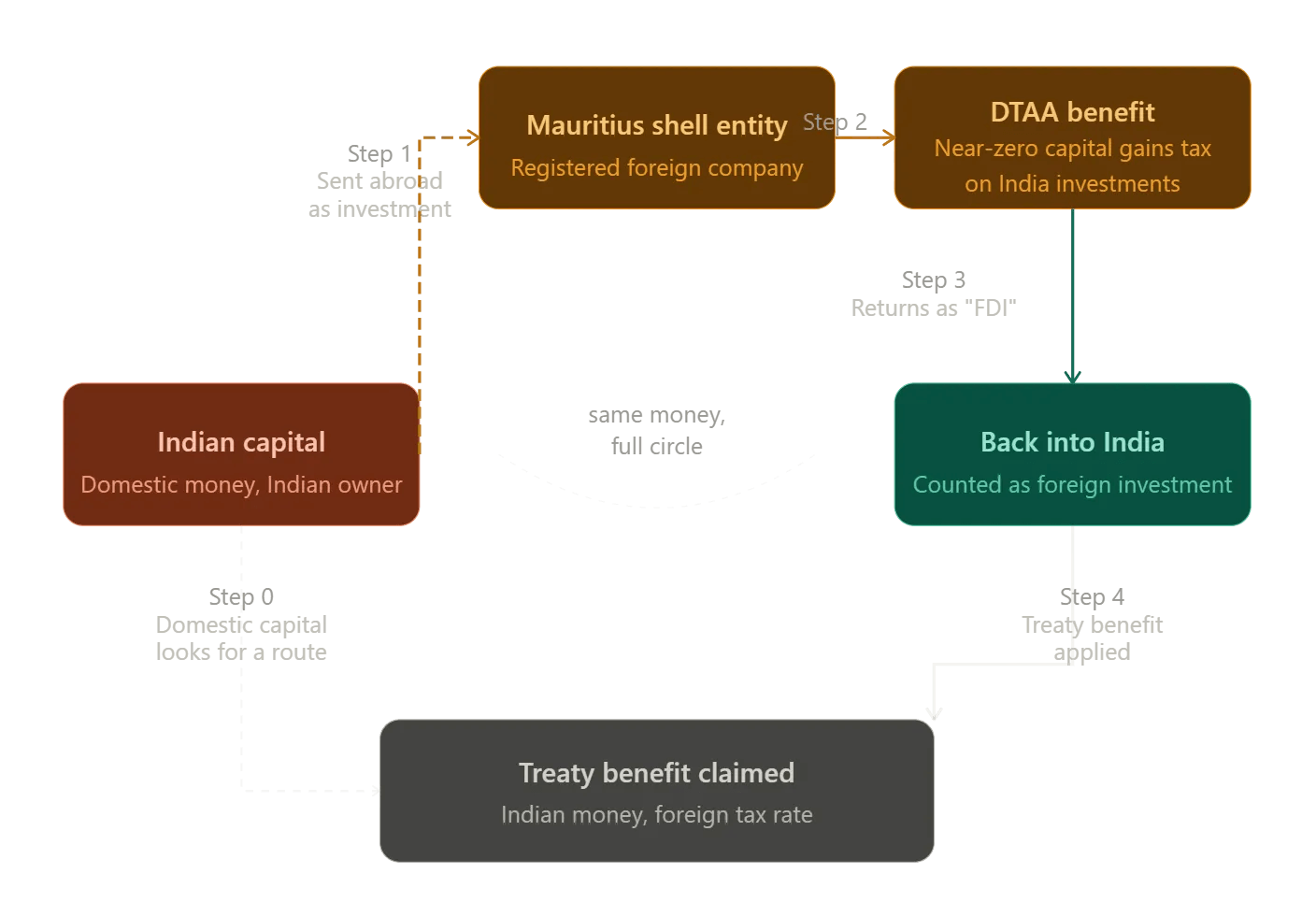
The India-Mauritius DTAA offered near-zero capital gains tax, which made Mauritius an easy route to send money into India. And a significant portion of what was invested in India through Mauritius was actually round-tripped Indian capital only.
Basically, domestic money sent abroad and returned as foreign investment to claim treaty benefits.
That era ended in 2016, when India amended the Mauritius treaty and phased out the capital gains tax exemption. Mauritius lost its primary structural advantage almost immediately.
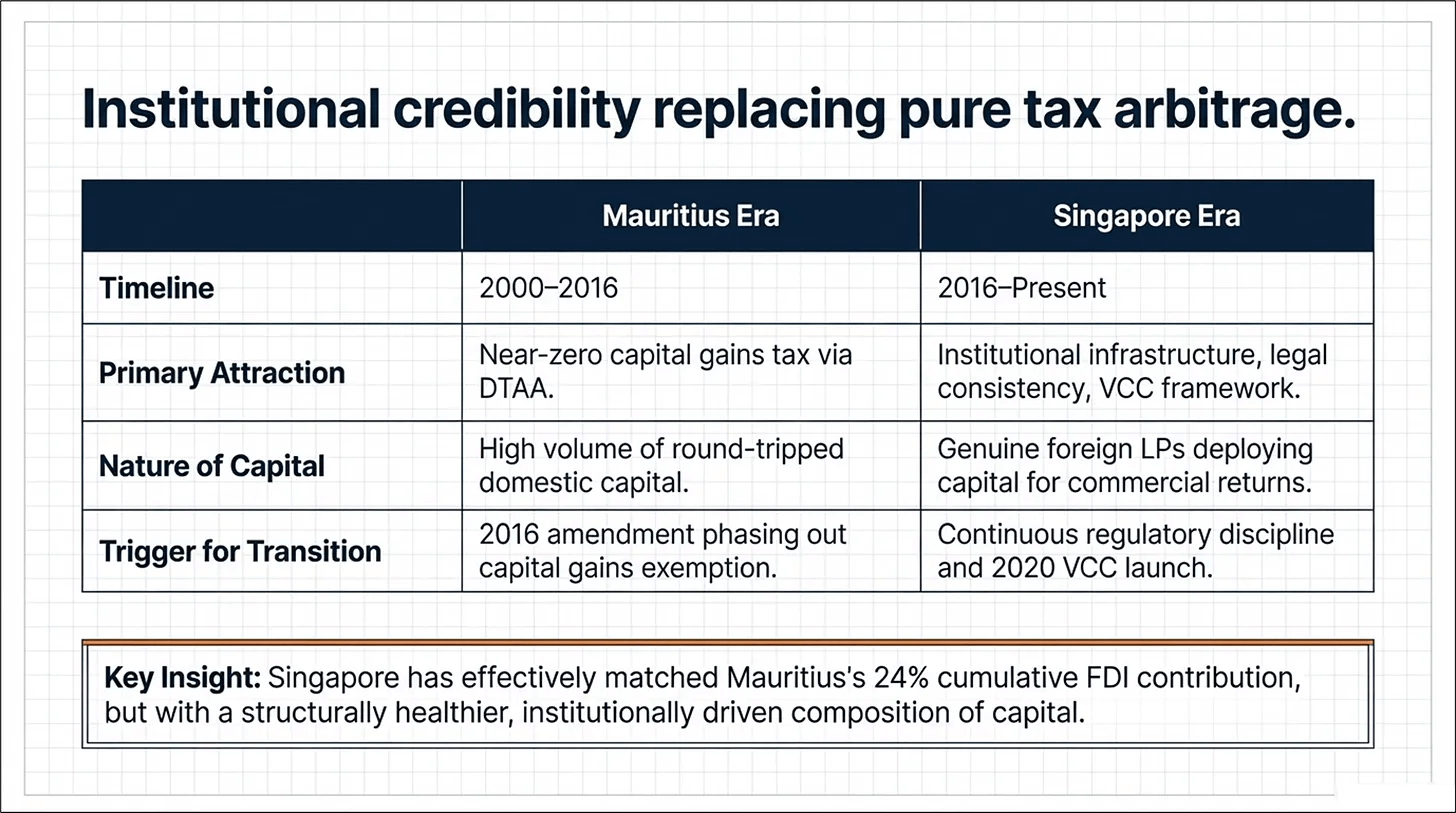
Singapore’s rise to the top position is not simply a replacement of one routing hub with another.
The character of the capital is different.
Singapore-routed investment is predominantly institutional; global funds with genuine foreign LPs, deploying capital into Indian companies for commercial returns. It is less susceptible to the round-tripping dynamics that characterised the Mauritius era.
The cumulative numbers reflect the transition.
From 2000 to 2025, Singapore accounts for approximately 25% of total FDI into India, with Mauritius at roughly 24%.
Singapore has, over a long enough time horizon, effectively matched Mauritius’s cumulative contribution; but with a structurally healthier composition of capital.
The Pressure Points Singapore Should Not Ignore.
This is where honest analysis requires a note of caution.
Singapore’s position as India’s primary capital conduit is not guaranteed. Several forces are actively working to reshape it.
India has become more sophisticated in its scrutiny of treaty-based structures.
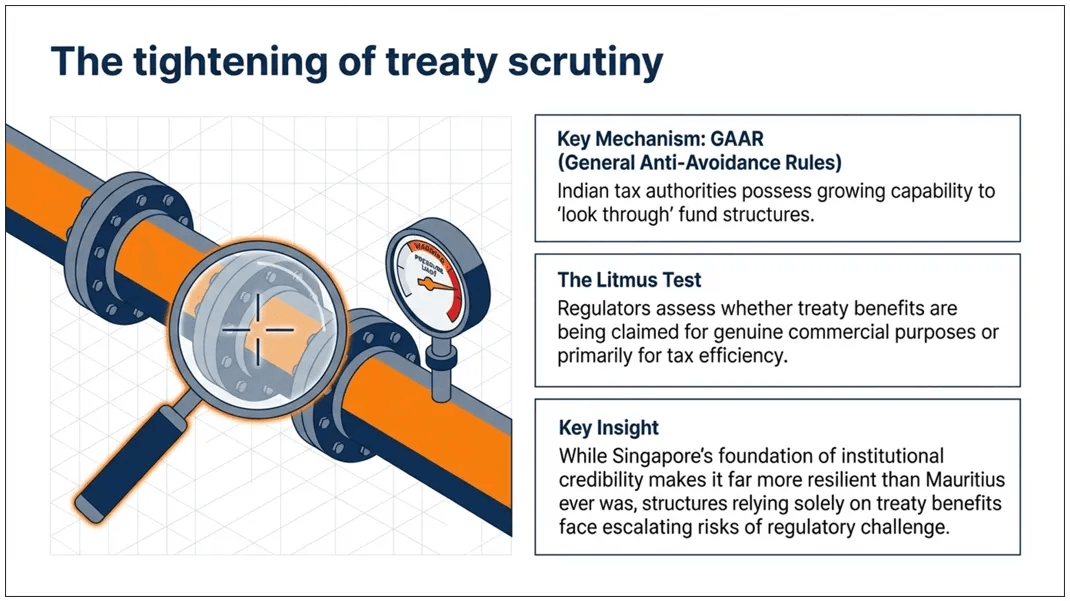
The General Anti-Avoidance Rules, known as GAAR, give Indian tax authorities the power to look through fund structures and assess whether treaty benefits are being claimed for genuine commercial purposes or primarily for tax efficiency. As GAAR enforcement matures, structures that rely primarily on treaty benefit face increasing risk of challenge.
Singapore’s advantage is stronger than Mauritius’s ever was; because it is built on institutional credibility rather than pure tax benefit; but the environment is tightening.
GIFT City,
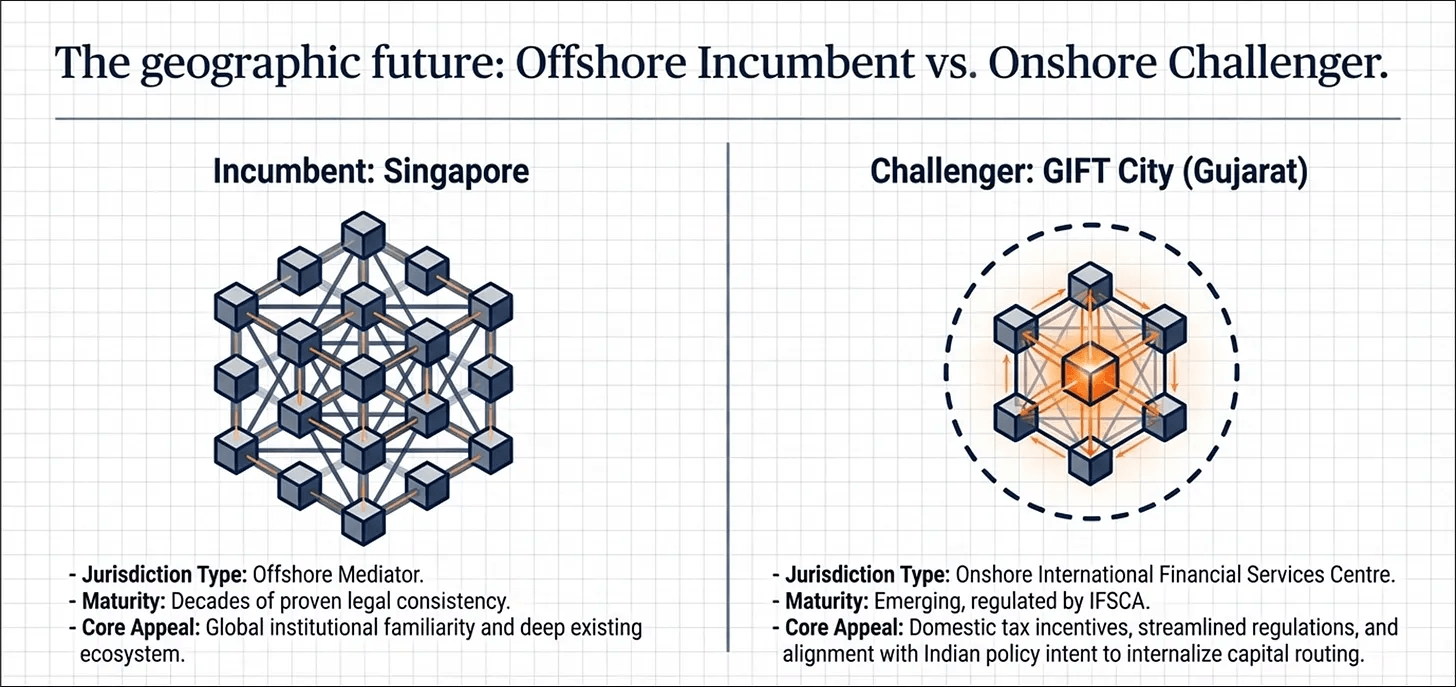
India’s own international financial services centre in Gujarat, is a more direct competitive challenge.
The Gujarat International Finance Tec-City, now regulated by the International Financial Services Centres Authority, or IFSCA, is attempting to build a domestic equivalent of what Singapore offers. It provides tax incentives, a streamlined regulatory framework, and a dedicated jurisdiction for international transactions.
The policy intent is clear: India would prefer that more of the capital routing infrastructure sit onshore.
If GIFT City delivers on its potential over the next decade, Singapore’s role will evolve; not disappear, but become more selective.
What Indian Investors Should Take From This?
There are two practical ways to engage with this picture:
The first is as an investment destination.
For Indian investors building their portfolios beyond domestic equities and real estate, Singapore offers access to S-REITs, investment-grade bonds, and globally diversified assets that are not easily accessible through Indian markets. These are mature instruments with institutional-quality governance.
They are worth understanding on their own terms.
The second, and more immediately useful lens, is analytical.
Understanding Singapore’s role in India’s capital flow makes you a more literate reader of financial news.
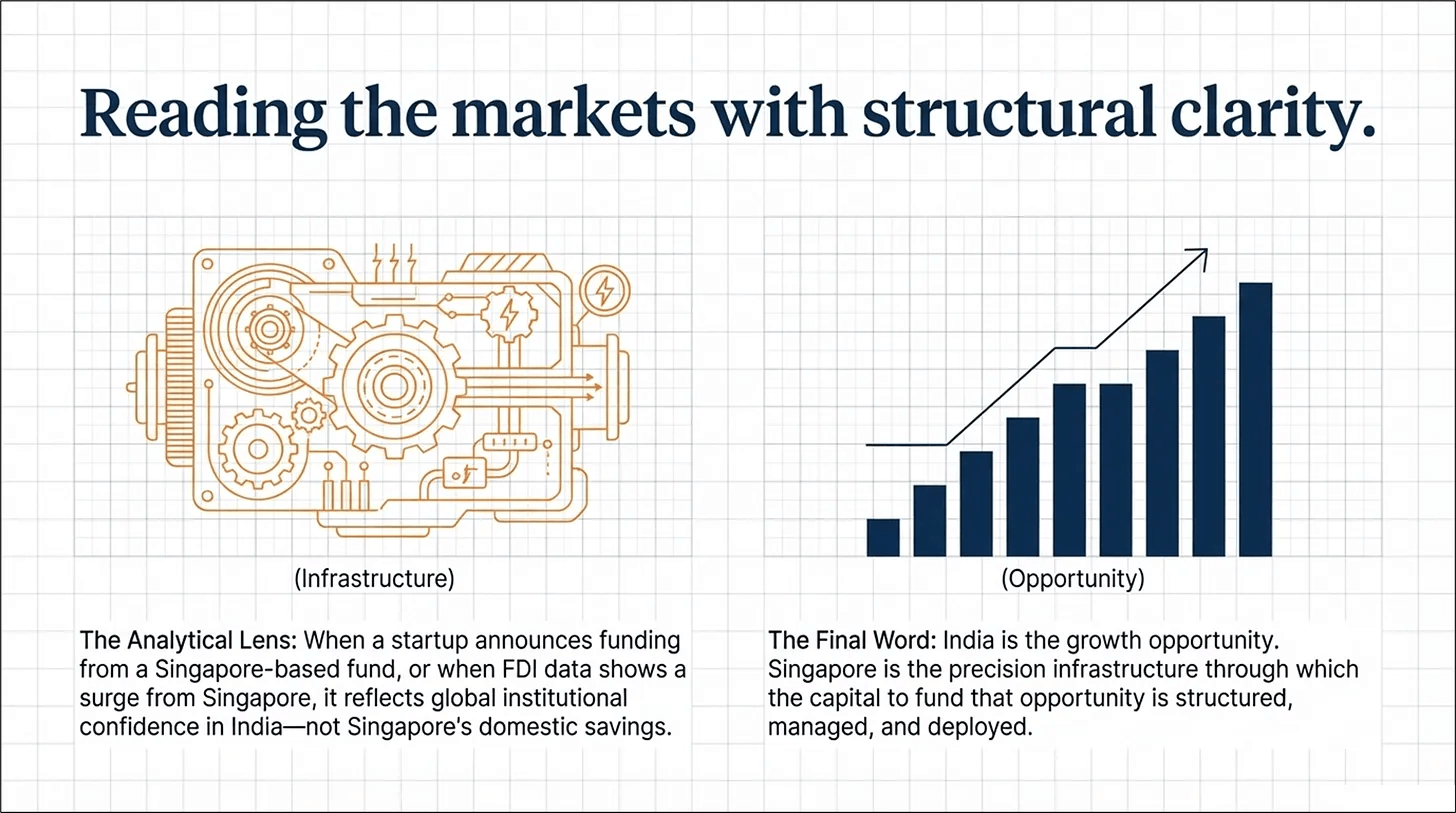
So when a startup announces a funding round from a Singapore-based fund, you now understand that the capital likely came from somewhere else and was structured through Singapore for legal and tax reasons.
So when FDI data shows a surge from Singapore, you understand it reflects institutional confidence in India, not Singapore’s domestic savings.
And when you see sectors like infrastructure and fintech attracting disproportionate foreign capital, you understand the institutional mechanics behind that concentration.
India is the growth opportunity. Singapore is the infrastructure through which a significant portion of the capital funding that opportunity arrives.
Both roles are real.
And the gap between investors who understand this distinction and those who don’t shows up in how clearly they read markets.
A Realistic Closing.
Singapore’s position in India’s capital story is substantial, well-earned, and for now; unchallenged.
It was not built on tax loopholes.
It was built on regulatory credibility, legal consistency, institutional infrastructure, and a fund structure framework that works.
The VCC, the MAS, and the DTAA network; these are not easy to replicate, and no other country has fully replicated them yet.
But the environment is changing. India is building its own answer in GIFT City.
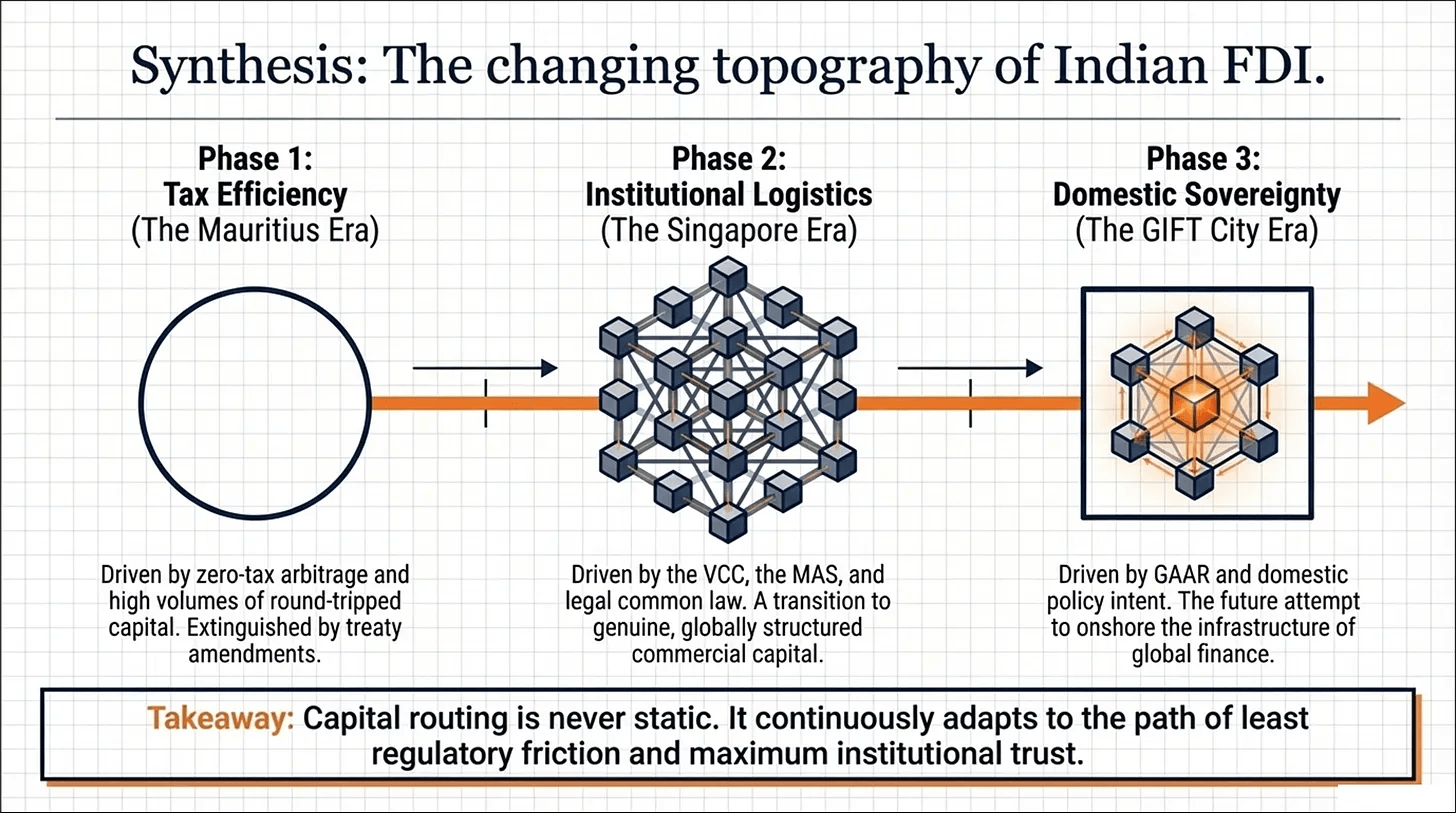
Indian regulators are looking at treaty structures more carefully. And global capital is always looking for the most efficient route, which means Singapore cannot rely on yesterday’s advantages indefinitely.
For the foreseeable future, Singapore will remain the dominant intermediary through which global capital reaches India.
The more interesting question, the one worth watching; is whether that dominance will still look the same a decade from now.
India is where the growth is. Singapore is where much of the capital funding that growth has been, and largely still is, structured, managed, and deployed.
That is the picture. All of it.
About Ethica Invest
Ethica Invest is a principled, Shariah-compliant investment platform that helps investors like you in identifying companies using well-defined criteria for finances, operations, and governance. Though grounded in Shariah guidelines, Ethica’s approach goes beyond any single faith by prioritizing openness, strong balance sheets, and responsible business practices.
Ethica Invest works with SEBI-registered analysts and seasoned investment experts who deliver organized, compliant analysis on stocks and other opportunities. Those interested in seeking more on Shariah-aligned investing, can connect with our Ethica team.
The goal is straightforward: empower investors with decisions based on ethics, solid data, and performance; not just stories.