
Syrma SGS: The Fellowship of Electronics
Fellowship.
A word that means more than togetherness — it means purpose, trust, and shared strength.
And J.R.R. Tolkien captured this idea beautifully in, “The Lord of the Rings” — where nine companions, each different in nature and ability, came together around one purpose larger greater than themselves: to destroy the One Ring of the Dark Lord Sauron and save Middle-earth from his dark power.

That is what makes fellowship powerful. It is not about being the same. It is about becoming stronger together.
 Ethica Invest
Serious about long-term investing?
Unlock our professionally managed portfolios.
That same idea quietly defines the story of Syrma and SGS. Two companies, different in their roots and strengths, eventually came together around one shared purpose: to build a stronger electronics platform.
And that is where this story begins — not with a merger alone, but with the history of two businesses, how they evolved separately, and how they finally met on the same path to become Syrma SGS Technology.
History and Evolution
The story begins not with a merger document, but with two businesses walking separate roads.
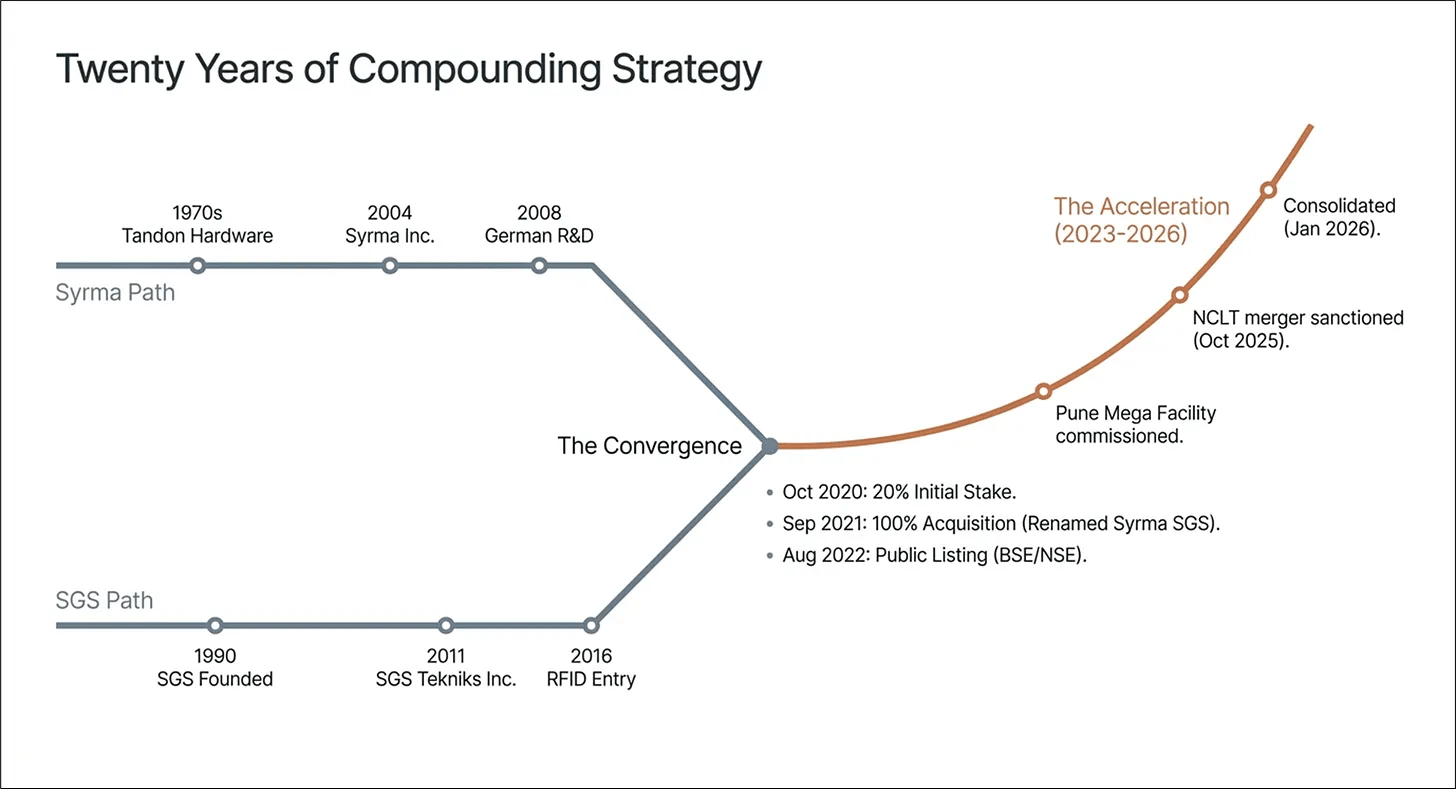
Syrma’s road started in the late 1970s.
With the Tandon group — an Indian industrial house that was building world-class hardware long before India had any real electronics industry to speak of.
Tandon Magnetics made disk drives for IBM. Tandon Motors was a joint venture with engineering firm Kollmorgen. Both were eventually sold — to Western Digital and Danaher respectively.
These were not some small bets.
They were globally competitive hardware businesses, and the discipline of building complex electronics for demanding global customers became the founding DNA that Syrma would later inherit.
By 2000, the group had shifted into modern Electronics Manufacturing Services through Celetronix, a venture with Flex. This was the pivot from old-world hardware into scalable contract manufacturing. And it was from this lineage that Syrma Technology Private Limited was formally incorporated on 23 August 2004.
What followed after this was a decade of quiet, deliberate building.
A manufacturing unit in MEPZ-SEZ Chennai in 2006. An R&D centre in Germany in 2008. A domestic R&D department in 2010. A Manesar facility in 2014. Bengaluru in 2016, alongside the launch of RFID manufacturing — a precision, IP-driven product line that most Indian EMS companies were not even attempting.
And then in 2018, Syrma formalised its product development capability through the Zone of Autonomous Creation, an internal unit focused on proprietary product engineering, not just assembly.
Syrma was export-oriented, design-capable, and building the kind of engineering depth that earns stickier customer relationships. That is a different business model from standard contract manufacturing; and it matters enormously for the margins you can defend over time.
Ethica Invest
Serious about long-term investing?
Unlock our professionally managed portfolios.
SGS’s road ran differently.
SGS Tekniks began in 1990 as a domestic-focused electronics manufacturer serving automotive customers in North India.
Where Syrma looked outward, SGS looked inward. Where Syrma chased engineering differentiation.
SGS built its reputation through manufacturing reliability and deep relationships with domestic OEMs. The entity, SGS Tekniks Manufacturing Private Limited, was incorporated in 2011. A related company, SGS Infosystems, followed in 2012. By 2016, SGS had also entered RFID manufacturing; a sign it was not standing still either.
Think of the two companies simply:
Syrma had global exposure and design capability. SGS had domestic depth and manufacturing credibility.
Neither was the complete picture.
But together, they were.
The combination happened in stages.
In October 2020, Syrma acquired 20% of SGS; and notably, the original share purchase agreement already referenced a “Proposed Merger.”
This was never meant to be a passive investment.
By September 2021, Syrma acquired the remaining 80%, making SGS a wholly owned subsidiary. The company immediately renamed itself Syrma SGS Technology Private Limited, converted to a public company in October 2021, and listed on BSE and NSE in August 2022.
Post-listing, the expansion has been deliberate.
In 2023, Syrma SGS acquired 51% of Johari Digital Healthcare, entering medical electronics.
The Pune Mega Facility was commissioned.
A design and prototype centre opened in Stuttgart.
A MedTech Design Centre was set up in Pune.
New subsidiaries were created across design, engineering, and semiconductors.
Then came the legal cleanup.
In November 2023, the board approved a two-step amalgamation: SGS Infosystems would merge into SGS Tekniks, and SGS Tekniks would then merge into the listed parent. The NCLT sanctioned the scheme in October 2025. And by January 2026, it had been given full accounting effect; one clean, consolidated entity.
The most recent moves go further.
A PCB manufacturing joint venture with South Korea’s Shinhyup Electronics.
A high-reliability electronics JV with Italy’s Elemaster, targeting rail, industrial, and medical segments.
A 60% acquisition of Elcome Integrated Systems — a defence and maritime electronics company founded in 1978.
And groundwork for a new PCB plant in Andhra Pradesh.
What started as a Tandon group hardware operation in the 1970s is today a multi-segment electronics platform with upstream PCB ambitions, medtech presence, defence exposure, and global engineering partnerships.
That is not a series of unrelated events. It is twenty years of compounding strategic decisions.
The Present — What Syrma SGS Actually Does
First, set aside the phrase “contract manufacturer.” It is technically accurate, but it misses what makes this business interesting.
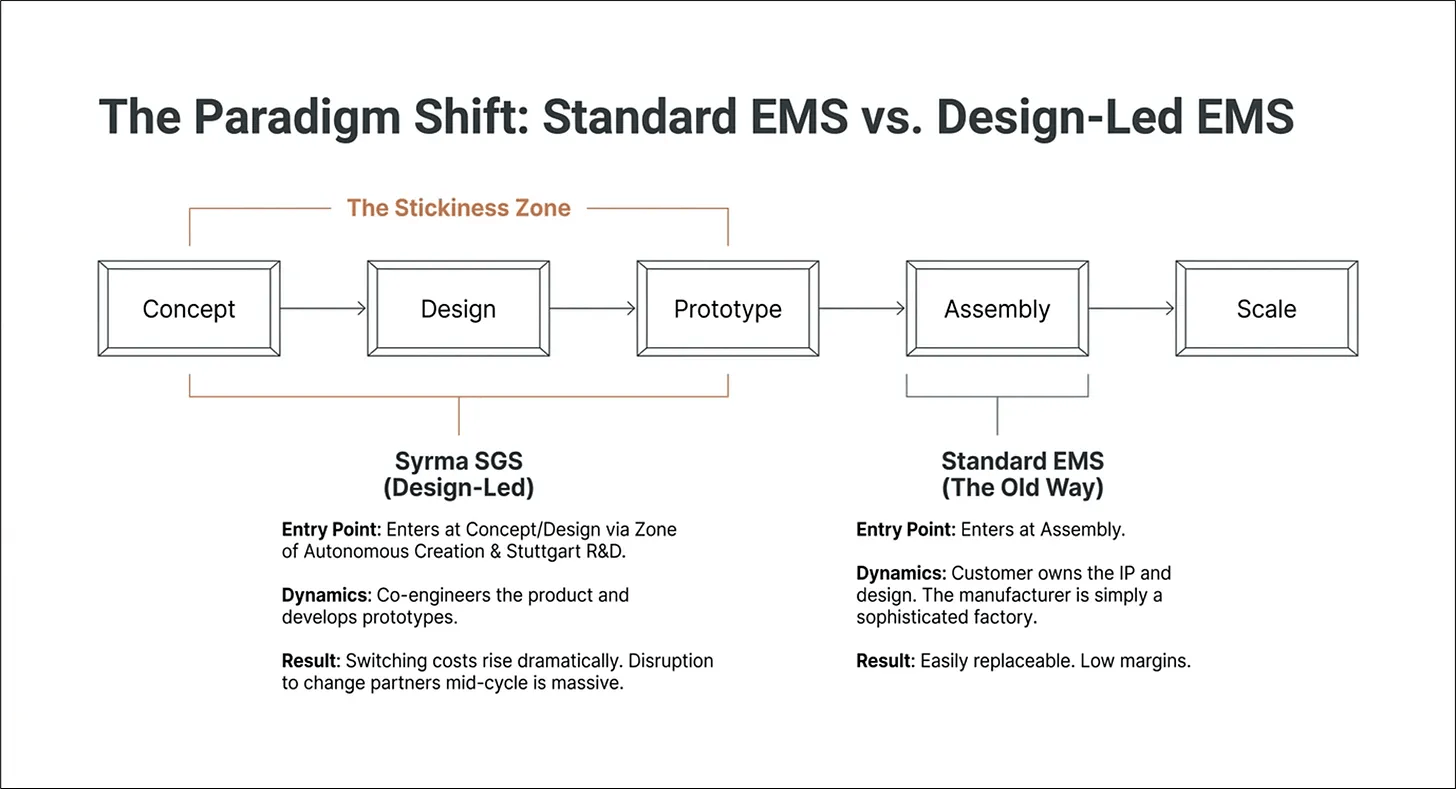
A standard EMS company receives a design from the customer, manufactures the product, and gets paid a fee. The customer owns the IP, the design, and the relationship. The manufacturer is essentially a sophisticated factory.
Syrma SGS works differently.
It engages with customers at the design stage — helping engineer the product, develop prototypes, and then manufacture at scale. This embeds Syrma SGS deeper into the customer’s product lifecycle. The relationship becomes stickier. Switching costs rise. And the value the company can capture is meaningfully higher than what a pure assembler earns.
This is what “design-led EMS” actually means in practice. And it took twenty years to build.
The revenue mix
Business operations today spans industrial electronics, consumer products, IT and storage hardware, automotive electronics, healthcare devices, and railways, with defence now being added to that list.
No single segment dominates.
Industrial and consumer have historically been the larger contributors, but the mix is shifting toward higher-value verticals over time.
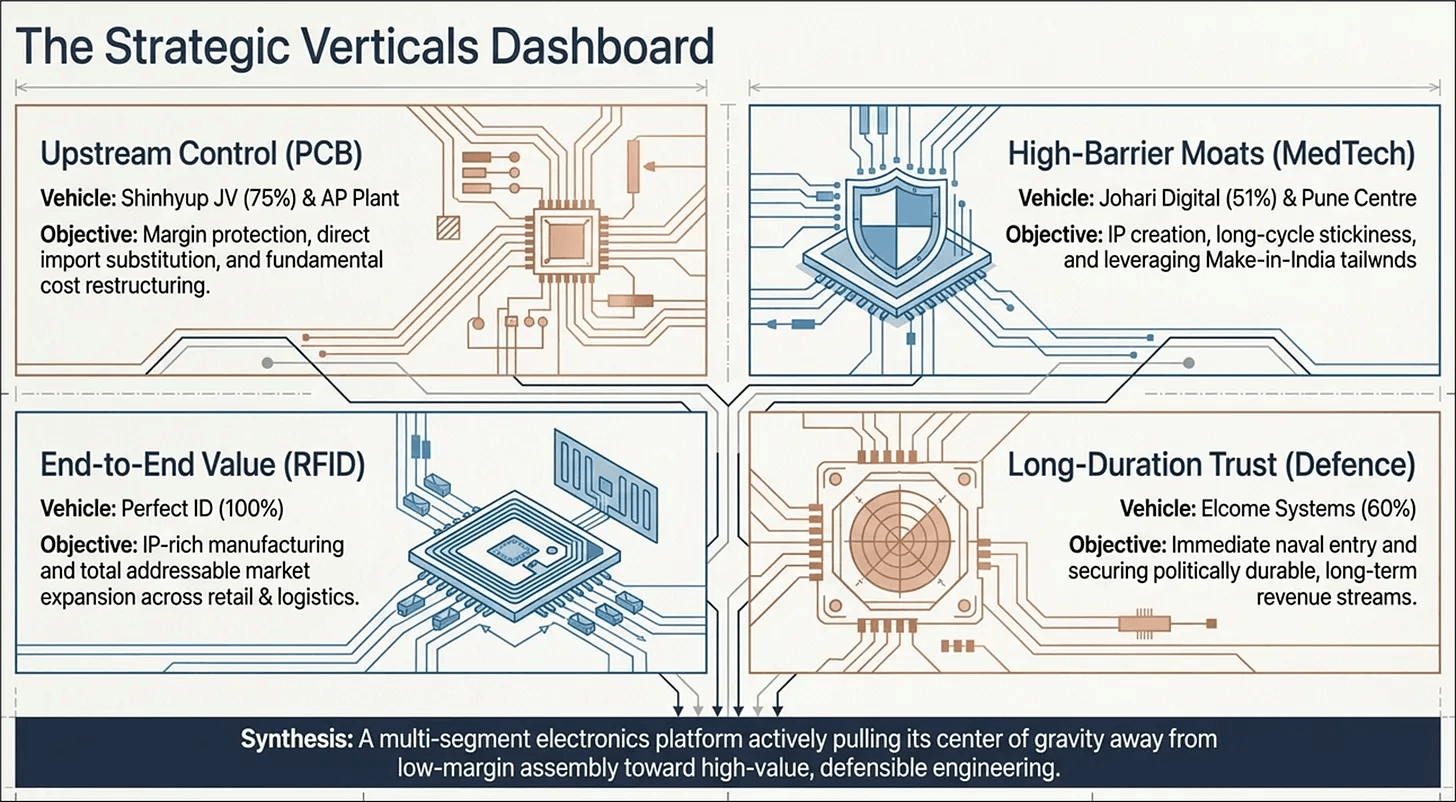
PCB manufacturing is the company’s biggest upstream bet.
India currently imports the vast majority of its printed circuit boards, primarily from China. The government’s PLI for electronics components is specifically aimed at fixing this.
Syrma SGS’s JV with Shinhyup Electronics; now renamed Shinhyup Syrma Circuits Private Limited, with Syrma holding 75%, is a direct play on this opportunity. A second PCB facility is being developed in Andhra Pradesh.
If these come online as planned, Syrma SGS will go from being a buyer of PCBs to being a manufacturer of them. That changes the cost structure and competitive positioning of the whole business.
RFID is the part of the business that tends to get the least attention and arguably deserves the most.
Syrma SGS is one of the very few Indian companies with end-to-end RFID capability; manufacturing products from scratch, not just assembling imported components.
The company strengthened this through the acquisition of Perfect ID in 2021. RFID is used in retail, logistics, healthcare, government programmes, and industrial automation.
The margins here are better than standard EMS, the IP content is higher, and the addressable market is expanding as more industries automate tracking and identification.
MedTech entered the picture through the 2023 acquisition of Johari Digital Healthcare.
Medical electronics is a high-barrier segment; long product cycles, strict quality certifications, and limited room for error.
Syrma SGS backed this with dedicated infrastructure: a MedTech Design Centre in Pune where engineering teams work on product development, not just manufacturing execution.
Healthcare electronics in India remains significantly underpenetrated, and the government’s push for domestic medical device manufacturing adds a policy tailwind.
Defence is the newest and potentially the most consequential addition.
The 60% acquisition of Elcome Integrated Systems in late 2025 gave Syrma SGS immediate entry into naval and maritime electronics; a domain where Elcome has been operating since 1978.
You cannot manufacture credibility in defence. It takes decades.
By acquiring Elcome, Syrma SGS bought what would have been impossible to build quickly from scratch: domain depth, customer relationships, and a track record.
Globally,
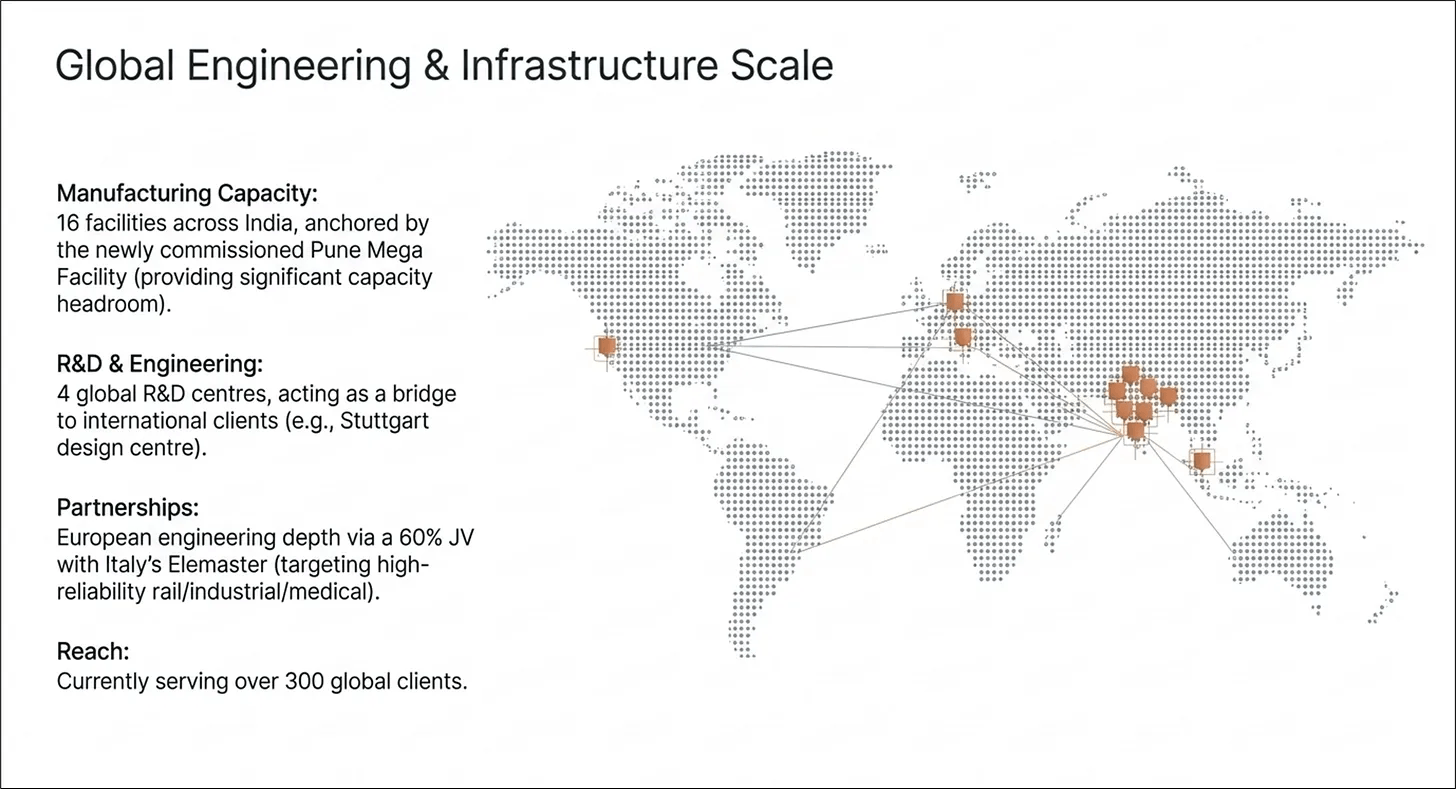
The company has also been building partnerships that bring European engineering capability into the platform.
The JV with Italy’s Elemaster; closed in April 2026 at 60% Syrma / 40% Elemaster; targets high-reliability electronics for rail, medical, and industrial applications. The Stuttgart design centre has been active for years as a bridge to European customers.
As of today, the company operates 16 manufacturing facilities across India, four global R&D centres, and serves more than 300 clients. The Pune Mega Facility, recently commissioned, adds significant capacity headroom for the next phase of growth.
Thesis and Anti-Thesis
Every investment has two honest stories. Here is how both look for Syrma SGS.
The Thesis
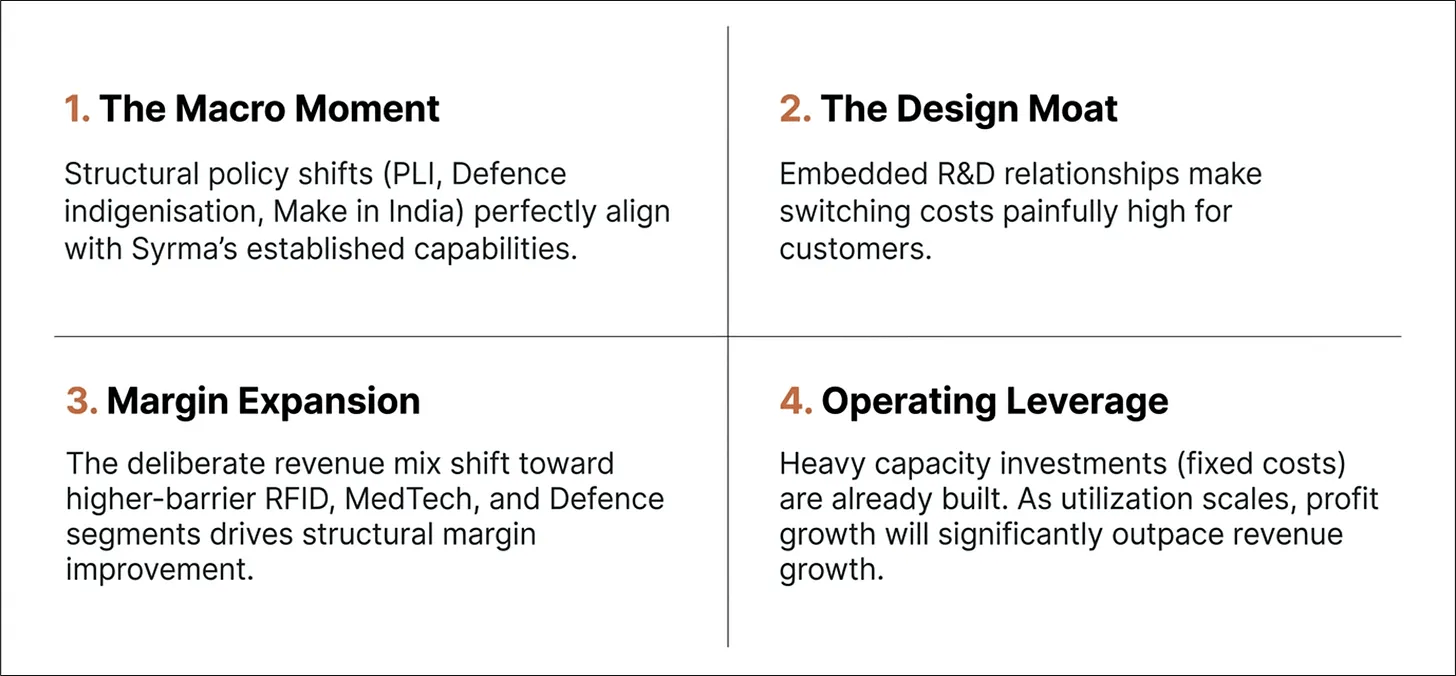
The macro moment is real.
India has long been dependent on imported electronics — and that dependence has become a recognised problem at the policy level.
PLI schemes for electronics and components, defence indigenisation mandates, Make in India for medical devices, domestic PCB push — these all reflect a structural shift in how India wants to position itself in the global electronics supply chain.
Syrma SGS is not waiting for this opportunity. It is already positioned across most of the segments this shift is creating demand for.
Design-led EMS is a genuine moat.
A company that only manufactures can be replaced by whoever offers a lower price. A company that also designed the product with the customer is much harder to replace. The cost and disruption of switching a design partner mid-cycle is significant.
Syrma SGS has been building this kind of embedded relationship for years through its R&D infrastructure in India and Germany, its Zone of Autonomous Creation, and its Stuttgart facility. These are not decorative assets. They are the foundation of a stickier, more defensible business.
The business mix is improving.
RFID, MedTech, PCB manufacturing, and defence are all higher-margin, higher-barrier businesses than standard EMS. Each addition is not just a new revenue line; it is a margin expansion story and a differentiation story. The mix today is still weighted toward lower-margin segments, but the direction of travel is clear.
Operating leverage is ahead.
Syrma SGS has been investing heavily in capacity; and much of it is not yet fully utilised.
In manufacturing, fixed costs arrive before revenues do. As utilisation rises and revenues scale into the built capacity, profit growth can outpace revenue growth significantly. Investors who understand this dynamic know that the most interesting entry points in manufacturing businesses are often during the investment phase, before the leverage kicks in.
Defence is a long-duration bet.
India’s defence indigenisation push is structural and politically durable. Customer relationships in defence last decades. The Elcome acquisition gave Syrma SGS an immediate and credible seat at that table. That is not a small thing.
The Anti-Thesis
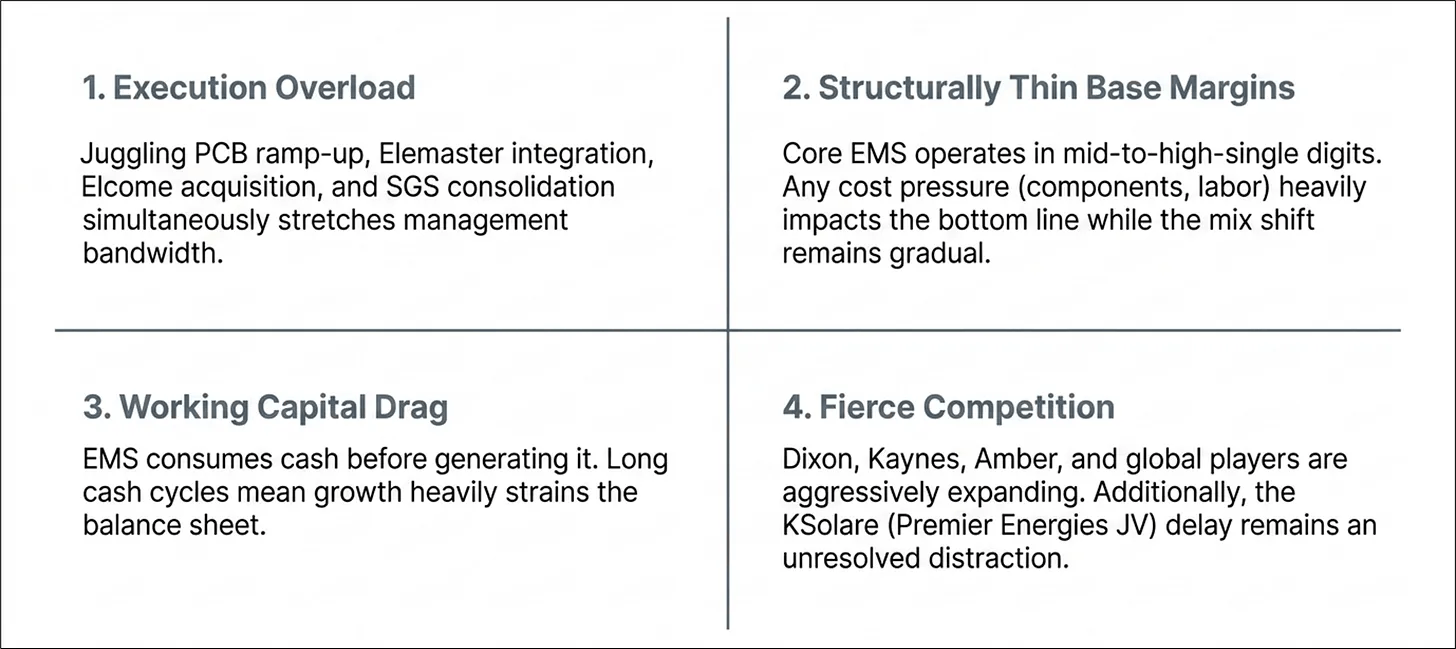
Execution is the central risk.
Syrma SGS is running multiple large and complex initiatives simultaneously; PCB JV ramp-up, Elemaster JV integration, Elcome acquisition, MedTech scaling, Pune Mega Facility utilisation, and post-merger consolidation of SGS. Each of these is demanding on its own. Together, they require enormous management bandwidth, capital discipline, and operational focus.
The risk is not that any single initiative fails.
The risk is that doing too many things at once means none of them get the attention they need. This is the most important thing for investors to monitor.
Margins are thin and improvement is slow.
EMS is structurally a thin-margin business. EBITDA margins in the mid-to-high-single digits leave very little room for error. Any cost pressure — components, labour, logistics, currency — flows directly into profitability.
The shift toward higher-margin businesses is happening, but it is gradual.
Until RFID, MedTech, PCB, and defence become a meaningfully larger share of revenues, the margin profile will remain constrained by the weight of the core EMS business.
Working capital is a structural drag.
EMS businesses consume cash before they generate it. You source components, manufacture, and then wait to be paid.
The cash cycle is long.
Syrma SGS is simultaneously building capacity, integrating acquisitions, and managing this cycle at scale. If growth slows or a large customer delays payments, the balance sheet can come under pressure quickly.
Competition is not standing still.
Dixon Technologies, Kaynes Technology, Amber Enterprises, and others are pursuing similar opportunities. Global players are also expanding in India. Differentiation needs to be actively maintained, not assumed.
The KSolare chapter is unresolved.
The joint venture with Premier Energies for solar inverter manufacturing has had its long-stop date extended multiple times. That pattern, however small, deserves attention. Investors should wait for clarity before assigning value to it.
The Balanced View
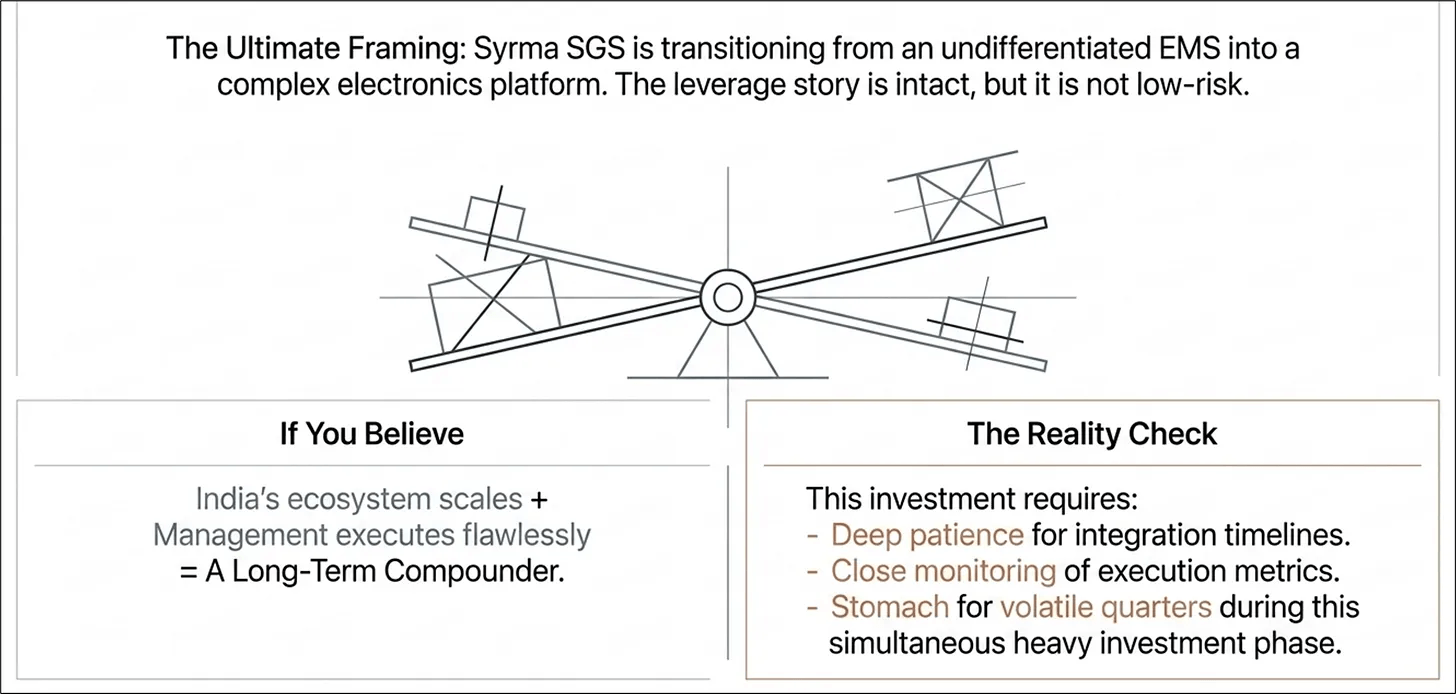
The structural tailwinds are real. The policy environment is supportive. The business model is becoming more differentiated, and the operating leverage story is intact as long as execution holds.
But this is not a simple or low-risk story. Margins are thin. The integration pipeline is busy. Many of the new businesses will take years to contribute meaningfully to profitability. And the management team is being asked to execute across a wide front simultaneously.
The honest investor framing is this:
If you believe India’s electronics manufacturing ecosystem will scale significantly over the next decade, and if you believe Syrma SGS’s management can execute without losing focus; then the business has the ingredients of a long-term compounder.
It requires patience. It requires watching execution closely.
And it requires comfort with the reality that a company building several new things at once will have quarters that disappoint before the full picture becomes clear.
The fellowship has formed. The path ahead is long.
Whether every member of it delivers on the journey; that is the question this investment ultimately rests on.
About Ethica Invest
Ethica Invest is a principled, Shariah-compliant investment platform that helps investors like you in identifying companies using well-defined criteria for finances, operations, and governance. Though grounded in Shariah guidelines, Ethica’s approach goes beyond any single faith by prioritizing openness, strong balance sheets, and responsible business practices.
Ethica Invest works with SEBI-registered analysts and seasoned investment experts who deliver organized, compliant analysis on stocks and other opportunities. Those interested in seeking more on Shariah-aligned investing, can connect with our Ethica team.
The goal is straightforward: empower investors with decisions based on ethics, solid data, and performance; not just stories.