Logistics in India: Two Businesses, Two DnAs
“Ye Duniya Kisi k Liye Nahi Rukti”.
You’ve definitely heard this dialogue before. And you already know what it means. But let me reverse it, just to understand; why?
“Kyuki, Ye Duniya Sab k Liye Chalti Hai”.
We all want things in our hands, at our doorsteps, and on store shelves. And for that to happen, there is a constant movement of goods.
 Ethica Invest
Serious about long-term investing?
Unlock our professionally managed portfolios.
From manufacturer → warehouse → transporter → distributor → retailer, and finally → to you.
Behind all of this, there is an entire system at work; ‘Logistics’.
And within this system, businesses operate across different parts of the chain to keep this constant movement going.
Some own infrastructure.
Some provide services.
Some orchestrate the entire chain.
Which is why two companies operating in the same space can look similar on the surface, yet be fundamentally different underneath.
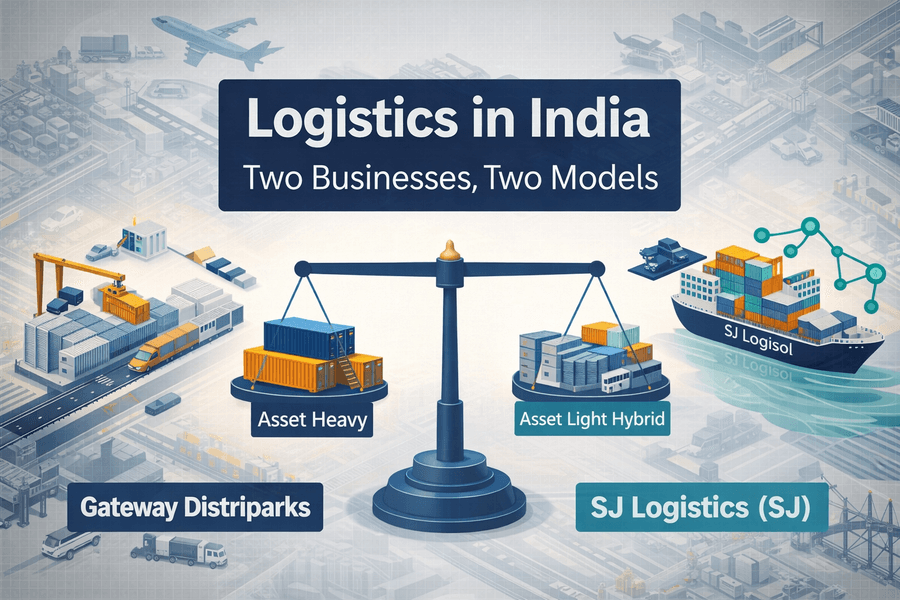
Gateway Distriparks Limited and SJ Logistics (India) Limited are two such companies.
To understand them, we first need to understand the system they operate in.
The Logistics Sector: More Than Just Trucks on a Highway
At its core, logistics is simple — getting things from point A to point B.
In practice, it is anything but.
The Value Chain — How Goods Actually Move?
Think of logistics as an ecosystem built on two broad pillars: logistics services and logistics infrastructure. One moves the goods; the other makes that movement possible.
Ethica Invest
Serious about long-term investing?
Unlock our professionally managed portfolios.
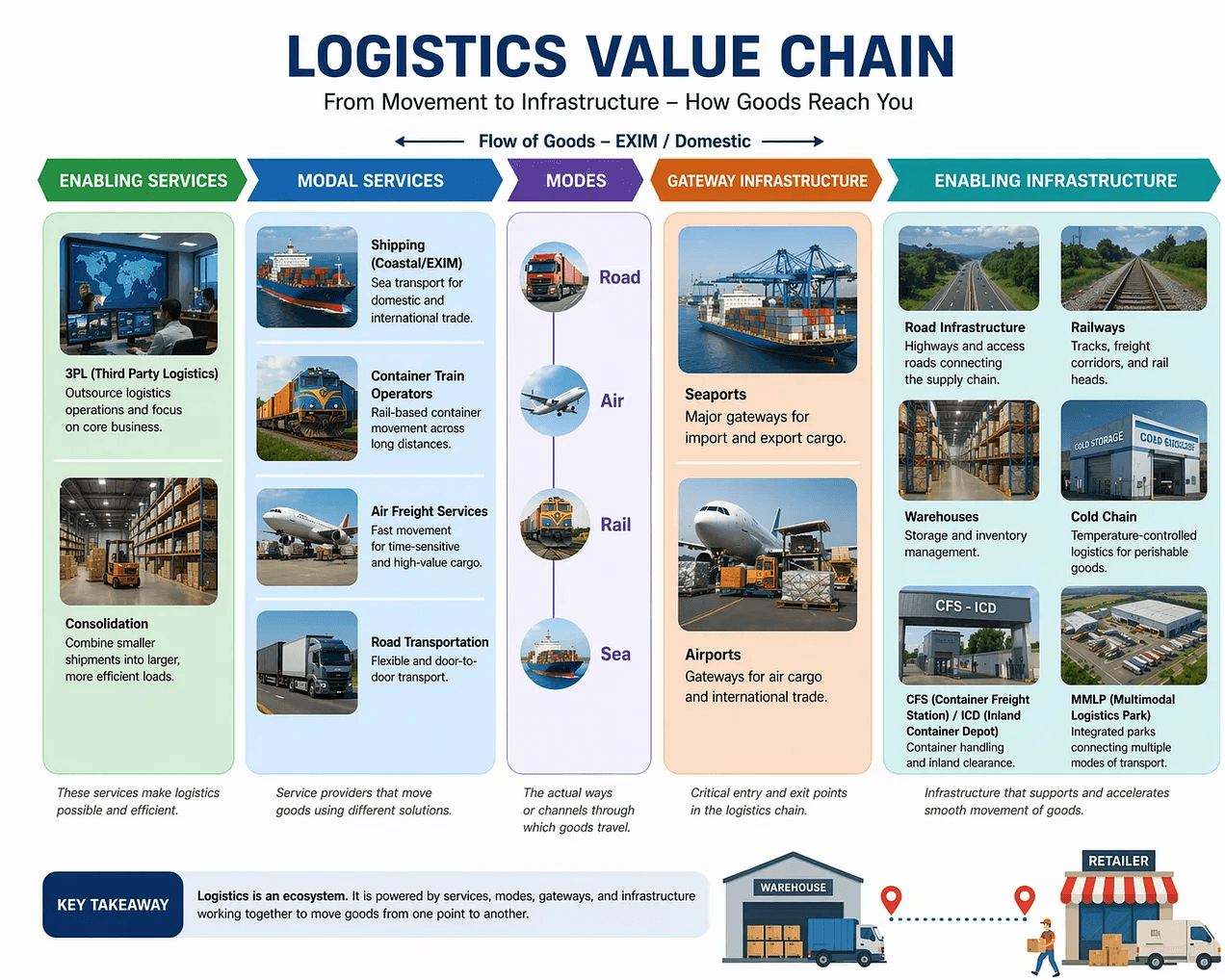
On the services side,
You have road transporters carrying goods across cities, container trains moving bulk cargo over long distances, shipping companies handling international trade, and air freight players moving time-sensitive cargo.
Then come the enablers — 3PL providers, freight forwarders, and consolidators — who don’t always move goods themselves but coordinate everything behind the scenes, stitching the entire journey together.
On the infrastructure side,
Seaports and airports act as entry and exit gates. Highways and railway tracks are the backbone of movement.
And then comes the supporting layer — warehouses, cold chains, ICDs, CFSs, and MMLPs — each playing a specific role in making sure goods flow smoothly without piling up at the wrong place at the wrong time.
Put simply, logistics is an entire ecosystem of movement, storage, coordination, and connectivity — working together to take a product from the factory floor to the final customer.
The Scale of the Market
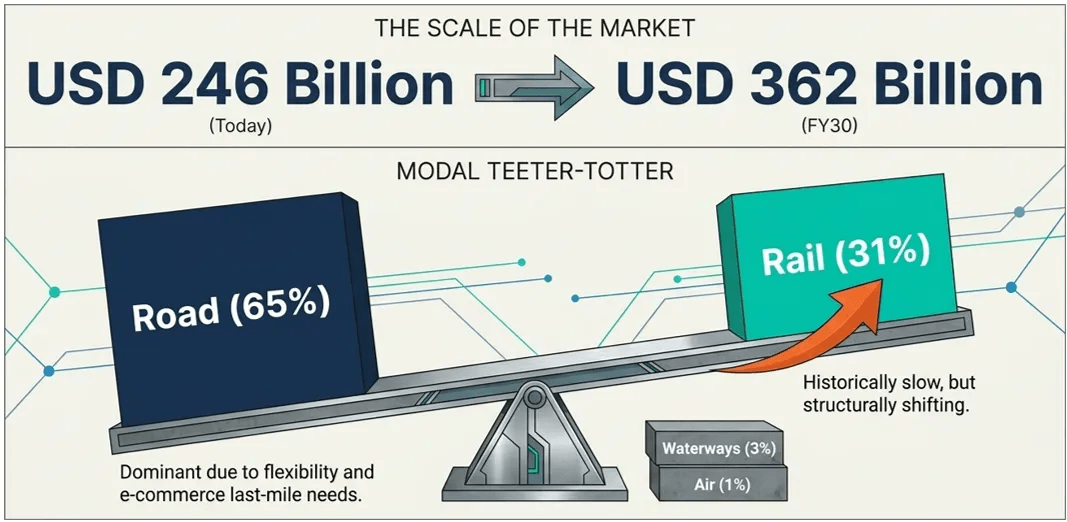
India’s logistics market is already massive — roughly USD 246 billion today — and is expected to grow to USD 362 billion by FY30. That is not a small number by any measure.
The government knows this too, which is why initiatives like the National Logistics Policy and PM GatiShakti are aggressively focused on making Indian logistics faster, cheaper, and more connected.
While in India; what we see is actually true.
Currently, road transport commands about 65% of India’s freight market. Rail handles around 31%, while waterways and air remain niche at 3% and 1% respectively. The dominance of road makes sense — it’s flexible, it reaches everywhere, and the e-commerce boom has only amplified its importance for last-mile delivery.
But here is where it gets interesting.
Rail is where the structural growth story is quietly building. And that matters enormously for understanding where the real investment opportunities lie.
A Sector in the Middle of a Structural Shift
For decades, Indian logistics was fragmented, cash-heavy, and paper-driven. Thousands of small truck operators, informal agents, and manual border checkposts defined the system.
That world is changing — and fast.
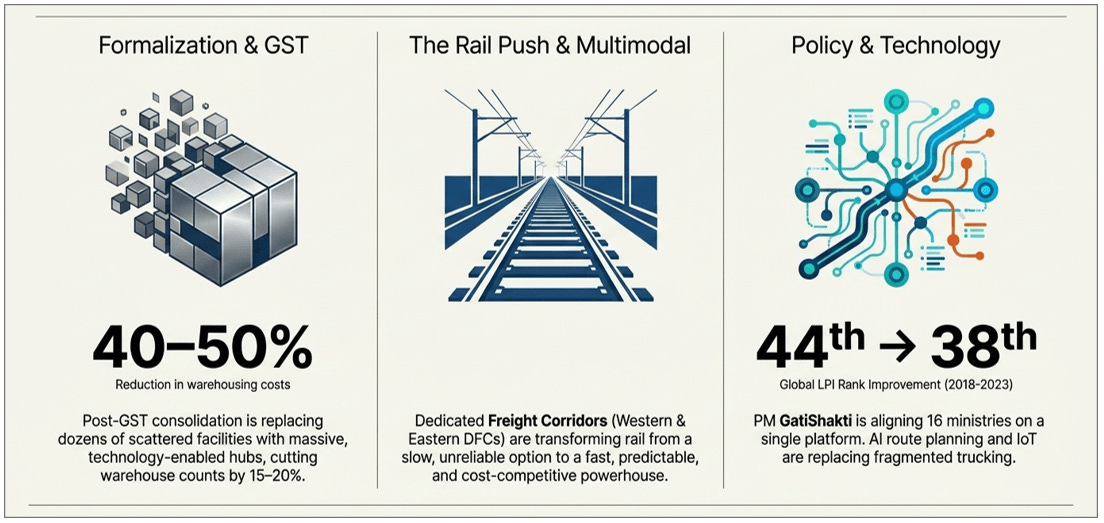
From fragmentation to formalisation.
The road transport industry is still heavily fragmented. Small and medium fleet operators control 85–90% of the market. But that’s slowly changing. Larger, organised players with the capital and technology to scale are gradually gaining ground.
Then came GST, and it quietly changed everything.
Before GST, logistics decisions were often driven by tax efficiency. After GST, the focus shifted to operational efficiency. Warehouses consolidated. Large, technology-enabled facilities replaced dozens of smaller ones. In some cases, companies reduced their warehouse count by 15–20% and cut warehousing costs by 40–50%. That’s a structural upgrade, not just a one-time saving.
The third shift is the push toward multimodal logistics and rail-linked assets.
For years, road dominated simply because rail was slow and unreliable. The government is now fixing that at scale. The Dedicated Freight Corridors — the Western DFC connecting Mumbai to Dadri, and the Eastern DFC connecting Dankuni to Ludhiana — are being built exclusively for freight. This is not an incremental improvement. It is a structural game-changer that will make rail faster, more predictable, and more cost-competitive over the coming years.
Policy support reinforces this shift.
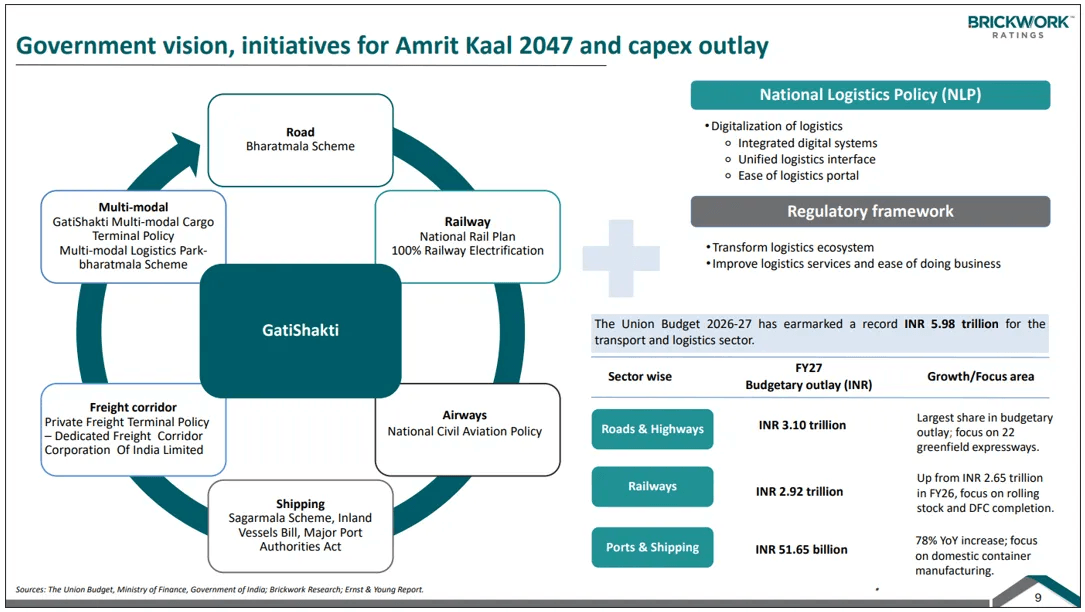
GatiShakti brings 16 ministries onto a single digital planning platform, improving coordination across infrastructure projects. The National Logistics Policy is targeting a top-25 global Logistics Performance Index ranking — India already moved from 44th in 2018 to 38th in 2023. Bharatmala is reshaping road connectivity, Sagarmala is building port-linked infrastructure, and Multimodal Logistics Parks are being developed as integrated hubs across the country.
Technology is becoming a separator too.
GPS tracking, AI-based route planning, IoT, robotics, and data analytics are helping organised players reduce fuel costs, shorten transit times, and automate warehousing. Smaller players, lacking capital and systems, simply cannot keep up.
And sustainability is no longer optional.
The shift toward rail and waterways, fleet modernisation, electric vehicles, and energy-efficient warehouses all point in the same direction. As regulations tighten, the organised players will gain further share.
The Full Picture: Tailwinds and Headwinds
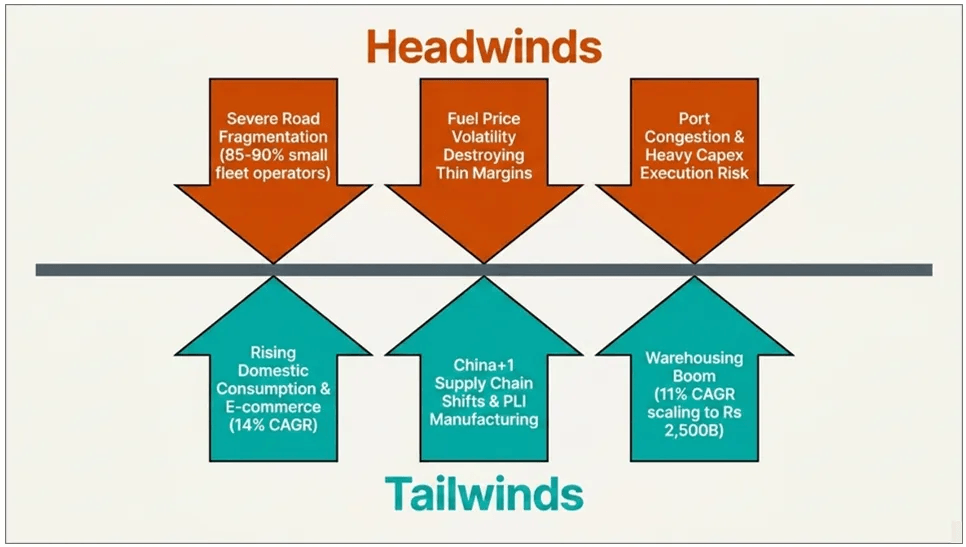
On the tailwinds side,
Rising domestic consumption means more goods being manufactured and sold — and therefore more goods that need to be moved. E-commerce amplifies this further, with express logistics expected to grow at a 14% CAGR, driven by stronger last-mile delivery, air cargo, and automated warehousing.
India’s Make-in-India push, PLI schemes, and the China+1 supply chain shift are bringing fresh industrial activity into the country, creating new logistics demand at every step.
Even the warehousing market alone is expected to grow at an 11% CAGR to reach Rs 2,300–2,500 billion by FY30.
On the headwinds side,
Road transportation remains fragmented and margins are thin. Fuel price volatility can quickly hurt profitability. Last-mile connectivity is still weak in several geographies. and port congestion continues to create bottlenecks despite government efforts.
And for capex-heavy businesses, execution risk is real — building freight terminals and developing ICDs requires capital, and delays in infrastructure rollout can hurt returns.
Now, with the sector mapped, let us place our two companies precisely within it.
Gateway Distriparks Limited: The Infrastructure Play
Gateway Distriparks Limited (GDL) sits at the infrastructure end of the logistics value chain. It is an asset-heavy business — meaning it owns the physical assets that make logistics possible, rather than simply coordinating the movement of goods.
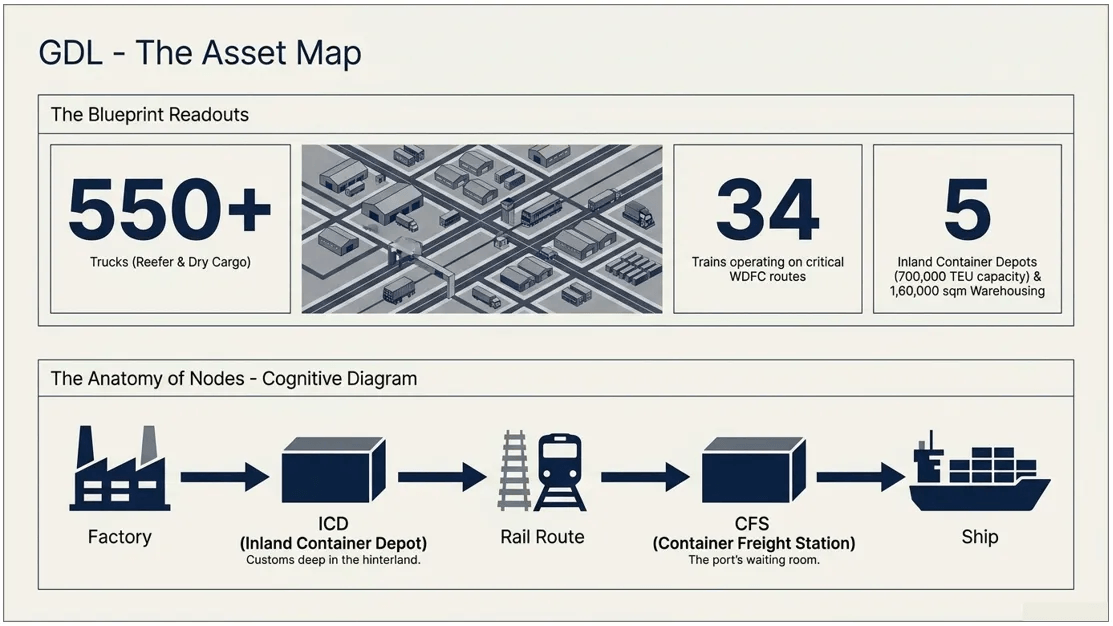
Start with road transportation.
GDL owns a fleet of 550+ trucks, capable of handling both 20-foot and 40-foot containers, including reefer (refrigerated) cargo.
Then comes rail.
It operates 34 trains providing transportation between ICD locations and Western Gateway Ports — JNPT, Mundra, and Pipavav.
Now, a quick explanation of two terms that are central to understanding GDL.
ICDs — Inland Container Depots — are located deep in the hinterland, cities like Delhi, Ahmedabad, or Nagpur. Their primary role is customs clearance and multi-modal connectivity in the interior of the country. GDL has 5 ICD locations catering to EXIM (export-import) business from Ahmedabad to Uttarakhand, with an installed capacity of 7,00,000 TEUs.
CFSs — Container Freight Stations — are located near ports, because ports are designed for loading and unloading ships, not for parking cargo. The CFS acts as the port’s waiting room, handling stuffing, de-stuffing, and temporary storage. When a ship arrives, containers move from the CFS to the ship in a precisely timed sequence.
GDL also has a warehousing capacity of 1,60,000 square metres and offers value-added services like reefer transportation — essentially giant fridges on wheels with backup power, ensuring food and pharmaceuticals stay cold from factory to port.
The Thesis
The core thesis for GDL is straightforward: it is the most strategically positioned player to benefit from India’s push toward rail-heavy freight.
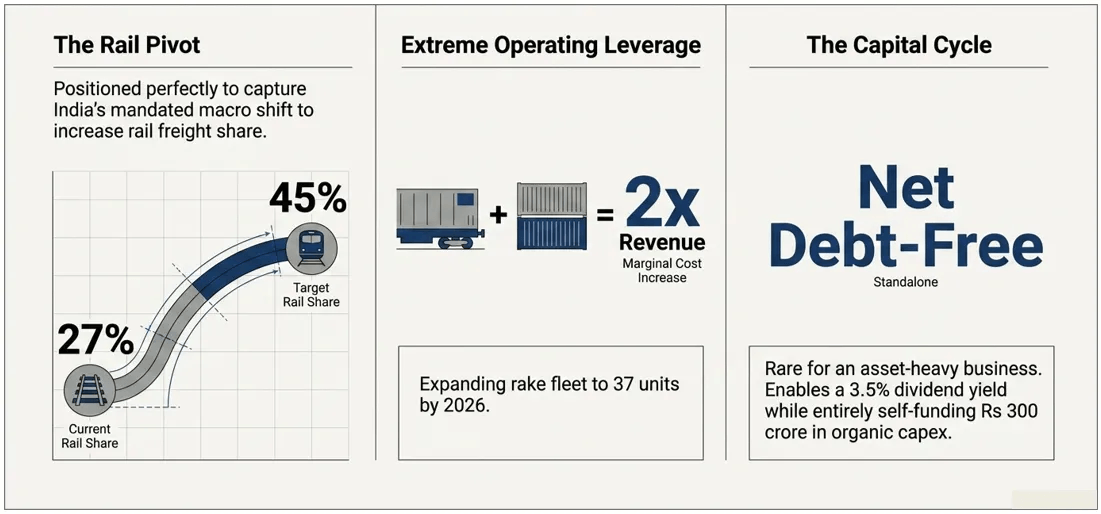
As India aims to increase rail’s share of total freight from 27% to 45%, GDL’s existing infrastructure becomes a critical gateway — literally and figuratively — for the Western Dedicated Freight Corridor.
One particularly powerful lever here is double stacking.
By stacking two containers on a single rake, GDL can effectively double its revenue per train run with only a marginal increase in operating costs. With plans to expand its rake fleet to 37 units by 2026, this is a direct operating leverage play.
The second pillar of the thesis is GDL’s physical moat.
Developing an ICD in the National Capital Region or acquiring a rail license is a multi-year, capital-intensive process. GDL’s established presence in Garhi Harsaru, Ludhiana, and the newly secured Ankleshwar MMLP gives it a captive customer base in India’s highest-density manufacturing clusters. That is not easily replicated.
And third — GDL is net debt-free on a standalone basis.
It is rare for an asset-heavy business. This allows the company to return capital to shareholders through dividends (a 3.5% yield) while still funding Rs 300 crore of organic capex. It is in the harvest phase of its capital cycle.
The Risks
But GDL’s story is not without complications.
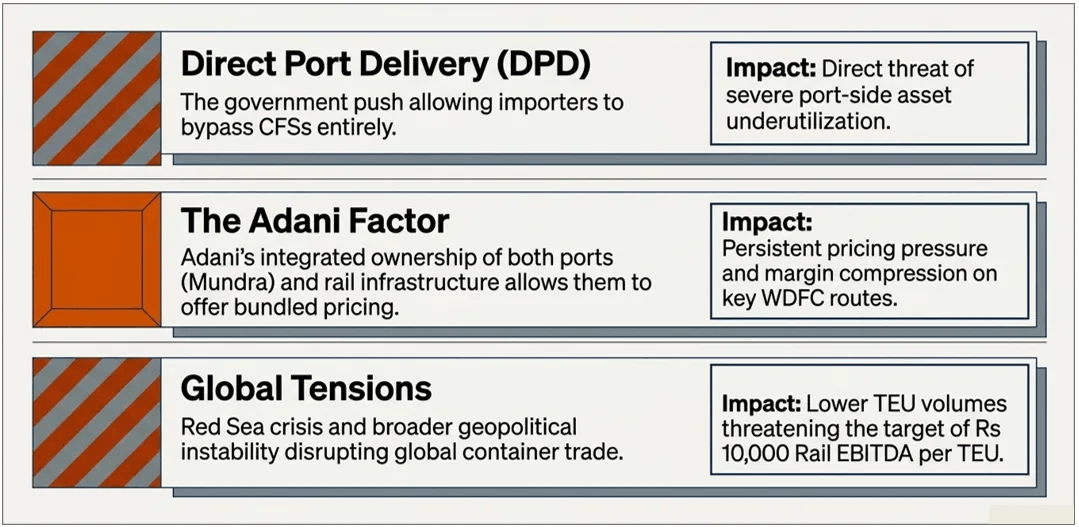
The most structural risk is Direct Port Delivery (DPD).
The government’s push toward DPD allows importers to collect containers directly from the port, bypassing CFSs entirely. If this trend accelerates, GDL’s port-side assets could face underutilisation, forcing a pivot to lower-margin warehousing.
Then there is Adani Logistics.
By owning both the ports (Mundra) and rail infrastructure, Adani can offer bundled pricing that GDL, as a standalone operator, simply cannot match. This creates a persistent risk of pricing pressure on the WDFC route.
Finally, GDL’s profitability is sensitive to global container trade dynamics.
The Red Sea crisis has already caused volume declines and increased operational costs. If geopolitical tensions persist, rail EBITDA per TEU could remain suppressed below the Rs 10,000 target.
SJ (India) Logistics Limited: The Services Play
SJ Logistics operates at the services end of the value chain. Unlike GDL, it is an asset-light business — it does not own the ships or the ports. Instead, it acts as the brain that coordinates the entire journey across the ocean.
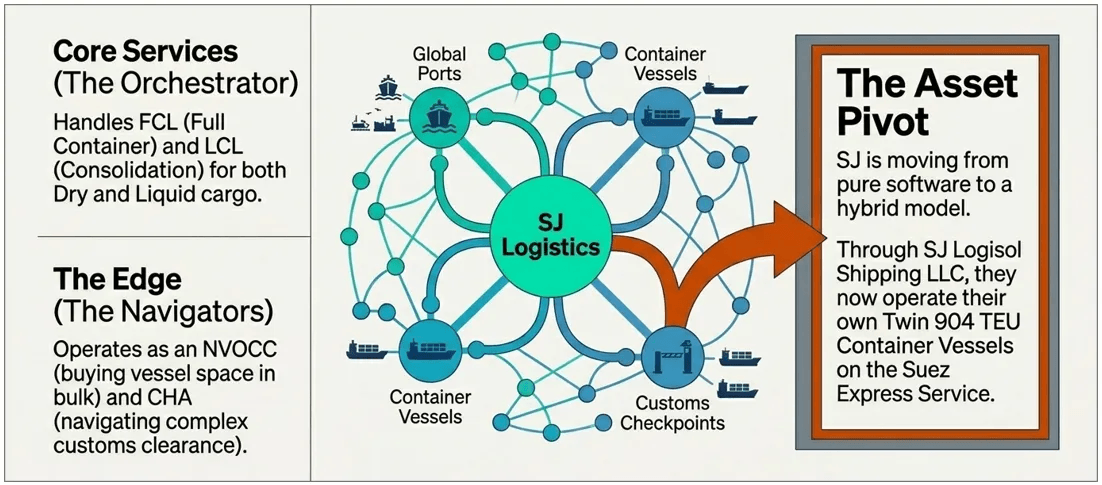
Think of SJ Logistics as the software to GDL’s hardware.
Its core services cover FCL (Full Container Load) shipments — where a single customer’s goods fill an entire container — and LCL (Less than Container Load) shipments, where SJ acts as a consolidator, packing smaller shipments from multiple customers into one container and sharing the cost.
SJ also handles both dry cargo (grains, electronics, industrial goods) and liquid cargo (petroleum, edible oils) through specialised vessels and safety protocols.
As an NVOCC (Non-Vessel Operating Common Carrier), it essentially acts as a shipping line for its clients — buying space in bulk from major vessel owners and passing the cost savings on.
It also operates as a CHA (Customs House Agent), navigating the regulatory complexity of customs so that cargo does not get stuck at a port gate because of a missing stamp or a wrong declaration.
What makes SJ Logistics particularly interesting, though, is that it has started moving beyond pure services into asset territory.
Through its subsidiary SJ Logisol Shipping LLC, Dubai, the company now operates its own vessels. Its Suez Express Service (SES) directly connects India to the Gulf and the Mediterranean using Twin 904 TEU Container Vessels — a move that fundamentally changes its position in the value chain.
The Thesis
SJ Logistics offers a classic “growth at a reasonable price” opportunity by targeting high-margin niches that larger, more diversified players tend to overlook.
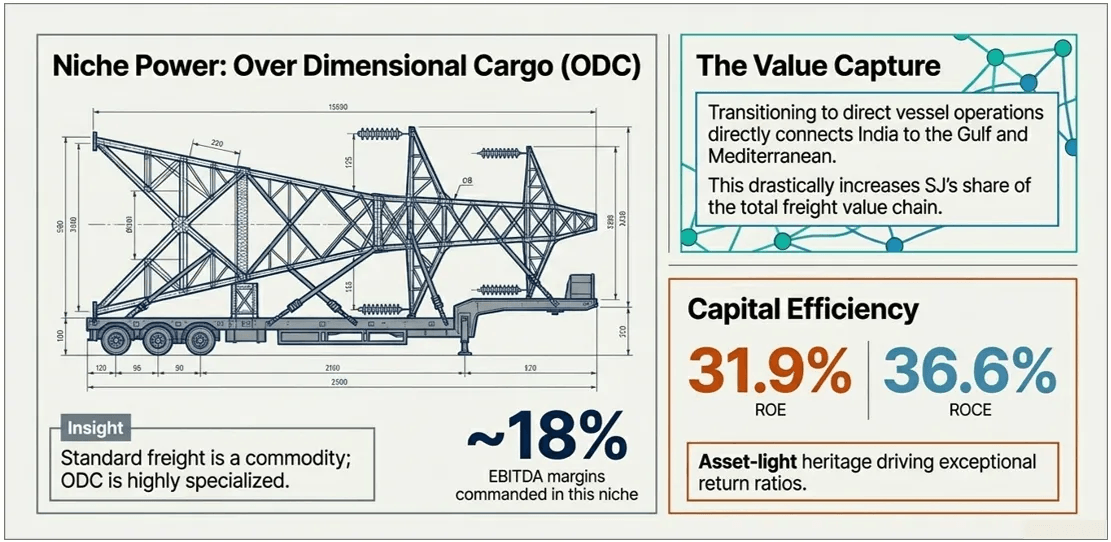
The most compelling piece is its specialisation in ODC (Over Dimensional Cargo).
Think transmission towers, earth-moving machinery, and other oversized industrial equipment shipped to underdeveloped ports in Africa and South America. Standard logistics is a commodity. ODC is a specialised service. And specialisation commands pricing power. SJ Logistics earns around 18% EBITDA margins here — well above its peers in conventional freight.
The second pillar is the vessel operation pivot.
By moving from freight forwarder to vessel operator, SJ is capturing a significantly larger share of the freight value chain. If it can maintain 90% utilisation on its shipping services, the unit economics improve dramatically — and that could trigger a meaningful re-rating of the stock.
And third, the return ratios are exceptional.
An ROE of 31.9% and ROCE of 36.6% make SJ Logistics one of the most capital-efficient players in the sector. Its asset-light heritage allows it to generate high returns even as it takes on more vessel-related exposure.
The Risks
The central risk for SJ Logistics is one that quietly hides behind strong profit numbers: working capital pressure.
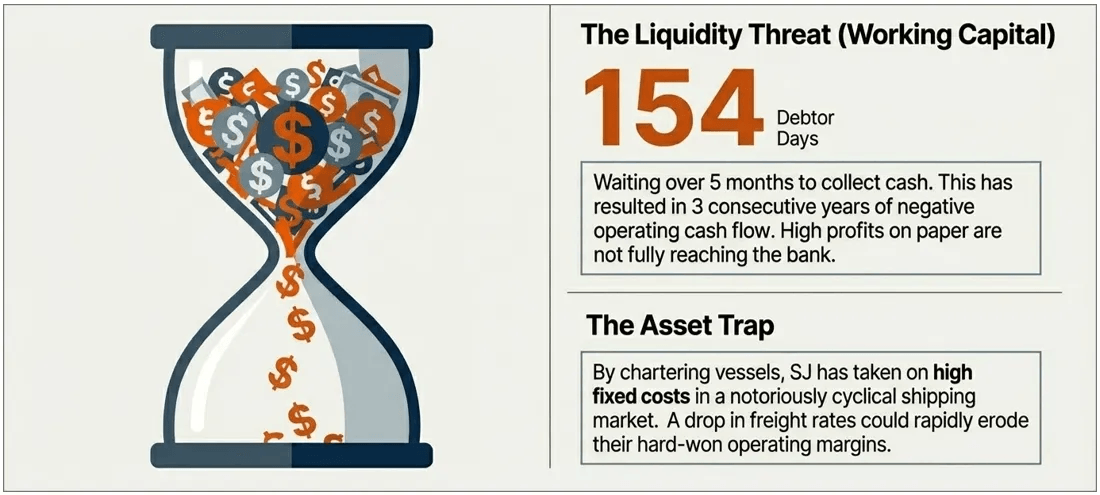
Debtor days of 154.
This means the company waits over five months on average to collect its receivables — is extremely high for a service business. More concerning, cash flow from operations has been negative for three consecutive years. That tells you the profits being reported are not yet fully reaching the bank.
If a major project cargo client defaults, or if global credit conditions tighten suddenly, SJ could find itself in a severe liquidity crunch despite healthy-looking profit margins.
The second risk comes with the vessel operations themselves.
Shipping is a notoriously difficult, cyclical business. By chartering vessels, SJ is taking on high fixed costs. A drop in container freight rates — which can be sudden and steep — or a technical breakdown of a vessel could quickly erode operating margins that took years to build.
Bringing It Together
Two companies. Same sector. Fundamentally different DNA.
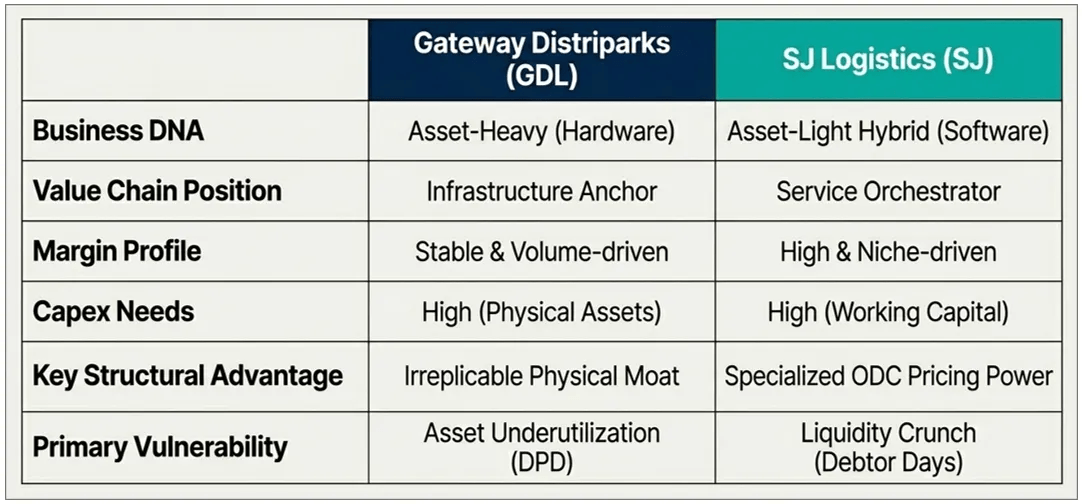
GDL is the infrastructure anchor — asset-heavy, cash-generative, net debt-free, and directly tied to India’s long-term freight corridor story.
It is a slower, steadier bet on India’s structural shift toward rail.
The risks are real but manageable, provided you watch the DPD trend and competitive dynamics carefully.
SJ Logistics is the high-growth play — capital-efficient, margin-rich in its niche, and in the middle of a transformation from pure services to a hybrid model with its own vessels.
The upside is significant if the vessel strategy plays out.
But the working capital situation demands close monitoring, because a business that grows fast but collects slow is walking a tightrope.
Understanding the difference between these two;
asset-heavy infrastructure versus asset-light services, stable returns versus high-growth specialisation; is really the first step to understanding how to think about any logistics investment in India.
The world doesn’t stop for anyone. But not every logistics company is equally positioned to profit from its relentless movement.
About Ethica Invest
Ethica Invest is a principled, Shariah-compliant investment platform that helps investors like you in identifying companies using well-defined criteria for finances, operations, and governance. Though grounded in Shariah guidelines, Ethica’s approach goes beyond any single faith by prioritizing openness, strong balance sheets, and responsible business practices.
Ethica Invest works with SEBI-registered analysts and seasoned investment experts who deliver organized, compliant analysis on stocks and other opportunities. Those interested in seeking more on Shariah-aligned investing, can connect with our Ethica team.
The goal is straightforward: empower investors with decisions based on ethics, solid data, and performance; not just stories.