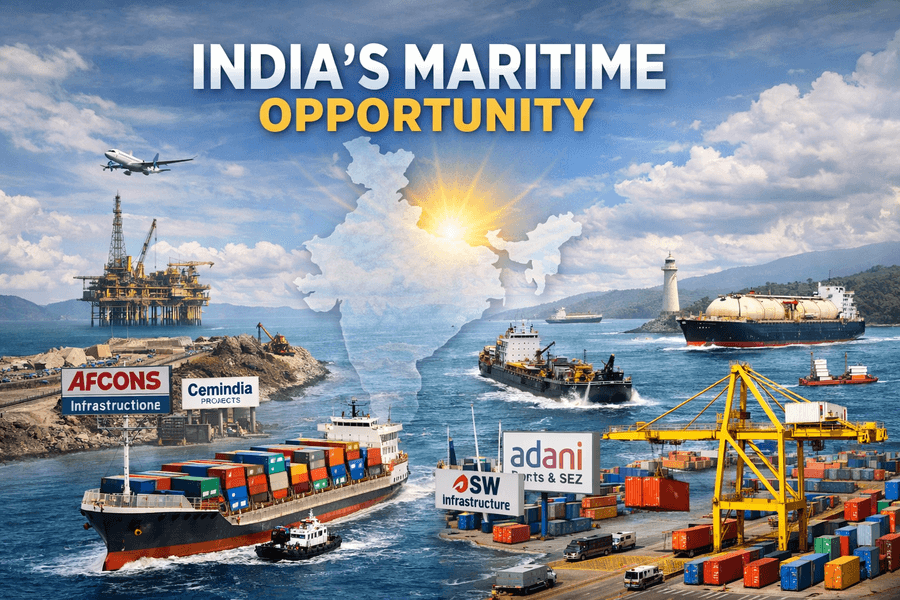
From Vision to Execution: Mapping India’s Maritime Opportunity
‘Convenience’.
We built our lives around it. It was always there; smooth, invisible, and taken for granted.
Until it wasn’t.
Today, with the world under stress, especially in the Middle East, the Strait of Hormuz keeps showing up in headlines. And suddenly, what used to feel normal doesn’t feel so normal anymore.
 Ethica Invest
Serious about long-term investing?
Unlock our professionally managed portfolios.
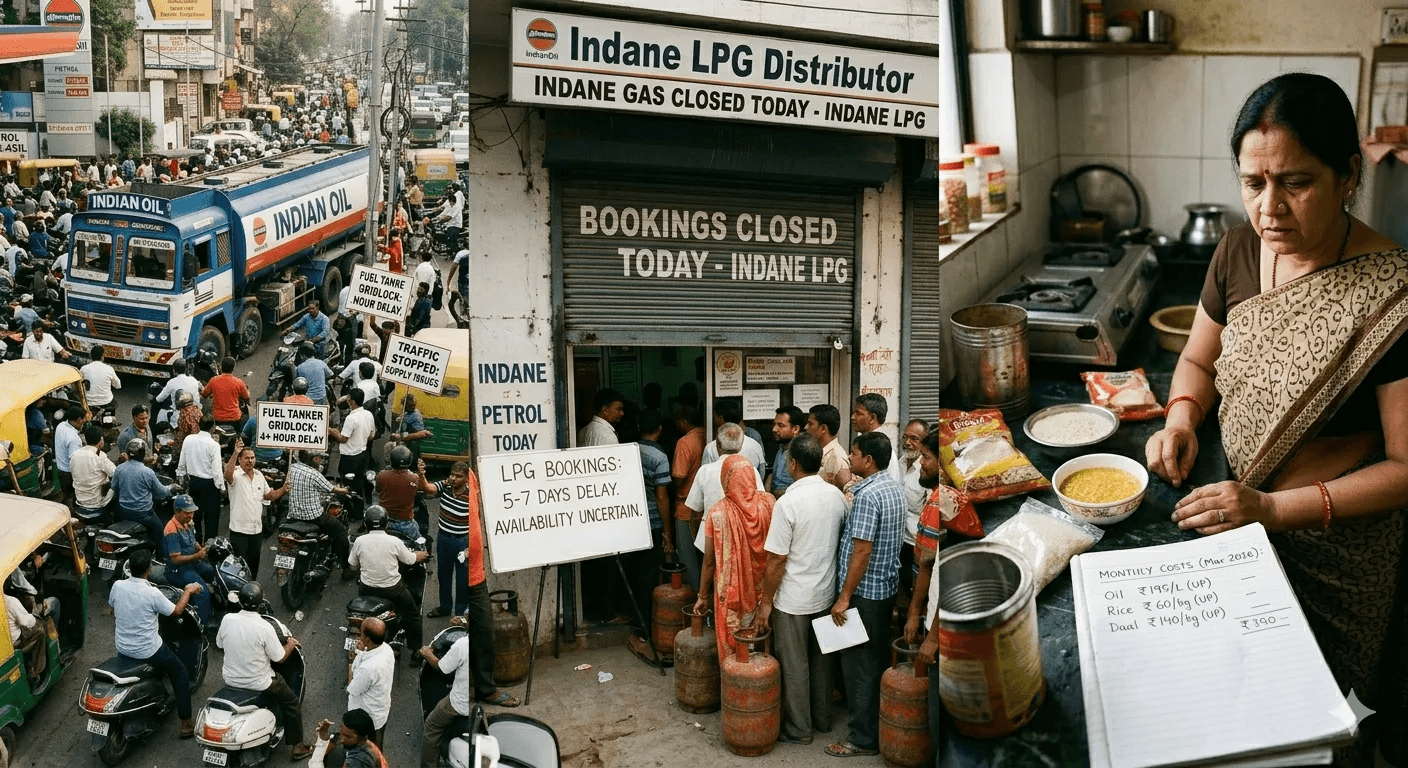
Longer queues at petrol pumps. Delays and uncertainty around LPG bookings. Rising prices that quietly hit every household.
We are experiencing, in real time, how this ‘convenience’; invisible when it worked, yet central to everything that moved; actually held our lives together.
In our previous article, “Samudra Strategy: India’s 2047 Playbook”, we started exactly here: breaking down this idea of convenience, and how India is now trying to rebuild it through its maritime vision.
But understanding the story is only step one.
Today, we go where the real value lies.
From the entire shipping ecosystem, we narrow down to the segments that actually matter as India works to rebuild its maritime backbone. And within those segments, to the companies best positioned to capture this shift.
Because this is where the narrative moves from understanding to opportunity.
If you haven’t read the earlier “Samudra Strategy: India’s 2047 Playbook”, we strongly recommend reading it first for context; it sets the stage for everything you’re about to see next.
Understanding India’s Maritime Sector
Before we go chasing numbers, and order books, let us slow down for a moment.
Because here is the thing about the Maritime sector; most investors look at it and see ships. Big ships, small ships, ports in the distance, cranes moving containers under floodlights. And they think, “I broadly get it.”
But they don’t. Not really.
The maritime sector is not a single industry. It is an ecosystem; a living, interdependent chain where if one link breaks, the entire chain seizes up. And the cost of that seizure falls on every exporter, every importer, every Indian consumer who buys something that crossed the ocean to reach them.
Ethica Invest
Serious about long-term investing?
Unlock our professionally managed portfolios.
Understanding this ecosystem; not just the headlines about it; is the starting point for any serious investor looking at this space.
So let us walk through it. Slowly. The way it actually works.
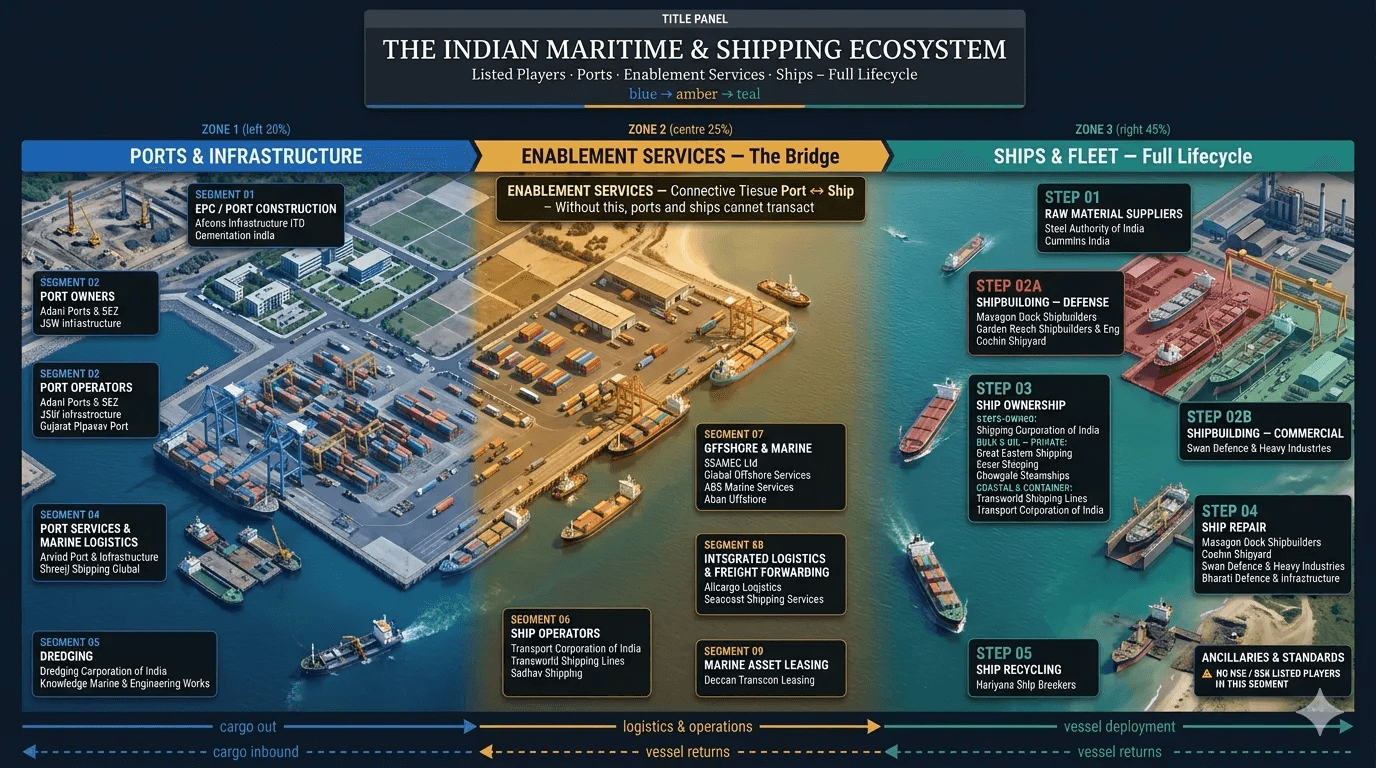
Ports & Infrastructure - The Foundation
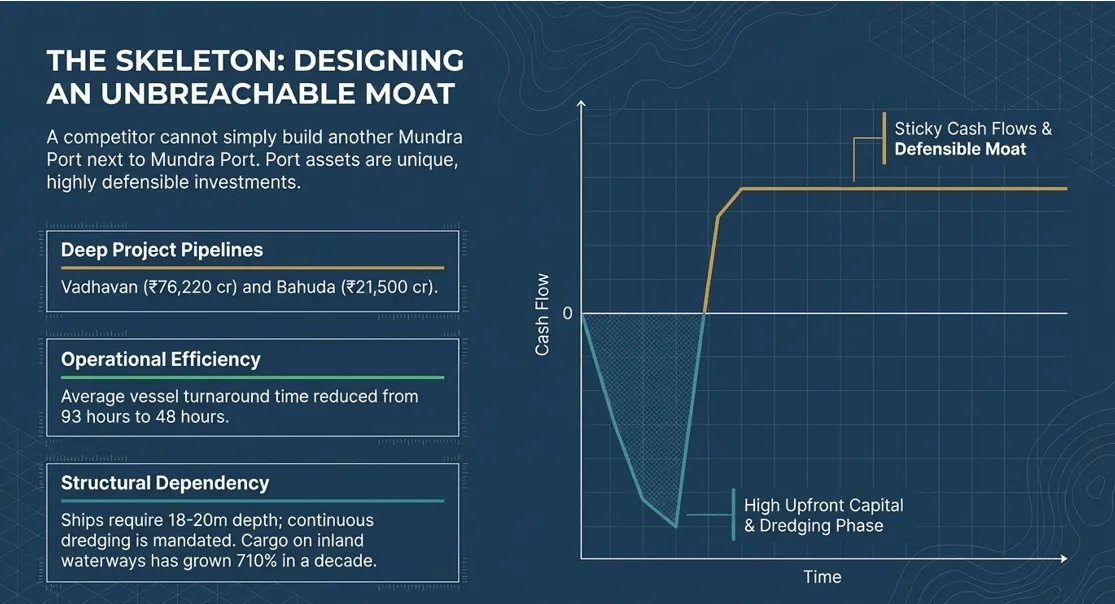
If the maritime sector were a human body, Ports & Infrastructure would be the skeleton. Nothing else functions without it.
EPC / Port Construction is where it begins.
Companies like Afcons Infrastructure and Cemindia Projects are builders; they come in, execute the contract, collect their fee, and move to the next project. The investment story here is driven by order books and the pipeline of new construction, which with projects like Vadhavan (₹76,220 crore) and Bahuda (₹21,500 crore) is extraordinarily deep right now.
Once the port is built, Port Owners step in.
Traditionally the Government, today increasingly private players like Adani Ports & SEZ and JSW Infrastructure. The economics are classic infrastructure economics: high upfront capital, long gestation, but deeply sticky cash flows once operational. A competitor simply cannot build another Mundra Port next to Mundra Port.
There is a subtle but important distinction between owning a port and running it.
Port Operators manage the day-to-day; vessel berthing, cargo handling, turnaround management. India has made real progress here; average vessel turnaround time has fallen from 93 hours to 48 hours. But we are still not Rotterdam. That gap is both a problem and an opportunity.
Then there are Port Services & Marine Logistics
Pilotage, tug services, stevedoring, and warehousing. Fragmented and largely unlisted today, but as Indian ports scale, this segment will throw up investable opportunities worth watching.
The fifth segment is one most investors have never thought about; Dredging.
Ports need deep water. Ships are getting larger, requiring 18–20 metres of depth, and India’s natural depth at most locations is not that. So someone has to continuously scoop out the seabed, because the sea fills it back in. As new deep-draft ports get built and inland waterways expand; cargo on which has grown 710% in a decade; the dredging runway is long and structurally driven.
Industry 2: Enablement Services - The Bridge
This is the industry that most people miss. And missing it means you misunderstand how the entire ecosystem actually works.
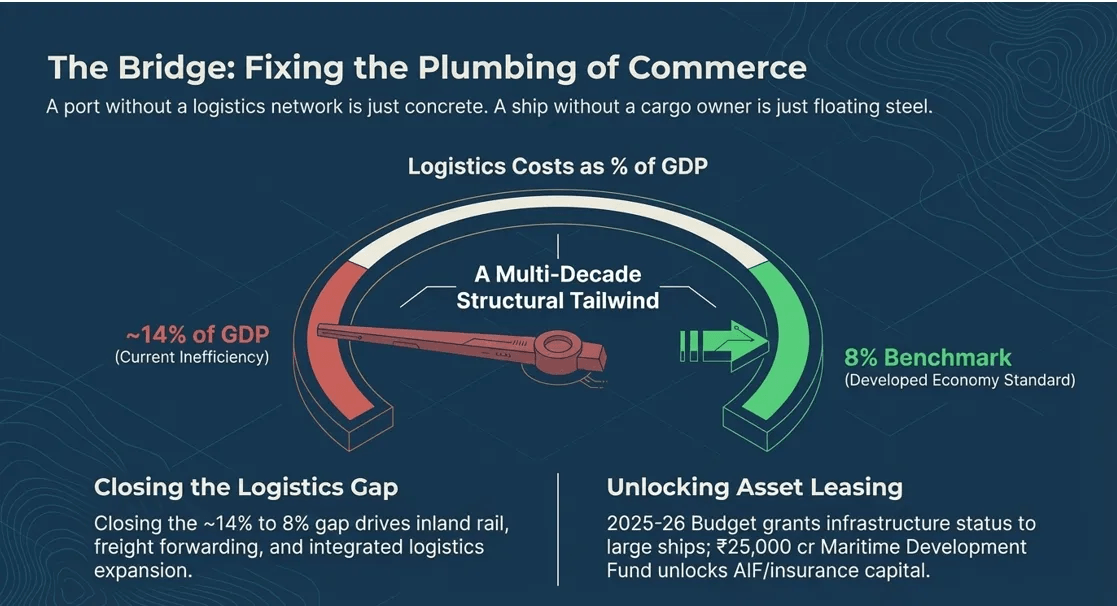
A port and a ship, taken individually, cannot transact. A port without a logistics network is just concrete and cranes. A ship without a cargo owner and a freight forwarder is just steel floating on water.
The Enablement layer is what brings them together; it is the plumbing of maritime commerce.
Ship Operators commercially deploy vessels; finding the cargo, booking routes, managing schedules, collecting freight.
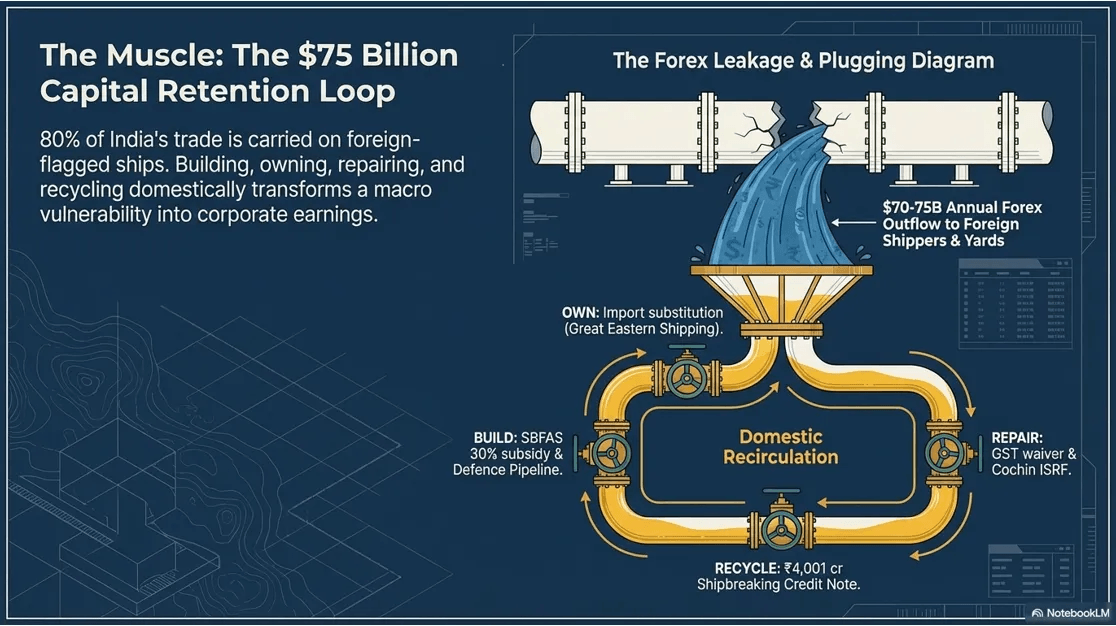
Think of it as the difference between owning an apartment and being the property manager who keeps it rented. The investment story here centres on India’s dependence on foreign shipping lines; over 80% of India’s trade is carried on foreign-flagged ships, causing an annual forex outflow of USD 70–75 billion. Correcting that is a decade-long opportunity.
Offshore & Marine Services serves energy rather than trade.
India’s offshore oil and gas production requires support vessels and marine construction. The segment is now being pulled toward offshore wind and hydrogen bunkering; directionally, that is where the next growth chapter is.
Integrated Logistics & Freight Forwarding coordinates the entire chain; documentation, customs clearance, inland transport, and financing. The tailwind is India’s rising trade volumes and the push to lower logistics costs from ~14% of GDP to the developed-economy benchmark of 8%. Closing that gap is a multi-decade story.
Finally, Marine Asset Leasing; vessels cost hundreds of millions of dollars, and not every operator buys one outright. The 2025–26 Budget’s decision to grant infrastructure status to large ships, allowing AIF funds and insurance companies to lend into this space, combined with the ₹25,000 crore Maritime Development Fund, is opening this door. The investable opportunity is emerging. It just does not have a neat listed proxy yet.
Industry 3: Ships & Fleet - The Full Lifecycle
If Ports & Infrastructure is the skeleton and Enablement Services is the circulatory system, Ships & Fleet is the muscle. This is where the vessel; the physical asset; is born, works, and eventually retires.
It starts with Raw Material Suppliers; primarily marine-grade, corrosion-resistant steel that no ordinary mill can produce. As India aims for the Top 5 global shipbuilding positions by 2047, the demand for indigenous materials and engineering components will scale alongside every new hull laid.
From there, the chain moves to Shipbuilding - Defence, arguably the highest-conviction segment in the entire sector right now. India’s Navy has a modernisation pipeline worth ₹2.3 lakh crore, with 75% reserved for domestic procurement. What makes this segment unique is the nature of its contracts; a submarine is a 7–10 year execution cycle. When a company wins a contract, it locks in a compounding earnings stream for the better part of a decade. That is the kind of earnings visibility most sectors can only dream of.
Shipbuilding - Commercial is the sibling segment: bulk carriers, container ships, tankers. Slower to develop in India than defence, but gaining momentum through the SBFAS scheme’s 30% subsidy on non-conventional builds and the Bharat Container Shipping Line’s requirement for 51 domestically sourced vessels.
Once built, ships are Owned.
The story here is import substitution: every ship owned by an Indian company is a ship whose freight stays in India rather than flowing to Maersk or MSC. The SCI–Oil PSU joint venture, targeting 59 vessels with firm cargo commitments, is the government’s most concrete attempt to change this equation.
Eventually, ships need to be Repaired.
India today spends USD 70-75 billion annually sending ships abroad for exactly this, because domestic capacity has historically been inadequate. The ₹69,725 crore shipbuilding package includes ₹19,989 crore under the SbDS specifically for four national-level ship repair clusters. The demand is already there. India just needs to build the supply.
And finally, every ship is Recycled.
Alang in Gujarat; the world’s largest ship-recycling beach; handles over 90% of India’s volume. The government’s Shipbreaking Credit Note Scheme (₹4,001 crore) incentivises recycling at certified domestic yards, and the credit earned can be used to buy a new vessel from an Indian builder.
Build in India. Repair in India. Recycle in India. The loop closes cleanly.
From Understanding to Filtration - Where the Real Work Begins
Structure alone does not make you money.
The maritime sector is a collection of different businesses; each with its own economics, cycles, and risk profile. A port owner compounds over decades. A defence shipbuilder re-rates on order inflows. A freight forwarder swings with trade volumes. A dredging company depends on government spending cycles.
Miss these distinctions, and you start comparing apples to submarines.
Most investors stop at the map, get excited by the narrative, and buy broadly. That is where returns break.
Understanding the ecosystem is Step 1. Knowing where to look within it is Step 2.
Step 1: Not Every Segment is Equal - Identify the Ones With Real Fuel
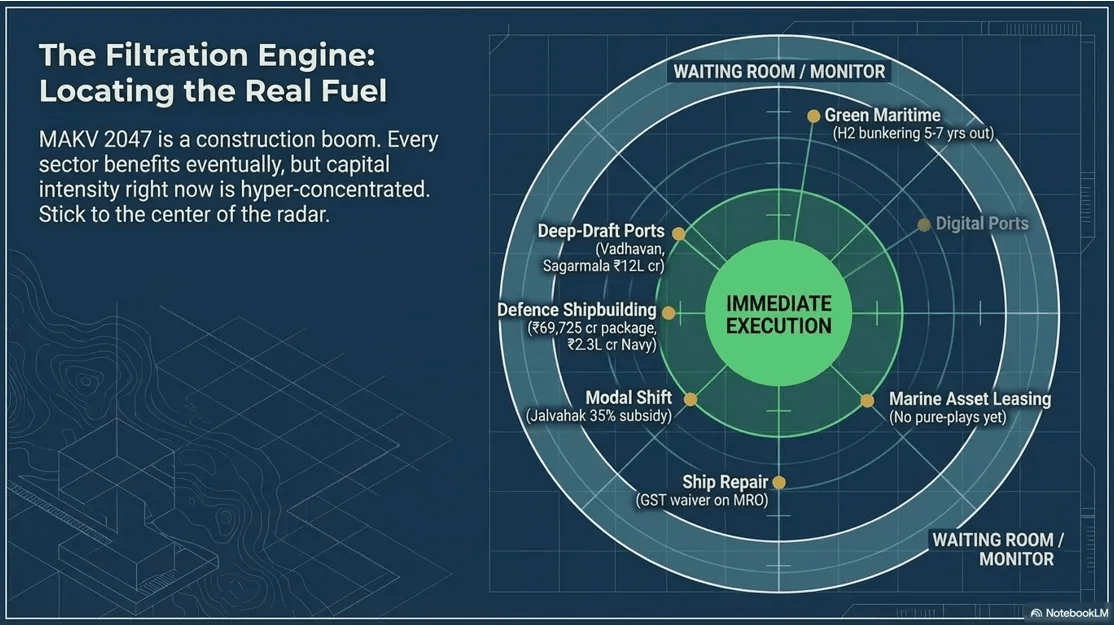
Think of the maritime ecosystem like a city during a construction boom. Every part of the city benefits eventually; the grocery store, the school, the hospital. But in the immediate years of the boom, the ones who benefit most directly are the cement company, the steel supplier, the infrastructure builder. The boom is the same. The timing of benefit is very different.
MAKV 2047 is that boom for India’s maritime sector. And right now, not all segments are receiving the same intensity of capital, policy, and order flow.
So which segments have real fuel in the tank?
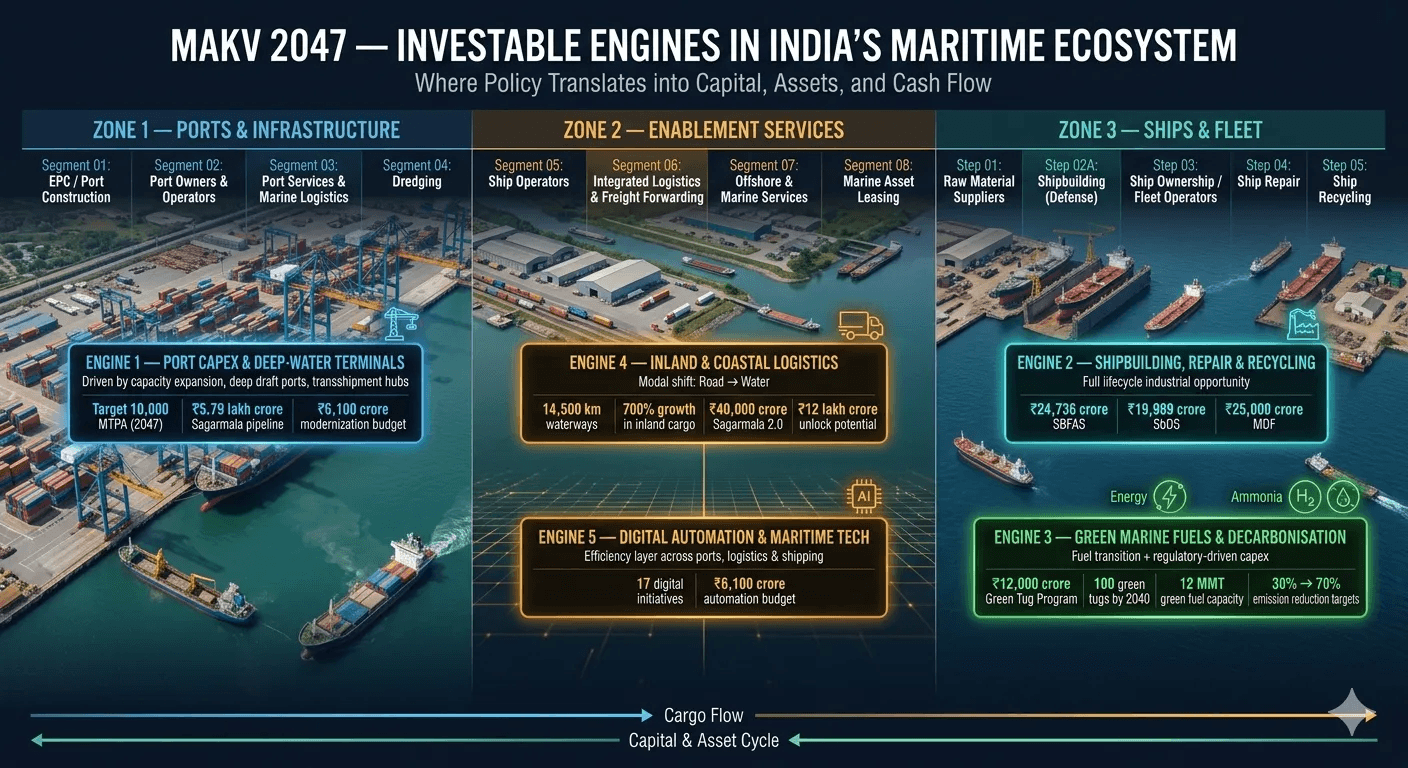
Port Capacity Expansion and Deep-Draft Terminals are the most immediate opportunity.
- Vadhavan Port received Cabinet approval in June 2024, the PM laid the foundation stone in August 2024, and Phase 1 construction is underway.
- Vizhinjam; India’s first deep-draft transshipment port was commissioned in May 2025.
- Sagarmala 2.0 targets ₹12 lakh crore in investments between 2025 and 2035, with ₹40,000 crore in direct government support.
This is the actual procurement, land acquisition, contractor mobilisation, and steel in the ground.
Defence Shipbuilding has equally unmistakable fuel.
- The Cabinet approved a ₹69,725 crore shipbuilding mega-package on September 24, 2025, with disbursement guidelines notified on December 28, 2025.
- The Navy’s ₹2.3 lakh crore modernisation pipeline has 75% reserved for domestic procurement.
- The P-75(I) submarine programme alone is valued at ₹70,000–99,000 crore.
- Indian shipyards are bidding for ₹2–2.5 lakh crore in contracts over the next 18–24 months.
The order visibility here is measured in years, not quarters.
Modal Shift - Road to Water is building momentum steadily.
- The Jalvahak scheme (launched December 15, 2024) offers a 35% reimbursement on operating costs for cargo moved 300 km+ on key national waterways.
- The Coastal Shipping Act 2025 provides the legal foundation.
At ₹1.19 per tonne-km versus ₹2.28 for road, the economics make a compelling case on their own.
Ship Repair is perhaps the most underappreciated segment in this entire story.
- Cochin Shipyard’s ISRF; ₹970 crore, 42 acres, now commercially operational; is the first serious listed company to go after this market domestically.
- The GST reverse-charge waiver on MRO (Budget 2025–26) directly erodes the cost advantage of sending ships abroad.
The demand side is proven. India just needs to redirect the supply homeward.
Three segments; Green Maritime, Digital Ports, and Marine Asset Leasing; are genuinely part of MAKV’s vision, but their investable clock has not fully started.
- H₂ bunkering is five to seven years from commercial viability.
- Digital infrastructure benefits accrue to port operators themselves rather than creating standalone plays.
- Marine leasing has no pure-play listed company in India yet.
These are themes worth monitoring, but not the segments where you deploy capital today.
Step 2: Who Is Actually Playing - Map the Companies
Now that we have identified the segments with live triggers, let us see who is executing within them. And let us be honest about what “executing” means; it means orders in hand, capex deployed, capacity under construction, or a business already generating revenue.
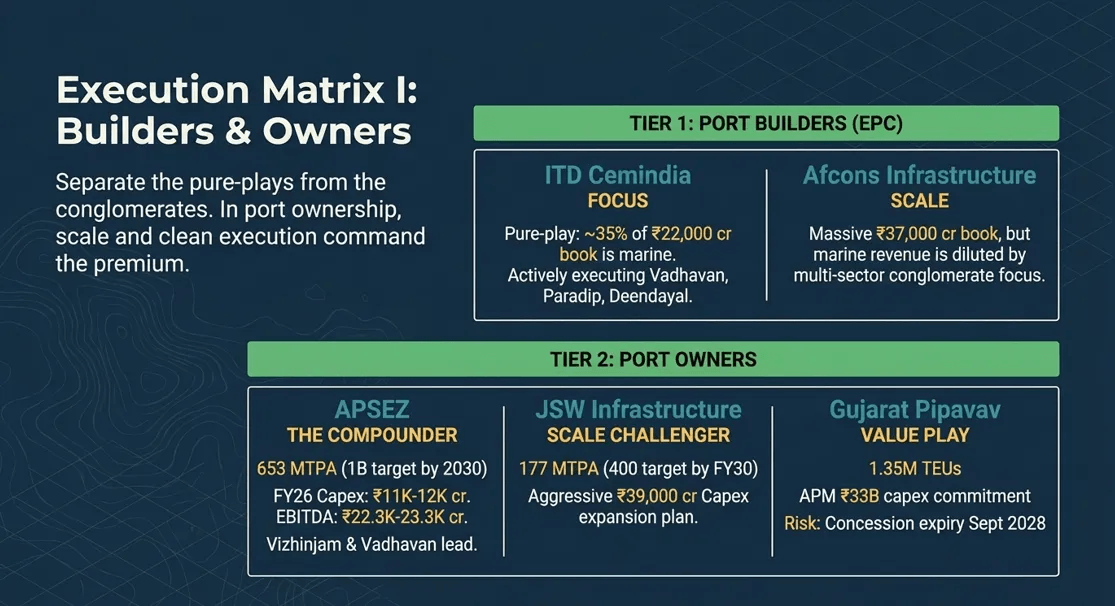
In Port Construction (EPC), two serious listed names stand out.
- ITD Cementation (Cemindia) is the more focused; marine structures constitute ~35% of its ₹22,000 crore order book, and it is actively executing berth, breakwater, and jetty contracts at Vadhavan, Paradip, and Deendayal. This is a company that builds ports for a living.
- Afcons Infrastructure (listed November 2024) carries a ₹37,000 crore book with marine as a key vertical, but maritime is one of several businesses for Afcons. The pure-play argument sits with ITD.
In Port Ownership, the two dominant names are well-known but not equally positioned.
- APSEZ is the cleanest large-cap maritime compounder in India; 15 ports, 653 MTPA capacity (targeting 1 billion tonnes by 2030), a 129-vessel marine fleet, Vizhinjam operational, and Vadhavan Phase 1 under construction with APSEZ as the designated developer. FY26 capex guidance: ₹11,000-12,000 crore. EBITDA guidance: ₹22,350-23,350 crore.
- JSW Infrastructure is India’s second-largest private port operator, expanding from 177 MTPA to a target of 400 MTPA by FY30 through a ₹39,000 crore capex plan. Less headline-grabbing, but a clean, consistent compounder.
- Gujarat Pipavav Port deserves mention; not as a growth story but as a value play. Container capacity of 1.35 million TEUs, a ₹17,000 crore MoU with Gujarat Maritime Board, and APM Terminals’ ₹33 billion capex commitment signal confidence in the port’s future despite the concession expiry risk in September 2028.
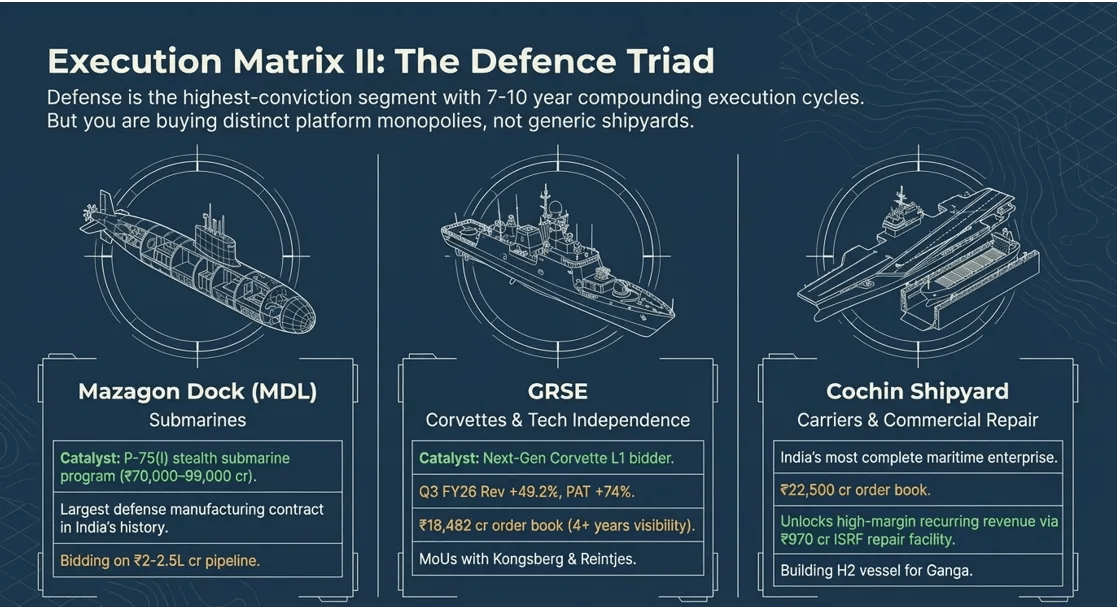
In Defence Shipbuilding, all three listed names are serious; but they are not the same business.
- Mazagon Dock (MDL) is India’s only submarine builder. The P-75(I) programme (six stealth submarines, valued at ₹70,000–₹99,000 crore) had CNC negotiations completed in March 2026. When signed, it will be the largest defence manufacturing contract in India’s history. MDL is bidding on ₹2–₹2.5 lakh crore of pipeline.
- Garden Reach Shipbuilders (GRSE) has delivered the most dramatic near-term numbers; Q3 FY26 revenue up 49.2% yoy to ₹1,896 crore, PAT up 74% to ₹171 crore. Order book at ₹18,482 crore with 4+ years of visibility. It is the L1 bidder for the Next-Generation Corvette (multiple contracts expected from the same platform). GRSE’s technology ambition is growing; MoUs with Kongsberg (Norway) for India’s first Polar Research Vessel and with Reintjes GmbH (Germany) for marine gearbox technology transfer. This is a company beginning to develop what it builds, not just build what was designed elsewhere.
- Cochin Shipyard is India’s only aircraft-carrier builder and its most versatile listed shipyard. Order book at ₹22,500 crore, defence pipeline at ₹2.8 lakh crore. And uniquely among the three, it has already opened a second revenue stream; the ISRF ship repair facility; providing recurring, high-margin revenue that the pure defence builders do not have. The H₂ fuel-cell vessel for the Ganga is being built here as well. Of the three, Cochin is the most complete maritime industrial enterprise.
In Ship Ownership,
- Great Eastern Shipping (GESCO) is India’s largest private ship owner. 41 vessels, 3.25 million DWT, near 100% utilisation. Four vessel acquisitions in FY26, all funded from internal accruals; no dilution, no leverage. Every vessel added to the Indian-flagged fleet directly reduces the USD 70–75 billion annual forex outflow. GESCO benefits from the ownership threshold reduction to 51% and from infrastructure status for ships, which reduces future cost of capital.
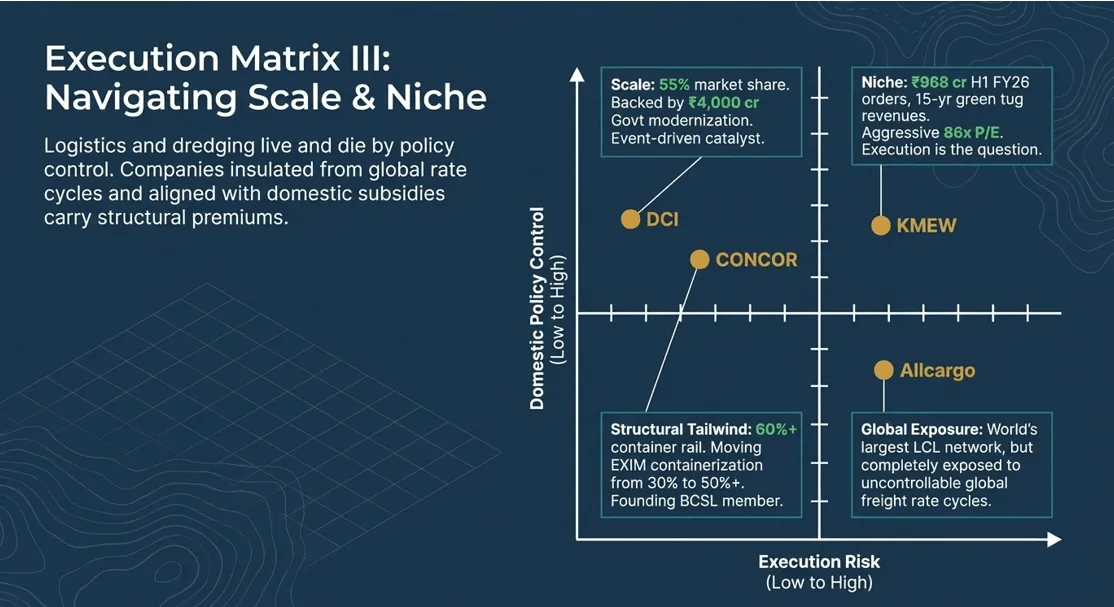
In Dredging, the two listed plays are structurally different.
- DCI handles 55% of India’s total dredging requirement and is executing capital dredging at Vadhavan, Paradip, Deendayal, and JNPA. The PM announced a ₹4,000 crore fleet modernisation programme for DCI at India Maritime Week in October 2025; a meaningful catalyst. It is event-driven right now, not earnings-driven.
- Knowledge Marine & Engineering Works (KMEW) is the sharper surprise; in H1 FY26, it won 7 orders aggregating ₹968 crore, including ₹650 crore in Green Tug contracts carrying a 15-year guaranteed revenue stream. For a company generating ~₹50 crore in quarterly revenue, this order intake is transformative. At P/E of 86x, the market has noticed. The question is execution.
In Integrated Logistics,
- CONCOR is the most direct listed beneficiary of India’s containerisation push; 60%+ of containerised rail traffic, 66 terminals, and a founding MoU signatory of the Bharat Container Shipping Line (BCSL, launched February 2026, 51 vessels, USD 6.9 billion). The government’s target to move containerisation from 30% to 50%+ of EXIM trade directly expands CONCOR’s addressable market without requiring it to build new assets. That is structural tailwind in its purest form.
- Allcargo Logistics plays through ECU Worldwide; the world’s largest LCL network, 180+ countries. BCSL, SagarSetu, and India’s EXIM trade growth all create volume tailwinds. The honest caveat: global freight rates are outside India’s policy control, and when they normalised after 2022, Allcargo’s margins contracted sharply. MAKV is the structural backdrop here, not the near-term catalyst.
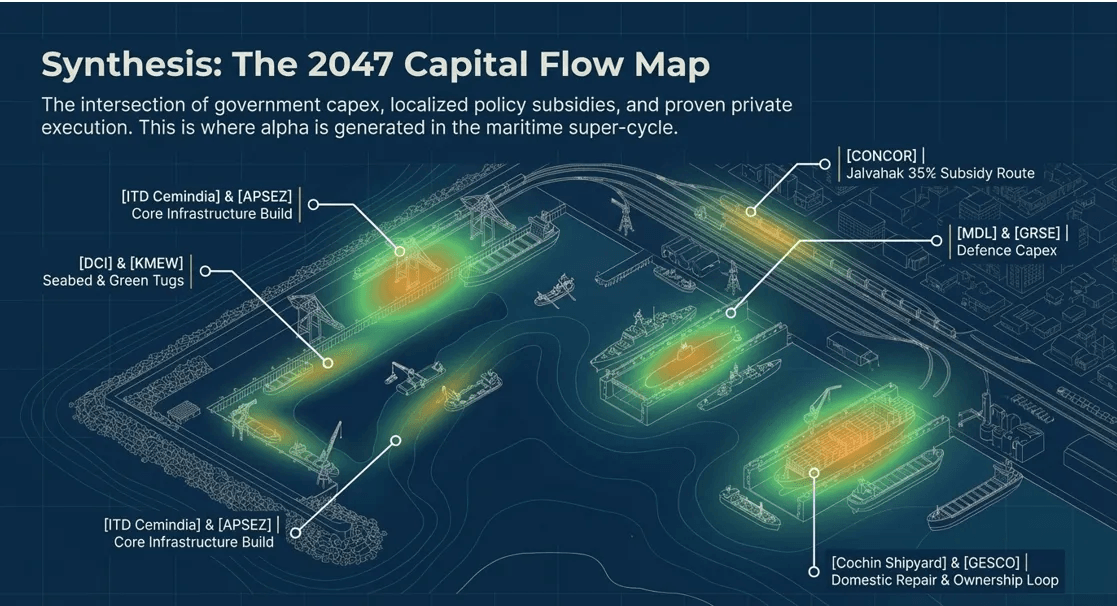
India’s maritime story is quietly shifting. It’s no longer just about building bigger ports; it’s a strategic play to control our own trade destiny. While the headlines focus on the 2047 “vision,” the real compounding is happening in the companies putting steel in the ground right now.
This isn’t a theme for the impatient. Maritime transformations take years, but they build competitive moats that are incredibly hard to cross once they’re in place.
If you can look past the noise and see how ports, shipbuilding, and logistics interlock into one giant system, you’ve already found your edge. Ultimately, this isn’t just a sector story; it’s the new blueprint for how India moves, trades, and grows.
About Ethica Invest
Ethica Invest is a principled, Shariah-compliant investment platform that assists investors in assessing companies using well-defined criteria for finances, operations, and governance. Though grounded in Shariah guidelines, Ethica’s approach resonates beyond any single faith by prioritizing openness, strong balance sheets, and responsible business practices.
Ethica Invest works with SEBI-registered analysts and seasoned investment experts who deliver organized, compliant analysis on stocks and other opportunities. Those interested in seeking more on Shariah-aligned investing, can connect with our Ethica team.
The goal is straightforward: empower investors with decisions based on ethics, solid data, and performance; not just stories.