GHCL: Q2 FY27 Earnings Review
Quarter ended 30 September 2026 · Earnings call: 2 November 2026
How GHCL earns its profits
GHCL mainly produces soda ash, used in glass and detergents. Profitability depends on selling prices relative to energy, salt, limestone and transport costs, alongside plant efficiency and output. Imports influence domestic prices, so stronger Indian demand does not automatically translate into better margins. Captive salt production and cost improvements help protect earnings. Newly commercialised vacuum salt and bromine broaden the product range, but soda ash remains the main earnings driver.
The key takeaway: recovery still depends on soda ash pricing
GHCL has made tangible progress in diversification, but the November call did not establish a recovery in soda ash profitability. Q2 earnings improved year-on-year, while margins fell sequentially as the temporary input-cost benefits identified in August faded. The immediate task is to ramp up the new plants. The larger earnings opportunity depends on stronger Indian demand translating into better selling prices after costs, despite global oversupply. These two developments should be assessed separately.
A stronger year-on-year quarter, with further pressure expected in Q3
Sales increased 12.0% year-on-year to ₹808 crore and profit after tax rose 18.7% to ₹127 crore. Operating profit before depreciation and other income increased 20.3%, indicating a stronger operating performance than a year earlier.
 Ethica Invest
Serious about long-term investing?
Unlock our professionally managed portfolios.
The sequential picture was weaker. Sales rose 4.4%, but operating profit declined 9.4% as energy and raw-material costs increased. Management had explicitly warned in August that Q1's unusually favourable input inventories would not persist. Q2 therefore followed the direction already indicated, rather than introducing a new warning about the business.
Management expects Q3 EBITDA below Q2, but above Q3 FY26. Further erosion of the inventory-cost benefit and annual maintenance will offset some benefit from a small price increase. Management corrected its initial production-loss discussion to approximately 3–4% of quarterly output. Existing inventory should help service customers, so the production reduction should not be treated as an equivalent forecast decline in sales.
For FY27, management's broad EBITDA outlook was around FY26 levels or slightly better, with the new projects contributing additional earnings.
The decisive catalyst: solar glass demand must improve realised margins
Indian soda ash demand grew only about 1% in H1, according to management, compared with around 9% last year. Detergent demand was weak and glass demand was stable. Solar glass projects had progressed more slowly than expected, limiting the anticipated demand support.
In August, management expected solar glass commissioning during January–March 2027, followed by a fuller benefit in FY28. In November, it described capacity rising from approximately 15 GW to 35 GW over six months, with the main soda ash demand benefit again in FY28. The broad timing remains similar; the latest call gives more detail, rather than announcing a clear acceleration.
Management estimates solar glass could add 4–5 percentage points to Indian soda ash demand growth in FY28. Together with underlying demand, it considers a return towards 9–10% growth possible. This is an industry expectation, not GHCL volume guidance. The important sequence is customer commissioning, actual glass production, soda ash purchases and finally improved pricing after input costs.
Imports remain a constraint. Management estimated H1 imports at roughly four lakh tonnes, compared with five lakh tonnes in the previous year's first half and four lakh tonnes in its second half. Fewer supplying countries could support pricing discipline, but a more concentrated import mix does not itself establish a sustained supply shortage.
A soda ash price increase of approximately 1.5–2% had just been taken when the November call occurred. It offers some relief, although management still expected soft realisations over the next few quarters. Quantitative import restrictions remained under government consideration at the call date. Investors should monitor an effective notification and subsequent import volumes before assuming a benefit. The separate minimum import price on clear float glass supports GHCL indirectly through domestic glass customers.
Financial comparison: distinguish sales, operating earnings and other income
₹ crore, except margins. Q2 FY27: July–September 2026; Q1 FY27: April–June 2026; Q2 FY26: July–September 2025. Changes use unrounded figures.
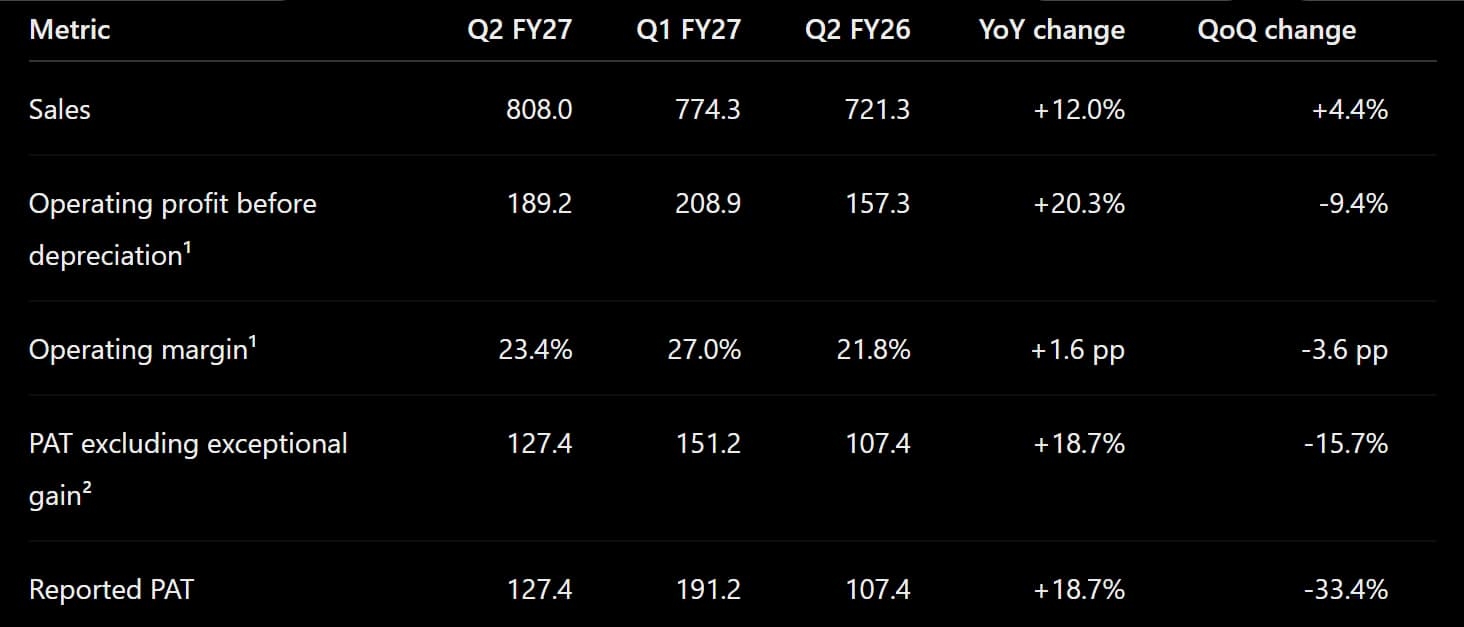
¹ Excludes other income. On the earnings call, management used broader income and EBITDA measures: approximately ₹821 crore and ₹202 crore respectively in Q2, including ₹13 crore of other income. Its stated EBITDA margin was 24.7%. Here, pp means percentage points.
² Q1 included a ₹40 crore exceptional gain after tax from an ESOS Trust settlement. Q2 did not contain this gain. The adjusted comparison better represents the sequential change in earnings.
Prices helped sales; higher costs reduced their benefit
Management cited soda ash prices around 7% above the year-earlier quarter, but said higher raw-material and supply-chain costs absorbed much of the benefit. It did not provide a complete price, volume and product-mix reconciliation. The 12% sales increase therefore cannot be described wholly as volume growth.
Ethica Invest
Serious about long-term investing?
Unlock our professionally managed portfolios.
Other income also contributed to the sequential earnings decline. Excluding the exceptional settlement, it fell from about ₹24 crore in Q1 to ₹13 crore in Q2. Q1 benefited from realised bond gains; Q2 included unrealised investment valuation losses. Consequently, the decline in the call's EBITDA measure was larger than the decline in operating profit alone.
Management again referred to historical EBITDA margins of 29–30%, against approximately 25% currently. This illustrates potential sensitivity to a better industry balance. It does not provide a dated commitment to restore those margins.
Vacuum salt and bromine: commissioning achieved, earnings delivery next
Vacuum salt began commercial production during Q2, while bromine started after quarter-end in Q3. Bromine therefore began later than the August expectation of commercial production in Q2. Both calls, however, envisaged FY28 as the year benefiting from full utilisation.
Vacuum salt refines solar salt using waste heat from existing operations. Bromine is a chemical recovered from salt-rich brine.
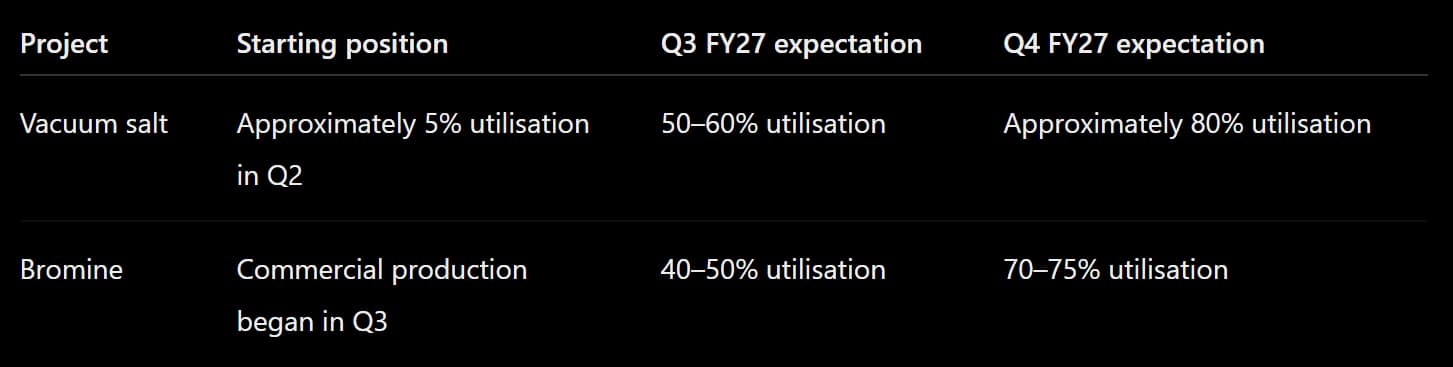
These are management's ramp-up expectations. The next evidence should be saleable output, customer purchases, achieved margins and cash collection. Commissioning alone does not demonstrate the earnings potential.
In November, management clarified combined annual revenue potential at approximately ₹168–170 crore, with margins above 40%. August's discussion had indicated approximately ₹160–170 crore and 40–45% margins. The broad economics remain similar. Applying that earlier margin range to the clarified revenue implies approximately ₹67–77 crore of annual EBITDA at full utilisation, an illustration rather than a new management forecast.
This is a useful addition, but combined project revenue would be only about 5–6% of FY26 sales. Diversification will initially moderate soda ash exposure rather than transform the earnings mix. Management also expects approximately ₹15–17 crore of additional annual depreciation, so project EBITDA will not translate fully into net profit. Further bromine expansion depends on developing the new salt fields, with a multi-year lead time.
Cash remains ample, but working capital absorbed much of H1 generation
GHCL reported a net cash surplus exceeding ₹1,070 crore at September-end. However, management's ₹360 crore H1 cash-generation figure came before a ₹217 crore increase in working capital, primarily inventory and receivables amid supply disruptions.
On that cash bridge, approximately ₹143 crore remained after working capital and ₹75 crore after ₹68 crore of capital expenditure. Dividend payments of ₹110 crore and borrowing repayments of ₹13 crore then resulted in a ₹48 crore net outflow. Collection of receivables and conversion of inventory into cash now matter alongside reported profits.
Management outlined approximately ₹450 crore for existing salt-field expansion and Zara Zumara development, plus ₹88 crore for railway infrastructure. Salt development is phased over several years. These investments should improve raw-material availability and reliability, with cost benefits as output increases. The siding's financial contribution has not been quantified.
Management retained its preference for balancing investment with shareholder distributions, citing past buybacks. It did not announce a new buyback on the call. Future distributions depend on project spending and other investment opportunities.
Greenfield soda ash: land resolution remains the gating milestone
Compared with August, management reported some progress on land and related approvals, but no significant breakthrough or firm construction start date. Environmental clearances were described as already in place. The project remains too distant to explain near-term earnings growth.
Management estimates 3–3.5 years from project commencement to production, followed by roughly a year to stabilise utilisation. The first phase carries an estimated ₹4,200 crore cost, within a larger 1.1-million-tonne development estimated at ₹6,800–7,000 crore. Costs will be reviewed before commencement, and most spending is expected later in construction. The current cash surplus provides flexibility, but the project's scale makes funding and returns important future decisions.
What shareholders should monitor next
The next quarter should establish whether vacuum salt and bromine approach their stated utilisation ranges while preserving margins. For soda ash, watch the realised benefit of the 1.5–2% price increase after energy costs and maintenance, followed by actual solar glass commissioning and customer utilisation. Import restrictions require implementation, while receivable collections and inventory reduction would improve cash conversion. For the greenfield project, the meaningful update is resolved land approvals and a credible start date.