Samudra Strategy: India’s 2047 Playbook
We live in a world built on convenience.

You walk into a petrol pump to fill your car tank. You use a smartphone assembled thousands of kilometres away. Coal reaches power plants, fertilisers reach farms, and products quietly appear on store shelves.
Everything simply… works.
But lately, the world has been reminded of something uncomfortable; this convenience rests on a fragile system called “Global Trade”.
 Ethica Invest
Serious about long-term investing?
Unlock our professionally managed portfolios.
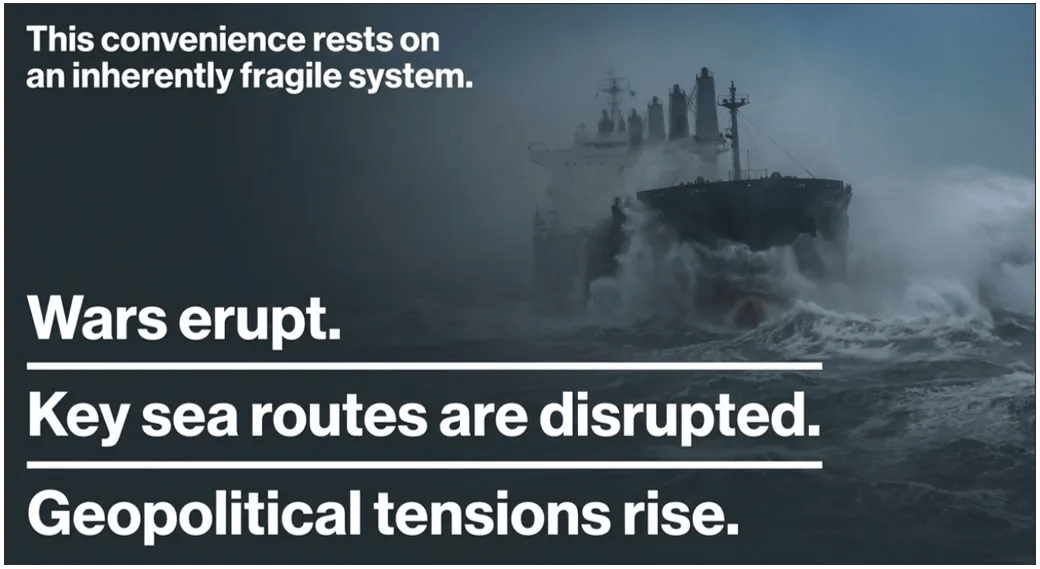
And today, nearly 90% of global trade (by volume) moves across the oceans on ships.
So when Wars erupt, when key Sea routes are disrupted, or when Geopolitical tensions rise, the consequences don’t just stay there; they reach us: higher fuel prices, snarled supply chains, and rising inflation.
Because behind the movement of almost everything we consume lies an ecosystem that connects the entire World: “Shipping”.
And perhaps now is the right moment to look a little closer; to understand how this vast ecosystem works, and how India is positioning itself within it as global trade continues to evolve.
Where does India stands today?
India’s maritime story begins with geography.
Our country has a coastline stretching over 7,500 kilometres, a natural outcome of its peninsular shape, with land surrounded by water on three sides. And along this long coastline sit more than 200 ports, acting as gateways through which India connects with the global economy.
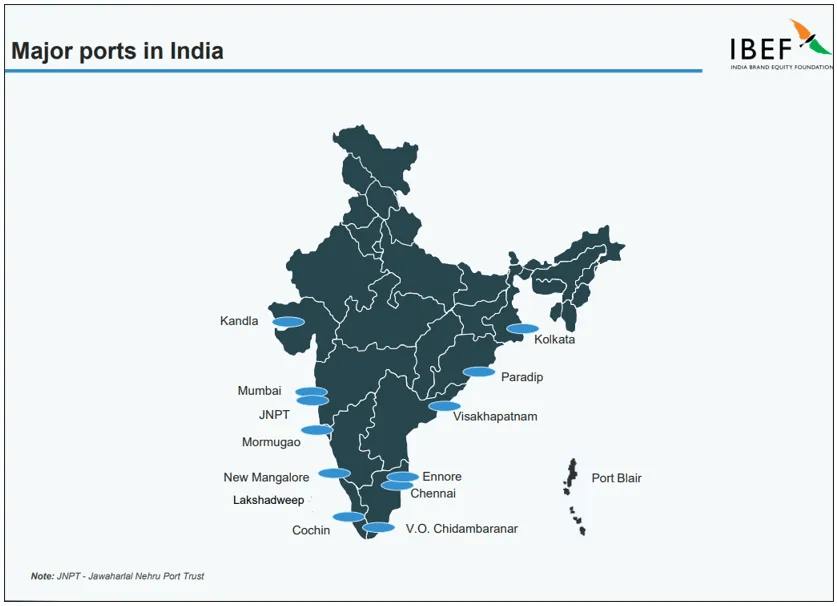
Out of these, 12 are classified as major ports, while the rest fall under the category of non-major (or minor) ports. These major ports are evenly split across the two coasts; 6 on the eastern side and 6 on the western side; and importantly, all of them fall under the jurisdiction of the GOI.
Even though these ports are fewer in number, they play an outsized role in India’s maritime trade.
More than 54% of India’s total cargo traffic moves through these 12 major ports.
This alone tells you how central they are to the country’s trade infrastructure.
And the system has been steadily improving.
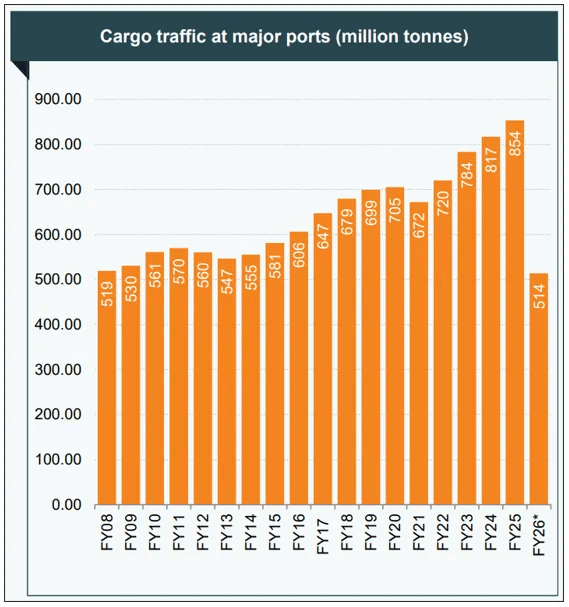
In FY25, India’s major ports handled around 854 million tonnes of cargo, up from 817 million tonnes in FY24, marking a 4.3% growth. It may not sound dramatic, but it reflects consistent improvements in capacity utilisation, infrastructure upgrades, and operational efficiency.
Ethica Invest
Serious about long-term investing?
Unlock our professionally managed portfolios.
But the real progress becomes visible when you look at how quickly ships move through Indian ports today.
Earlier, vessels would often spend days waiting at ports. Back in FY11, the average turnaround time; the time a ship spends at port; was about 127 hours.
Today, that number has fallen to just 45.55 hours in FY25.
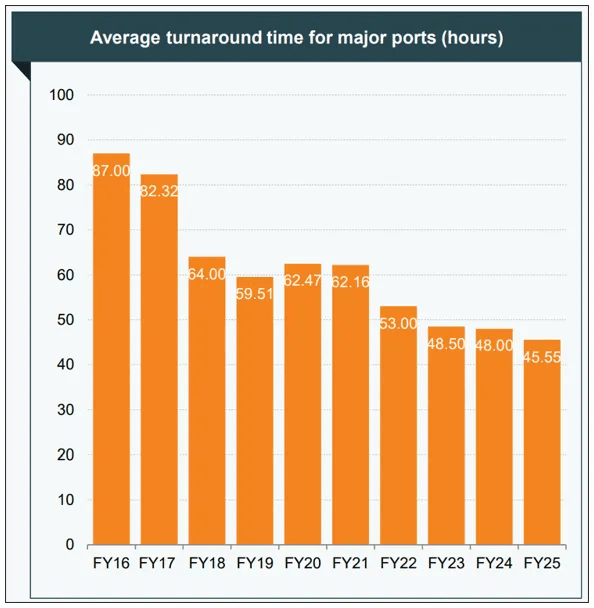
In simple terms, ships are spending far less time waiting and far more time moving cargo; a critical improvement for a trade-dependent economy.
Globally too, Indian ports are beginning to show up on the map. 9 Indian ports now rank among the world’s top-100 container ports, with Visakhapatnam even featuring among the top 20 globally.
But ports are only one piece of the larger shipping ecosystem.
Because trade doesn’t move just through ports; it moves on ships.
And this is where India’s position becomes more nuanced.
Despite being a large trading nation, India’s fleet remains relatively small by global standards.
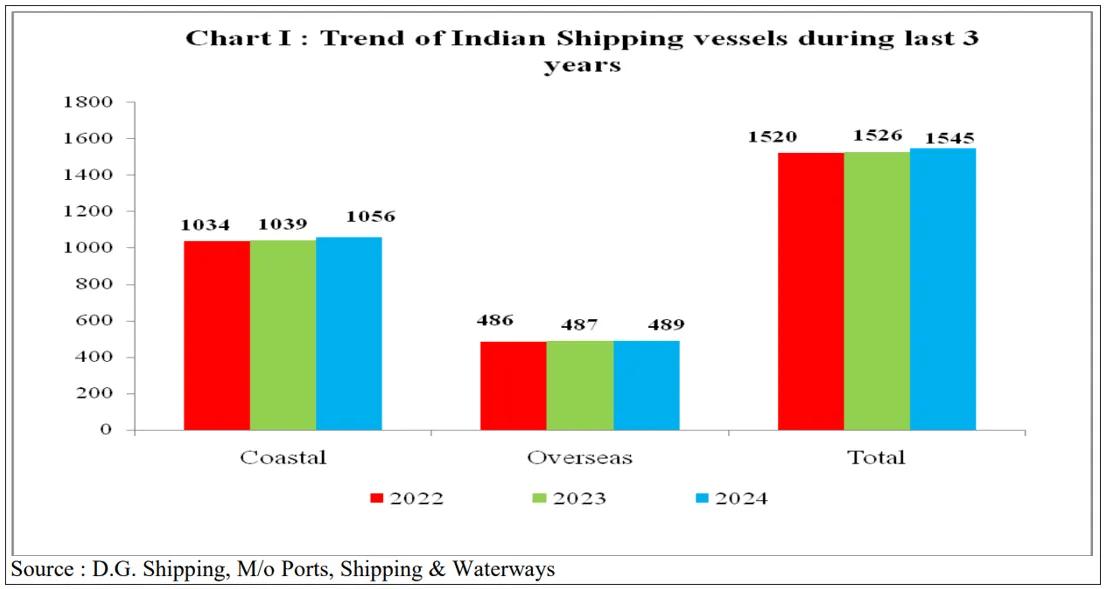
As of 2024, India had 1,545 Indian-flag vessels, with a capacity of 13.50 million gross tonnes. That’s an improvement from about 1,205 vessels in 2014, but even today, India ranks only around 17th globally by fleet size and accounts for less than 1% of the world’s shipping tonnage.
More importantly, most of India’s trade is not carried by Indian ships.
Nearly 90–95% of India’s seaborne cargo is transported by foreign-flag vessels, operated by global shipping giants. Indian shipping lines together carry only about 5-10% of the country’s import-export volume.
Which means while India trades heavily through the seas, the ships carrying that trade are largely owned by others.
The picture is similar in ‘Shipbuilding’.
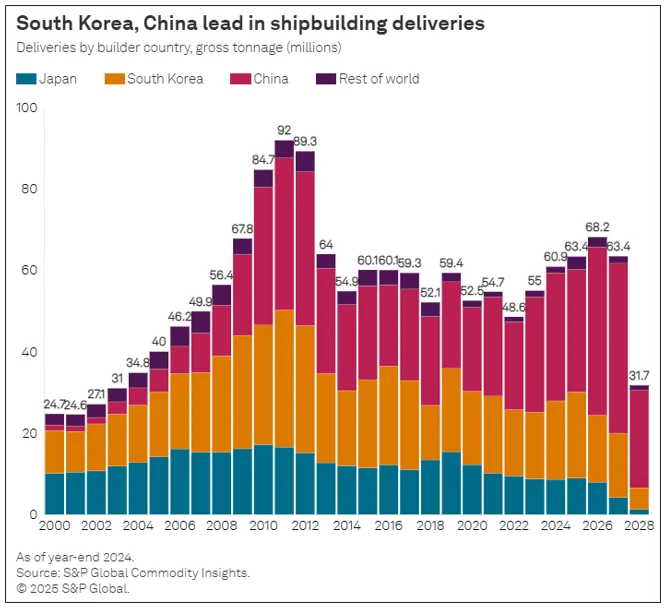
Globally, shipbuilding is dominated by countries like China, South Korea, and Japan. India’s shipbuilding industry is still at a relatively early stage, with less than 1% share in the global new-build market.
Historically, Indian shipyards have focused more on naval vessels, offshore platforms, and specialised domestic ships, rather than large commercial cargo vessels.
That said, there are early signs of progress.
In FY24, Indian shipyards had around 410 vessels on order, mostly small and mid-sized ships. And interestingly, India has now emerged as the world’s third-largest builder of general dry-cargo vessels, showing that certain niches are beginning to develop.
‘Ship repair’ is another area where India still has room to grow.
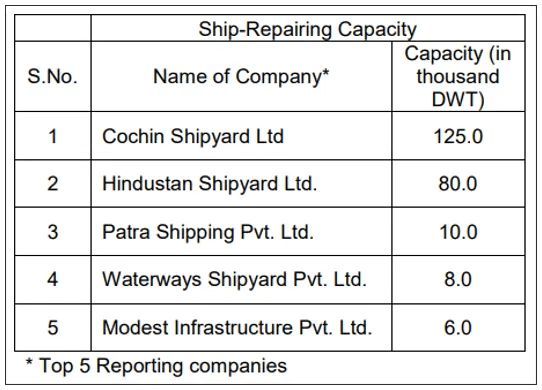
The country’s largest repair facilities; Cochin Shipyard and Hindustan Shipyard; have capacities of roughly 125,000 DWT and 80,000 DWT respectively, which means many large commercial vessels still go abroad for major repairs.
But there is one segment where India is already a global leader.
‘Ship recycling’.
In Alang, Gujarat, sits the world’s largest ship-breaking yard. The Alang–Sosiya complex dismantles more than one-third of the world’s end-of-life cargo ships, making India one of the most important players in the global ship recycling industry.
Together with China, India accounts for roughly 30% of global ship recycling capacity.

So when you step back and look at the full picture, India’s shipping ecosystem shows an interesting contrast:
- On one hand, India has good port infrastructure, growing cargo volumes, improving efficiency, and global leadership in ship recycling.
- On the other hand, the country still lacks scale in merchant shipping, shipbuilding, and maritime services, which means a large part of the value chain remains outside India.
And that gap is exactly what policymakers are now trying to address.
Because if India wants to become a global manufacturing and trading powerhouse, it cannot rely entirely on other countries’ ships, shipyards, and maritime services.
Which is why, in recent years, the government has started laying out a long-term plan to strengthen the entire maritime ecosystem.
And that is where the next part of the story begins.
Where Does India Wants to Go?
Over the last decade, the Government of India has already launched several programmes; like Sagarmala and MIV 2030; to strengthen the country’s maritime ecosystem.
These were important starting points; focusing on improving port infrastructure, increasing efficiency, and strengthening logistics networks around India’s coastline.
But as India’s economic ambitions started getting bigger, it became clear that the maritime ecosystem cannot be planned in short cycles of five or ten years.
It requires a multi-decade roadmap.
And that is where the government’s latest vision comes in.
Maritime Amrit Kaal Vision (MAKV) 2047
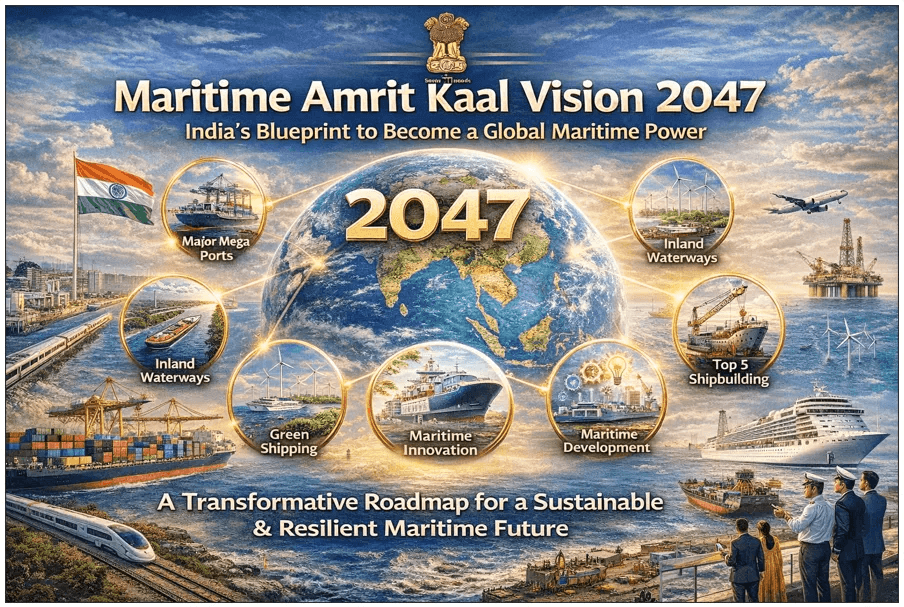
In 2023, at the Global Maritime India Summit, the Government of India unveiled its most ambitious maritime roadmap yet; Maritime Amrit Kaal Vision (MAKV) 2047.
Think of MAKV 2047 as the long-term blueprint for India’s maritime future.
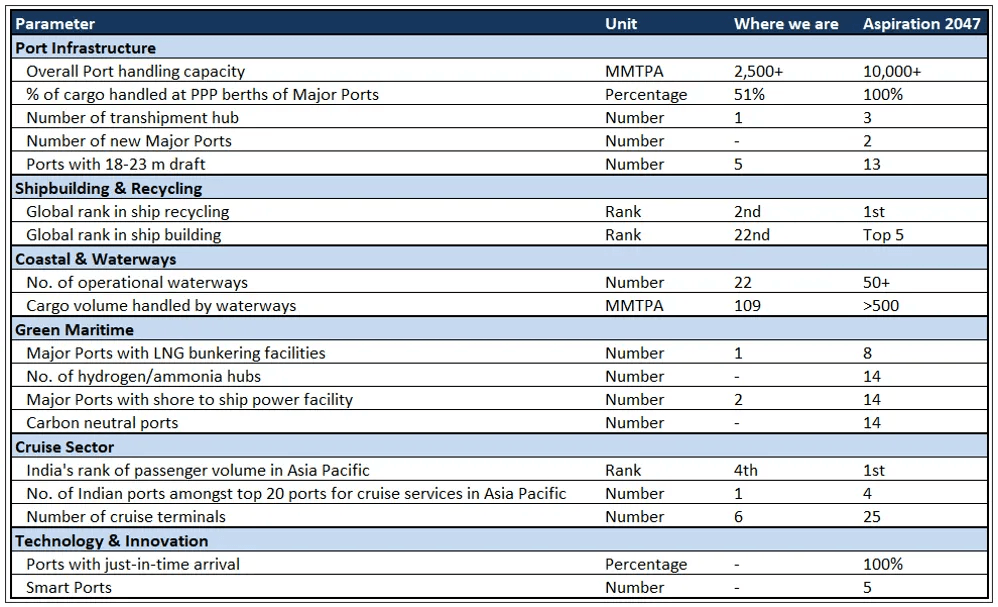
It lays out a 25-year strategy that aims to support India’s broader goal of becoming a “Viksit Bharat” (Developed India) by the time the country completes 100 years of independence in 2047.
And the scale of this vision is massive.
The plan envisions investments of nearly ₹80 lakh crore across the maritime ecosystem. And outlines over 300 actionable initiatives across 11 key themes, covering almost every layer of the maritime economy.
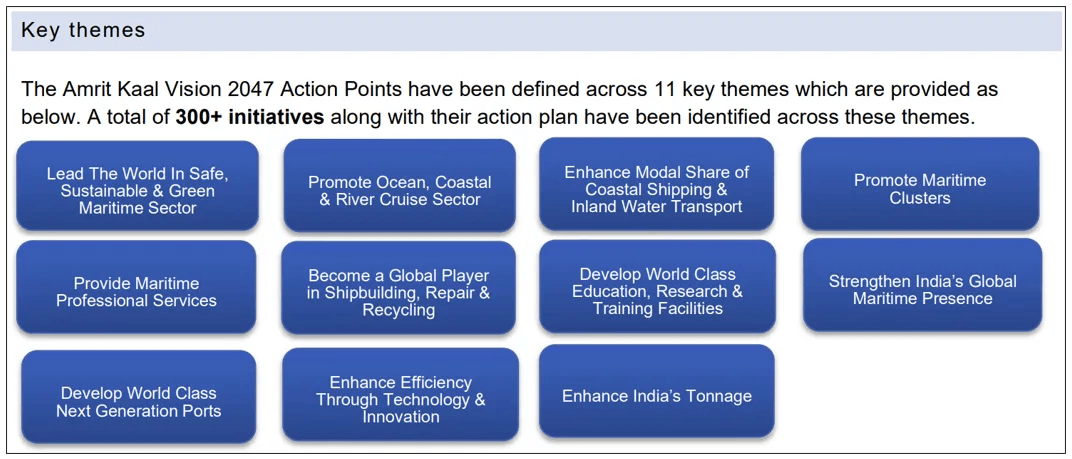
It aims to build a complete maritime ecosystem; one where India is not just moving cargo, but also building ships, financing maritime businesses, offering global maritime services, and participating in the future of green shipping.
Because if nearly 90% of global trade moves through the oceans, then countries that dominate the maritime ecosystem often end up shaping global trade itself.
And India clearly wants a much larger seat at that table.
But securing that seat requires more than ambition on paper; it requires execution on the ground.
And that execution has already begun.
Over the past few years, the government has started putting capital, policy support, and institutional machinery behind this roadmap, gradually translating the long-term vision of MAKV 2047 into real projects and initiatives.
Which brings us to the next chapter.
The progress so far
To understand the seriousness of this push, it helps to look at the financial architecture being built around the maritime sector.
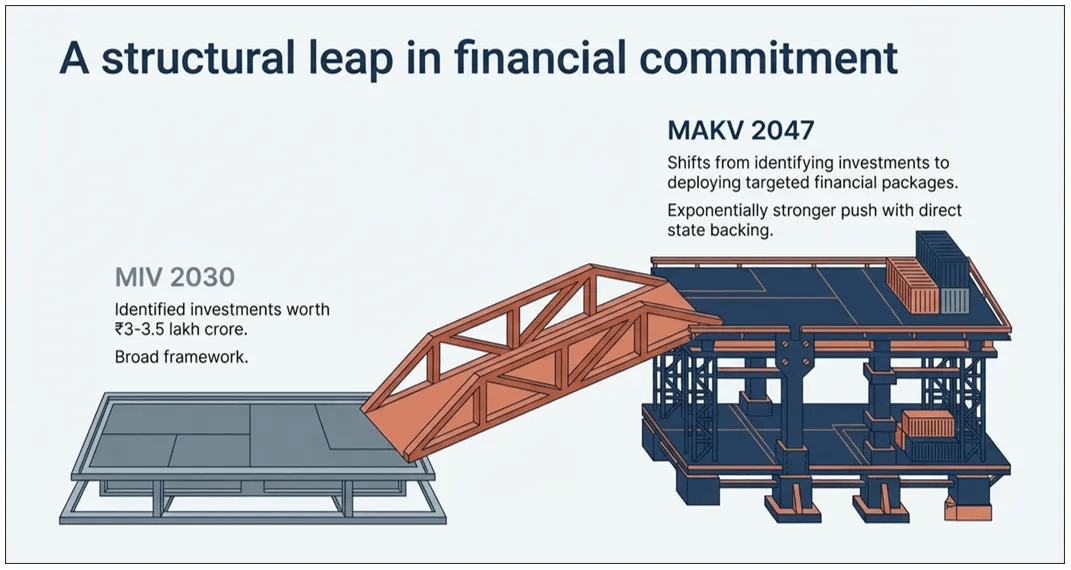
The earlier Maritime India Vision 2030 (MIV 2030) had already identified investments worth ₹3-3.5 lakh crore for the sector.
But under the broader MAKV 2047 framework, the push has become even stronger.
A ₹69,725 crore financial package has been approved specifically to revitalise India’s shipbuilding ecosystem.
Instead of relying on a single policy, the government is using multiple targeted schemes to strengthen different parts of the maritime value chain.
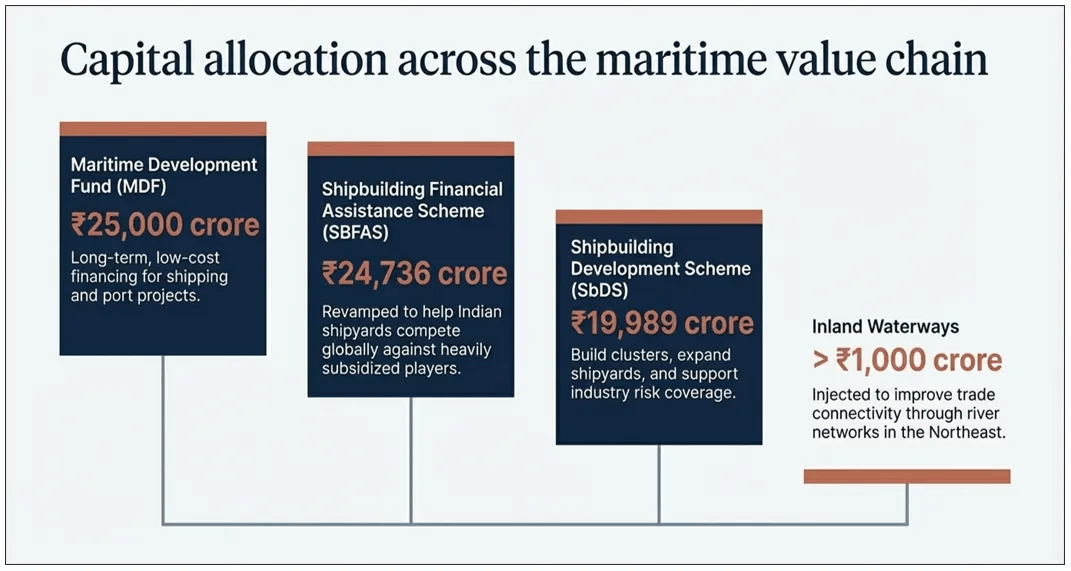
“Why does this matter?”
Because shipbuilding is not just one industry; it is a multiplier.
Every job created in a shipyard is estimated to generate six to seven additional jobs across the supply chain, supporting sectors like steel, machinery, electronics, and equipment manufacturing.
In other words, strengthening shipbuilding can ripple across multiple parts of the industrial economy.
Strategic megaprojects reshaping the maritime map
Policy support is one part of the story.
The other is large-scale infrastructure projects that could reshape India’s position in global shipping routes.
Two projects stand out here:
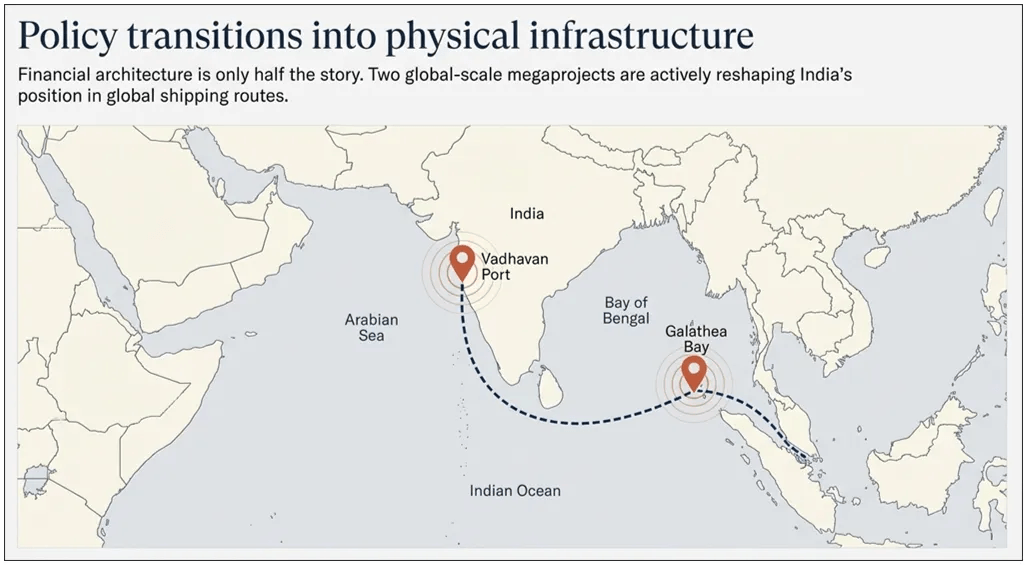
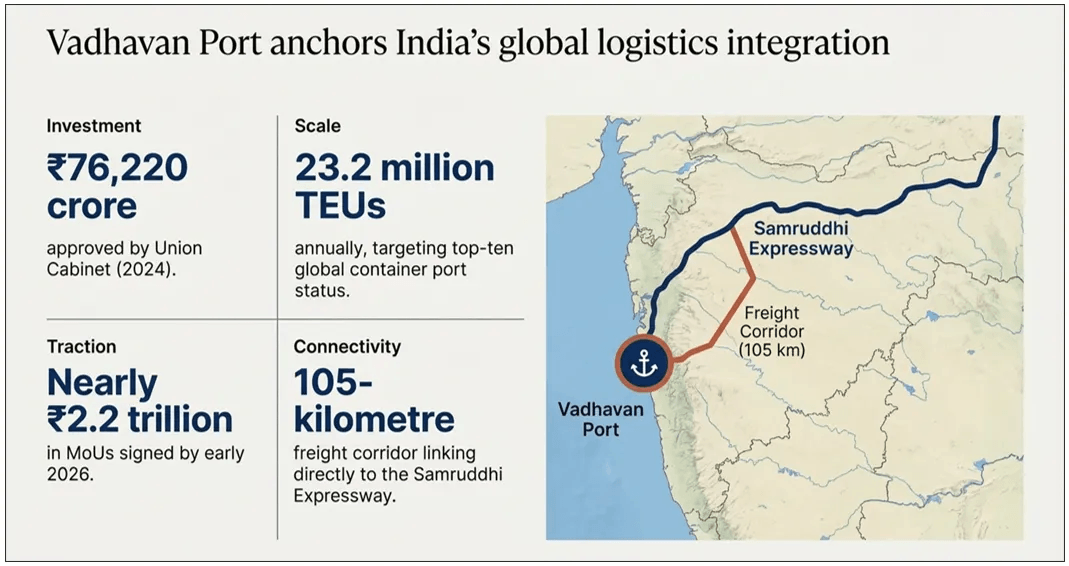
Vadhavan Port: India’s next global gateway
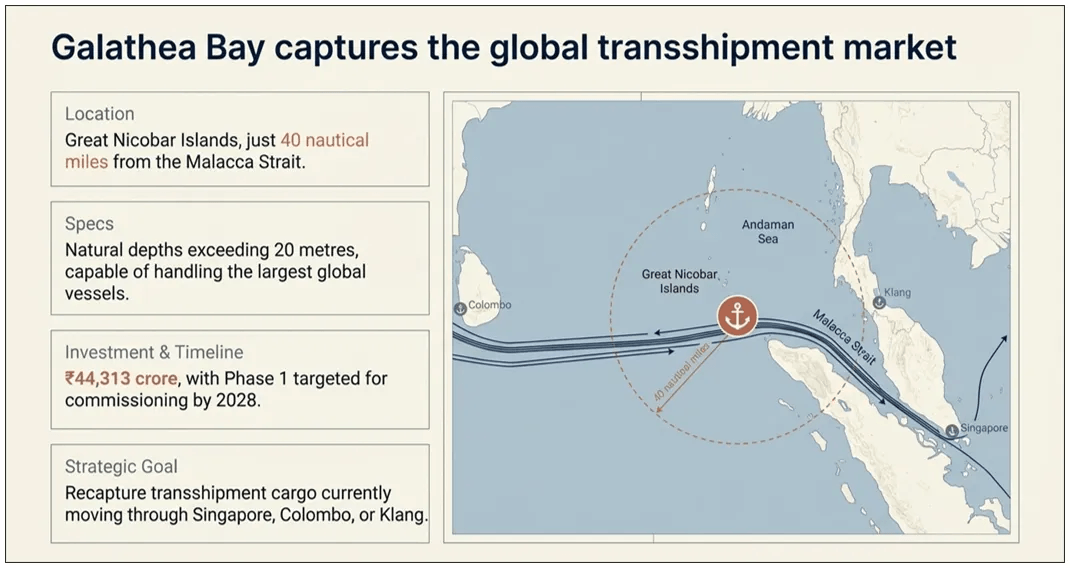
Galathea Bay: India’s transshipment play
A milestone moment: “Samudra se Samriddhi”
The momentum behind MAKV 2047 became even more visible during the “Samudra se Samriddhi - Transforming India’s Maritime Sector” summit held in Bhavnagar in September 2025.
During the event:
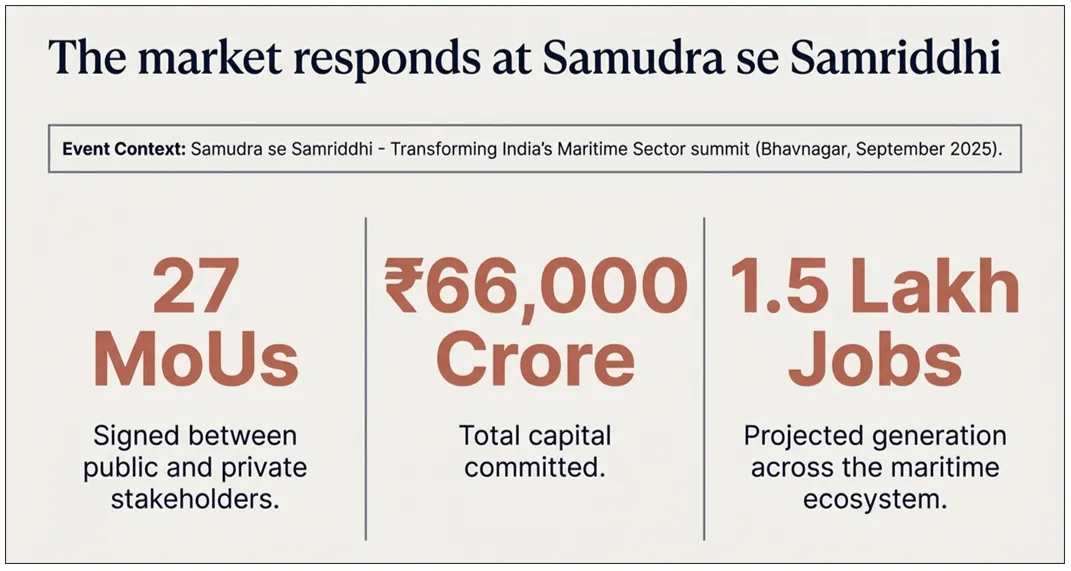
Some other key announcements:
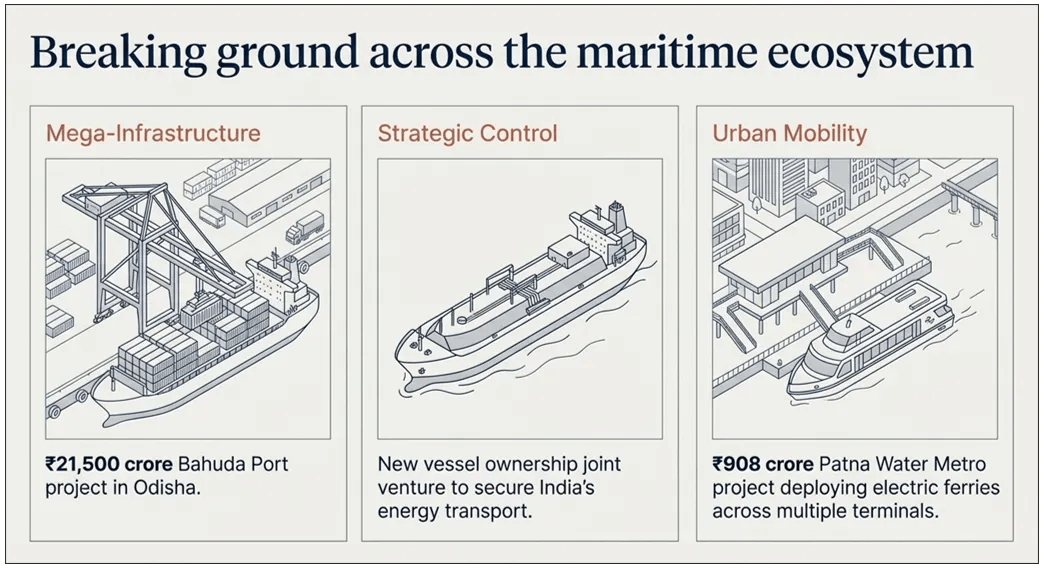
At the same time, infrastructure projects like the Mumbai International Cruise Terminal and the Chhara LNG regasification terminal were inaugurated; further expanding the maritime ecosystem.
Taken together, these developments show something important.
MAKV 2047 is gradually turning into execution on the ground.
What does this mean for businesses?
Whenever an ecosystem expands at this scale, the impact rarely stays limited to one single industry.
Instead, it creates opportunities across multiple layers of the value chain.
And that brings us to perhaps the most interesting question from an investor’s perspective.
If India is about to build a massive maritime ecosystem over the next two decades, then naturally the question becomes:
Which companies will actually benefit from it?
To answer that properly, we first need to step back and understand how the entire shipping ecosystem actually works; who operates the ports, who builds the ships, who moves the cargo, and who provides the services that keep global trade flowing.
And that is exactly what we will explore next.
Where the Real Opportunity Lies:
In the next edition of this story, we will break down the entire value chain of the shipping ecosystem. We will look at the different segments that make up this industry and identify the listed Indian companies operating across each part of that chain.
More importantly, we will try to understand how these companies could benefit from the structural changes taking place in India’s maritime sector, and what steps they are already taking to position themselves for this opportunity.
Because when an ecosystem begins to expand, the real story often lies in the businesses quietly building within it.
About Ethica Invest
Ethica Invest is a principled, Shariah-compliant investment platform that assists investors in assessing companies using well-defined criteria for finances, operations, and governance. Though grounded in Shariah guidelines, Ethica’s approach resonates beyond any single faith by prioritizing openness, strong balance sheets, and responsible business practices.
Ethica Invest works with SEBI-registered analysts and seasoned investment experts who deliver organized, compliant analysis on stocks and other opportunities. Those interested in seeking more on Shariah-aligned investing, can connect with our Ethica team.
The goal is straightforward: empower investors with decisions based on ethics, solid data, and performance; not just stories.