Subex: Q2 FY27 Earnings Review
Quarter ended 30 September 2026. Earnings call: 4 November 2026
How Subex earns its revenue
Subex sells software to telecom operators to identify missed billing, detect fraud and manage payments between business partners. Customers pay for licences, implementation, support and managed services. Profitability depends on contract wins, efficient delivery, customer retention and control of employee and development costs. Management says roughly 70% of annual revenue comes from recurring business or orders secured before the year begins.
The takeaway: the recovery is becoming more repeatable
Subex delivered another quarter of revenue growth while keeping its operating margin near 21%, despite annual wage increases. The next test is whether stronger execution and early AI wins can produce a durable stream of profitable contracts. The current business supports the recovery. The wider ambition to verify the financial consequences of AI decisions remains early and needs commercial proof.
Another growth quarter, with a less straightforward profit comparison
Revenue increased 7.7% sequentially to ₹85.59 crore, marking five consecutive quarters of sequential growth, according to management. Normalised operating earnings increased, although their margin eased slightly. Reported net profit was almost unchanged at ₹14.29 crore.
 Ethica Invest
Serious about long-term investing?
Unlock our professionally managed portfolios.
Q1 benefited from a one-off tax-refund item, while Q2 had a much smaller provision for potentially uncollectible customer payments. These opposing effects complicate the net-profit comparison, explained below.
The key catalyst: converting customer interest into paid deployments
The key catalyst is commercial conversion of new products alongside faster execution of existing orders. Management described a signed AI-agent contract secured about 90 days after the first customer conversation. Separately, three customer trials met their technical success criteria during the quarter. Their commercial terms were still being negotiated.
Shareholders should follow the stages individually:
- Contract: whether successful trials become paid engagements.
- Deployment: whether live customer use and billable milestones follow on schedule.
- Economics: whether repeat orders, support income and collections justify development and delivery costs.
The financial comparison
Consolidated figures in ₹ crore, except margins. QoQ compares the September 2026 quarter with the June 2026 quarter.
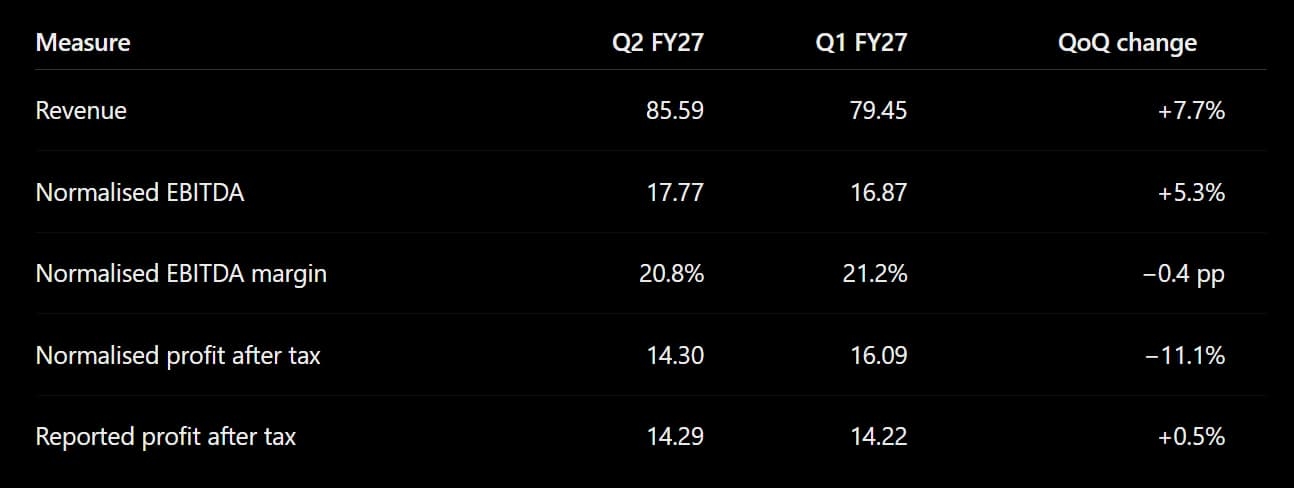
EBITDA measures earnings before interest, tax, depreciation and amortisation. Company-normalised figures exclude exceptional items and trade-receivable impairment allowances. Margin changes use rounded margins; pp means percentage points.
Why operating earnings rose but net profit barely changed
Normalised EBITDA increased by ₹0.90 crore despite the annual wage increase. This supports management's earlier view that Subex could maintain healthy margins while investing for growth. The small margin decline does not, by itself, suggest a change in that approach.
Other income fell from ₹4.69 crore to ₹2.58 crore. The company's Q2 presentation identifies a ₹2.88 crore one-off tax-refund benefit in Q1. Excluding that benefit, normalised profit before tax increased approximately 10.2%, rather than declining 7.1% as the unadjusted figures suggest.
The receivables impairment charge fell from ₹1.87 crore to ₹0.01 crore, supporting reported profit. Tax expense increased from ₹2.24 crore to ₹2.73 crore. Together, these changes explain why net profit was flat despite operating improvement. Sustained collections remain the better test of receivable quality.
Against September 2025, revenue grew 24.2% and reported net profit rose from ₹2.86 crore to ₹14.29 crore. The weak comparison base magnifies the profit increase.
Revenue growth needs to be read with its mix and currency effects
Licence, implementation and customisation revenue rose to 42% of sales from 33%. Managed services fell to 25% from 29%. Applying these rounded shares implies managed-services revenue of about ₹21.4 crore versus ₹23.0 crore. Growth was therefore uneven across revenue streams, with implementation-related work becoming more important.
Rupee depreciation helped year-on-year growth, but management did not provide a consistent numerical reconciliation to constant-currency growth. The reported 24.2% increase should therefore be read as rupee revenue growth, without treating it as equivalent growth in underlying demand.
Faster implementation can improve the revenue cycle
In August, management said contracts could take four to five quarters to reach subscription revenue, with licence and implementation revenue recognised along the way. It aimed to shorten this cycle by one quarter and reported gains of roughly one month to 45 days, below that objective.
Ethica Invest
Serious about long-term investing?
Unlock our professionally managed portfolios.
Reusable, preconfigured controls are now helping HyperSense implementations finish sooner. Management cited approximately 15–20% shorter deployment timelines, including recent projects completed ahead of customer schedules. Comparable work on the ROC product stack remains at an earlier stage.
The call does not establish a full-quarter improvement across the company. The practical benefit would be earlier billing milestones and an earlier transition into support or managed-services revenue, provided customer acceptance and collections follow.
Management separately said AI-assisted engineering increased feature output. That concerns product development, distinct from deploying software in a customer's environment.
Partner Ecosystem Management remains a nearer-term growth contributor
Partner Ecosystem Management, or PEM, helps operators calculate and settle payments with business partners. It was already a prominent growth opportunity in the August call, following investment in the product and team. The latest discussion reinforces that direction rather than introducing a new strategy.
Management attributed demand to product modernisation and consolidation among competing vendors. It described PEM as historically profitable and said further bids were under way. Recent wins included customers in Asia-Pacific and Europe, alongside a second-phase Middle East order.
The relevant checkpoints are order conversion, delivery and repeat business. Product-level revenue and margins were not disclosed, so the scale of PEM's contribution to the quarterly improvement remains unquantified.
A clearer AI strategy, with the same near-term priorities
August's discussion covered AI upgrades, newer fraud types and possible adjacent markets. November's call articulated a more specific ambition: software that checks whether actions by AI systems are authorised and financially appropriate. Subex intends to offer modular solutions that work with customers' existing technology.
Management explicitly described this as a strategic direction, rather than an established new business. The signed agent contract and completed trials provide early evidence of customer interest. They do not yet establish the revenue scale or profitability of the broader opportunity.
The near-term priorities remain core products, sustainable growth and investment discipline. High-single-digit or double-digit growth remains an aspiration; neither call supplied a formal numerical growth commitment or a fixed margin target.
Cash generation provides a useful check on the recovery
Operating cash flow for the first half was ₹27.74 crore against ₹28.51 crore of net profit, approximately 97% conversion. It fell from ₹32.85 crore a year earlier, but that period included ₹31.39 crore of net tax refunds. Cash generated before tax rose from ₹1.46 crore to ₹29.97 crore, a more useful indication of operating recovery.
Management's approximately ₹198 crore liquidity measure differs from statutory cash and cash equivalents of ₹39.95 crore. Funds also sit in bank balances and investments. The headline liquidity increase should therefore be read alongside cash flows.
The ₹12.38 crore increase in minority-investment values was recorded in other comprehensive income. It strengthens equity without adding operating profit or cash. Goodwill remains ₹196.14 crore, with its value dependent on future growth and profitability. These distinctions are set out in the company's results published on 3 November 2026.
The next capital-allocation decisions matter
In August, management was evaluating acquisition possibilities but said it was not actively talking to a target. In November, it described an active search and identified acquisitions as the main intended use of accumulated cash. The call did not identify an agreed transaction. Any proposal will need to be assessed through its purchase price, strategic fit, integration requirements and eventual cash contribution.
Product development also remains a claim on resources. Management said R&D is expensed through the profit-and-loss account, so reported margins already bear these costs. Continuing to fund useful development while maintaining profitability will be important as AI investment expands.
Employee share-trust purchases were still planned, potentially in stages. These purchases support employee awards. They should be distinguished from a conventional shareholder buyback, which management said was currently unavailable because of accumulated losses.
What shareholders should watch next
- Commercial evidence: conversion of the three successful trials, further paid agent contracts and PEM orders progressing into revenue.
- Execution and earnings quality: broader implementation-time improvements, sustained operating margins and strong collections as development spending continues.
- Demand visibility: a clearer constant-currency comparison and whether Middle East contract delays persist. Management continued to flag geopolitical uncertainty, with no major new execution obstacle identified on the latest call.
- Use of cash: concrete acquisition terms and whether subsequent investments improve the company's earnings and cash generation.