The Long Game: Why Time Beats Timing
We live in a world where we get almost everything in seconds.
From asking the simplest (and sometimes silliest) questions to AI and getting instant answers, to ordering food and receiving it within minutes; speed has become the default setting of our lives.
We want results in seconds, minutes, hours, or at most, days.
And so, in terms of wealth creation we want the results in the same manner.
 Ethica Invest
Serious about long-term investing?
Unlock our professionally managed portfolios.
But, real wealth doesn’t work that way.
It is not made in moments. It is built over the years.
And that’s where most people struggle. We are not patient enough to wait.
But if you want generational wealth, patience is not optional; it is the price of admission.
So today, we revisit a timeless idea: the philosophy of long-term investing;
A reminder that real wealth takes time, and if you truly want to build it, this is for you.
Time - The Real Edge
First things first: “How can you build wealth?”
“Simple; by investing in different asset classes.”
“But which asset class?”
Here’s the answer:
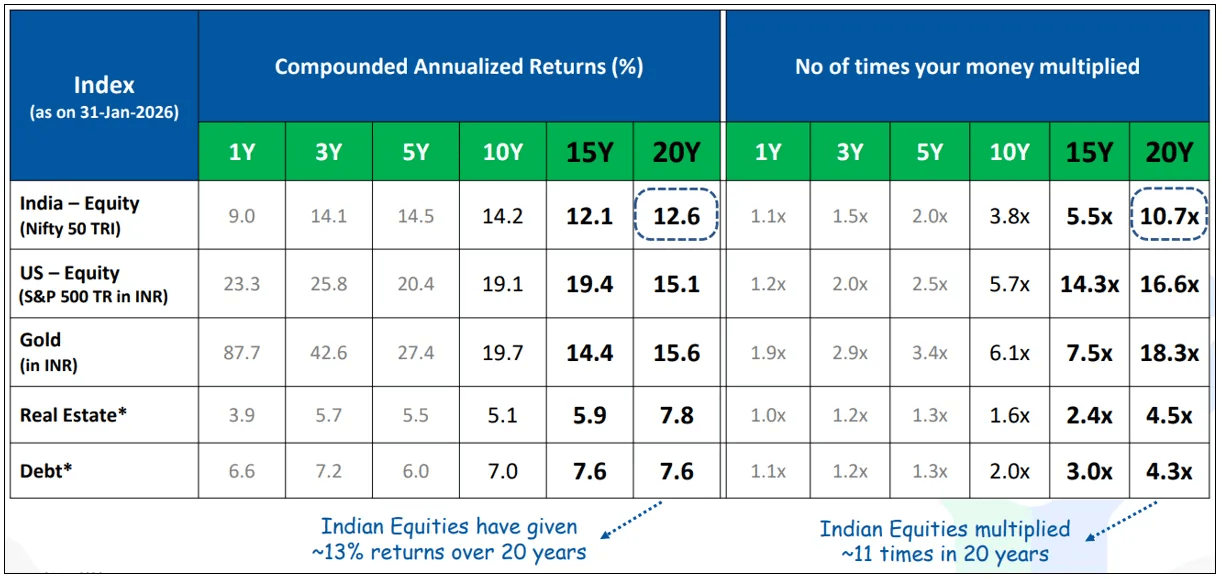
Over the years, equities have performed well compared to other asset classes.
So now it is clear: equities as an asset class provides the highest returns over very long periods.
Ethica Invest
Serious about long-term investing?
Unlock our professionally managed portfolios.
But if you look closely at the table, you’ll notice one surprise; gold has actually outperformed equities in some stretches.
Why so?
Let’s clear this once and for all.
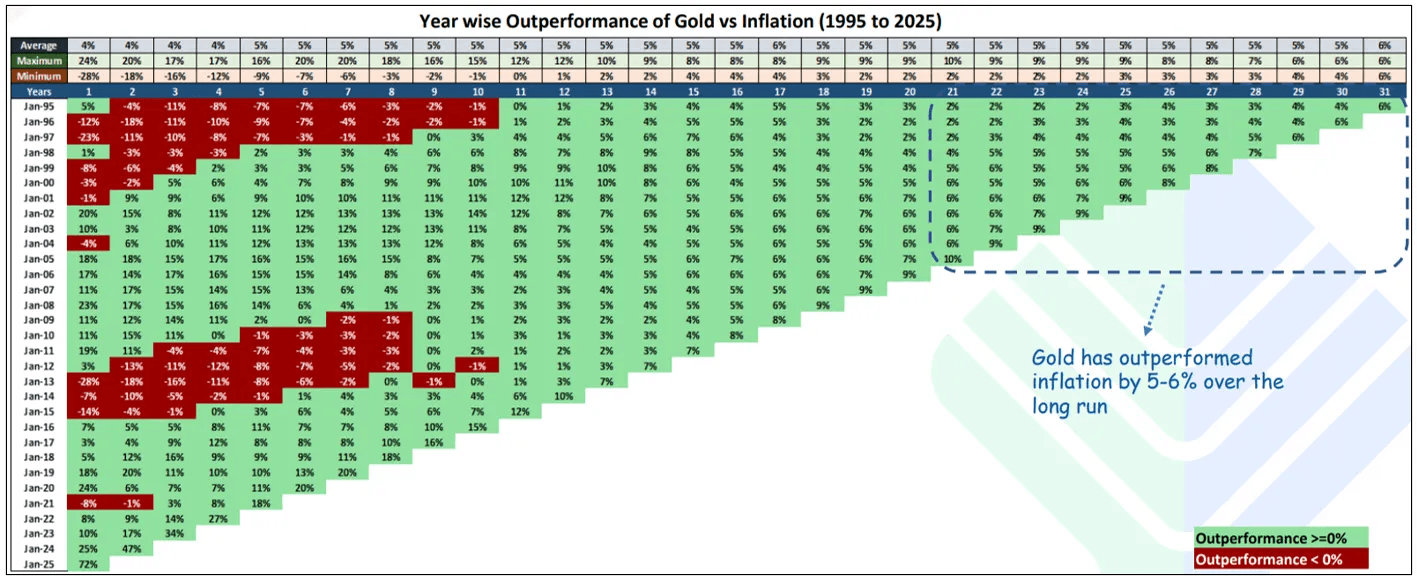
Over the long run, gold has tended to beat inflation by roughly 5–6% (real terms). However, that doesn’t automatically make it the best wealth-creation vehicle.
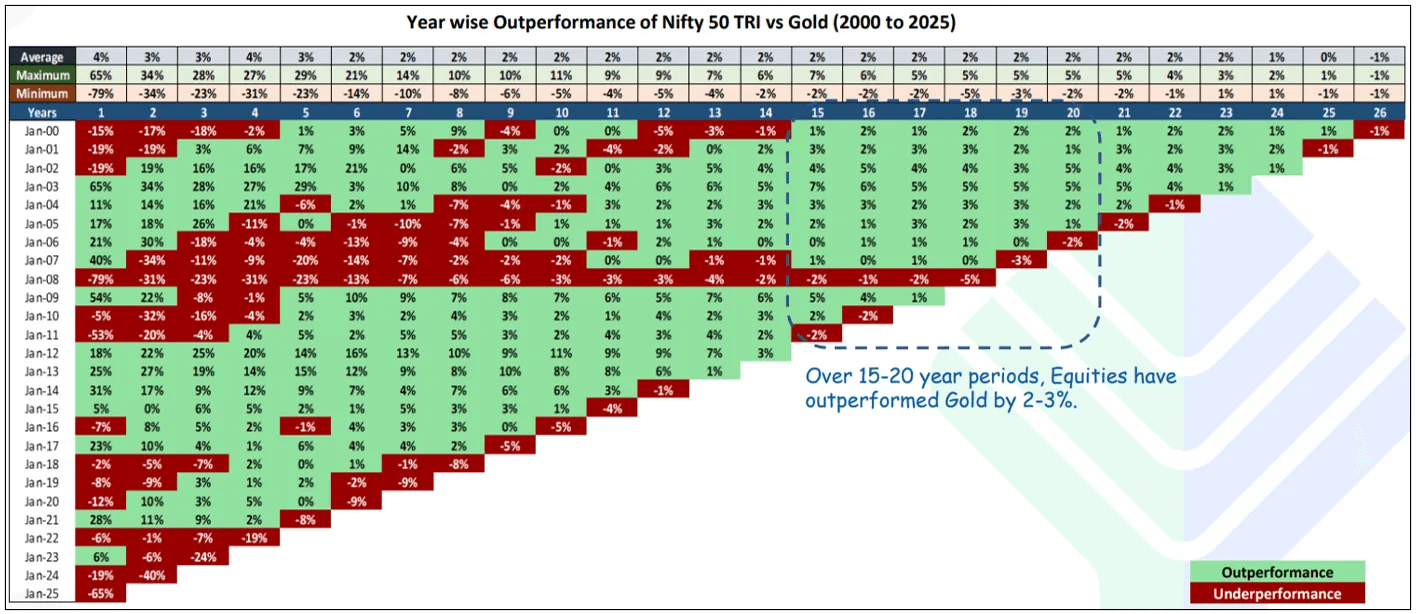
Over longer time frames, equities have outperformed gold by about 2-3%.
Why?
Because equities represent ownership of businesses; they capture economic growth, rising corporate earnings, productivity gains, and the power of reinvested dividends.
Gold, by contrast, is a non-yielding store of value: useful as an inflation hedge and crisis hedge, but it doesn’t compound earnings the way owning productive companies does.
In short:
Gold can outperform during certain periods because it preserves purchasing power and can surge in times of fear or currency weakness.
“This is exactly what’s happening right now.”
But over very long horizons, equities; because of earnings growth and compounding; tend to deliver the highest returns.
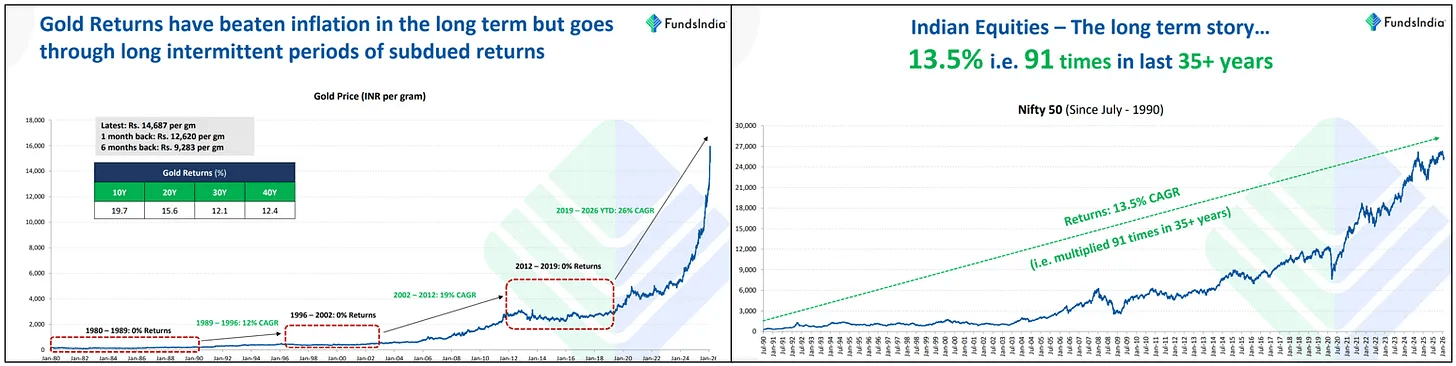
Gold also goes through long, intermittent periods of subdued returns, which is why it’s best used as a hedge, not the core engine of generational wealth.
Till now, you got one clear answer. “Okay so Equities is the asset class you can look up to build wealth”.
But, you my ask; “Why long term investing?”
Because,
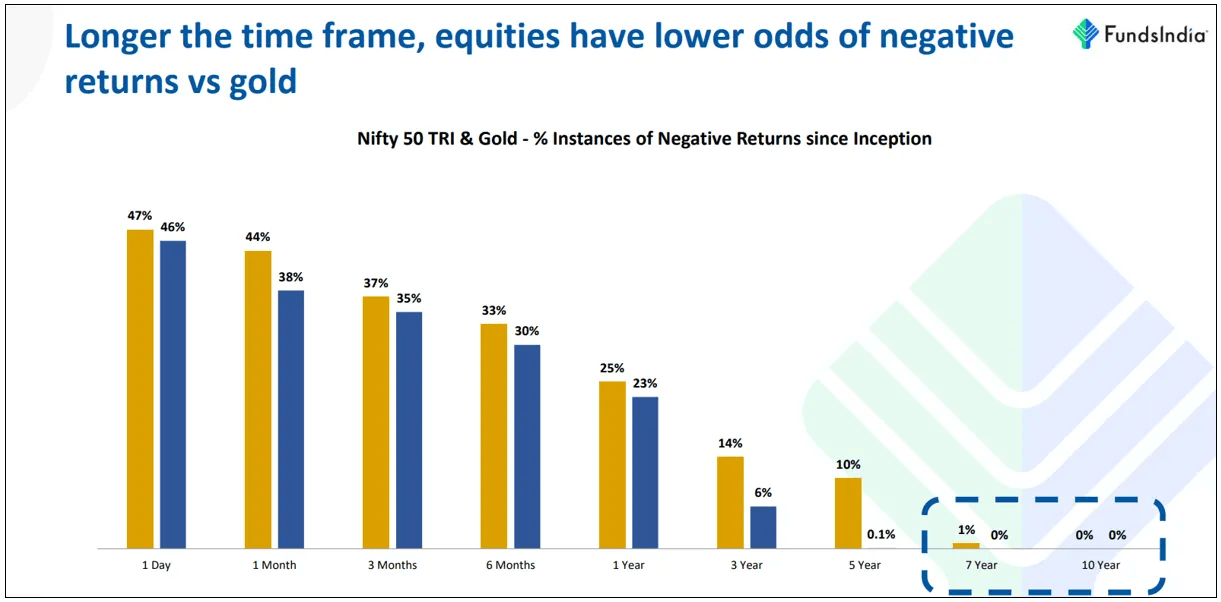
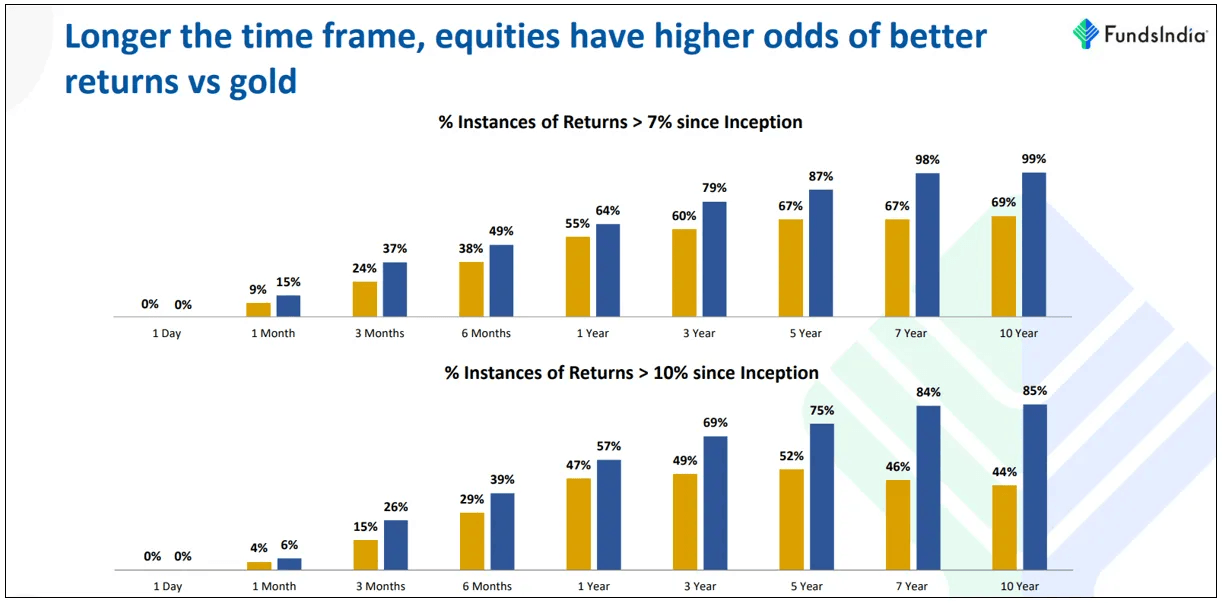
Over long time frames your odds of growing real wealth with equities improve materially; risk of loss falls and the probability of meaningful gains rises.
Put simply: time is the ally that converts volatility into opportunity, and compounding into generational wealth.
The Power of Compounding: Slow Is Fast
Now, you might think;
“Okay, but what exactly makes time so powerful in investing?”
It is not just patience. It is not just staying invested.
It is the silent force working beneath the surface; multiplying returns on returns, year after year.
To truly understand long-term investing, we must understand “The Power of Compounding”.
Let me ask you a simple question:
If you invest ₹100 at 10% annual return for 25 years, what do you think it becomes?
You might say, “It will become ₹350. Right?”
But that’s not how investing works.
Because in markets, you don’t earn returns only on your original ₹100. You earn returns on the new amount every single year.
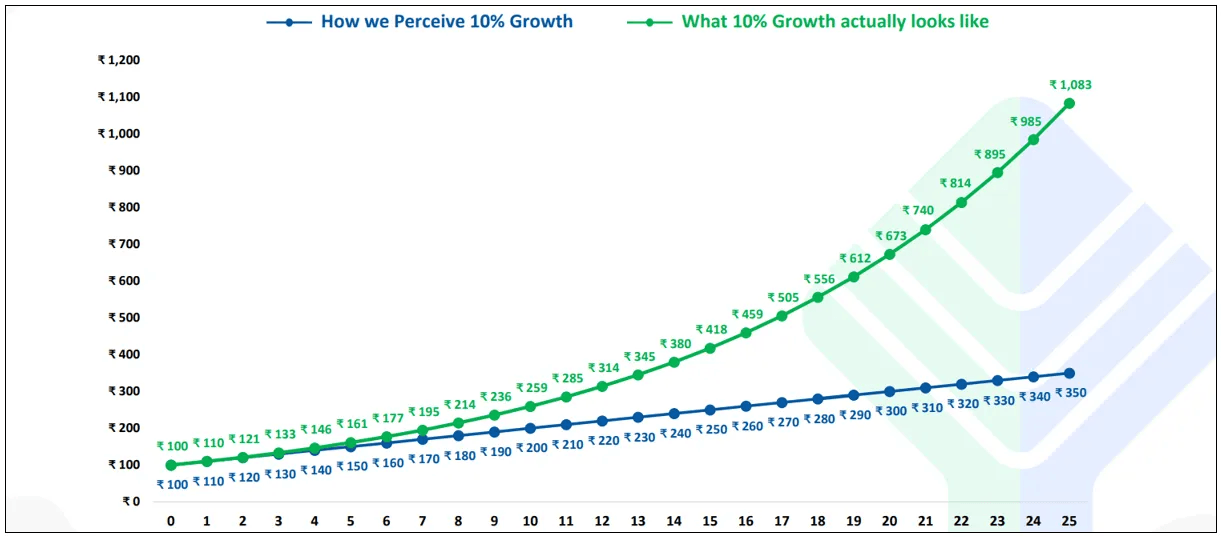
Here’s the compounding picture in plain terms:
- In Year 1, ₹100 becomes ₹110.
- In Year 2, you earn 10% on ₹110, not ₹100.
- In Year 3, you earn 10% on an even bigger number.
This keeps repeating for 25 years.
Compounding is not dramatic. It is boring. Almost invisible.
And at the end of 25 years, ₹100 doesn’t become ₹350. It becomes around ₹1,083.
That’s “The Power of Compounding.”
You didn’t just earn returns. You earned returns on returns; for 25 years.
That is the difference between linear thinking and exponential growth.
And that is why time in the market is not just important; it is everything.
As Warren Buffett demonstrated through his life, the majority of wealth is created after his 50 age; not because returns suddenly change, but because compounding accelerates.
Small numbers become big numbers. Then big numbers start producing even bigger numbers.
That’s the magic
But Returns Are Not Linear
Now, you might also think,
“Okay, I invested ₹1,00,000 into the markets. And because of compounding it will grow by the same percentage every single year.”
You are correct; but partially.
Because while investing in the markets, you are not making same returns every single year.
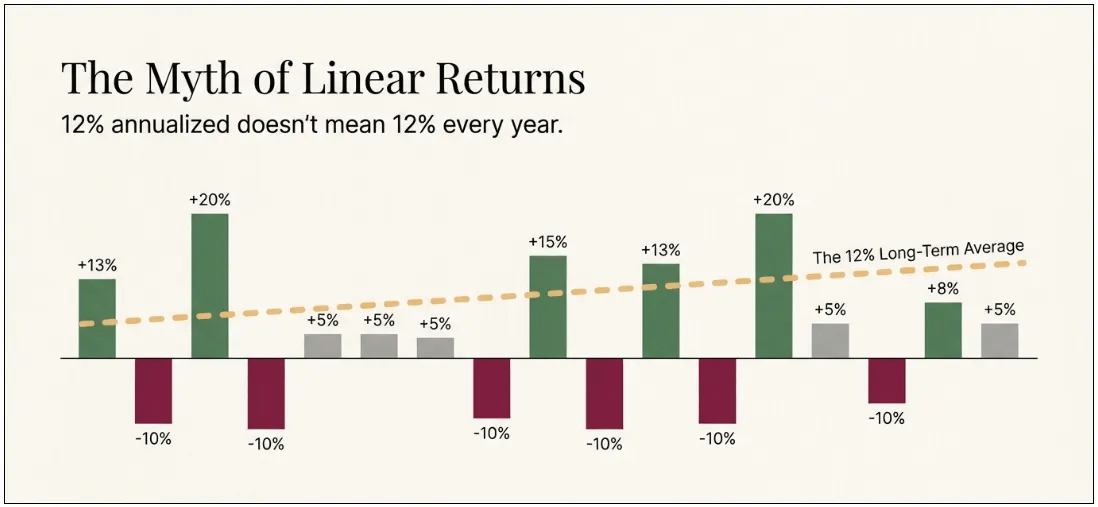
Some years will give you 20%.
Some years 5%.
Some years negative 10%.
Any asset class is bound to be volatile.
And so are equities.
Markets go up and down for a number of reasons; economic cycles, global events, liquidity shifts, investor psychology.
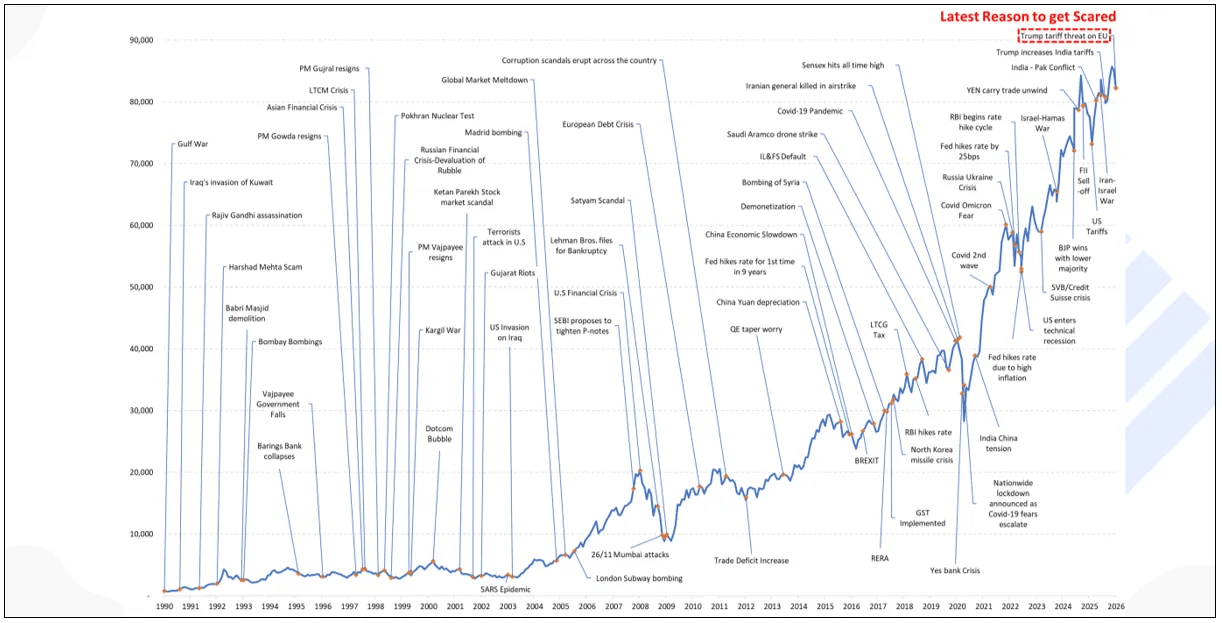
And so, if someone who is impatient enters the market with a short-term mindset, he is bound to quit early because he might not handle the volatility that comes with investing.
This is where temperament matters more than intelligence.
As Charlie Munger often emphasized, the big money is not in the buying or selling; it is in the waiting.
Waiting while others panic.
Waiting while headlines scream.
Waiting while markets fluctuate.
But as the horizon of investing increases, the chances of losing money decrease; as we already saw in the probability charts.
And so, over a very long period of time:
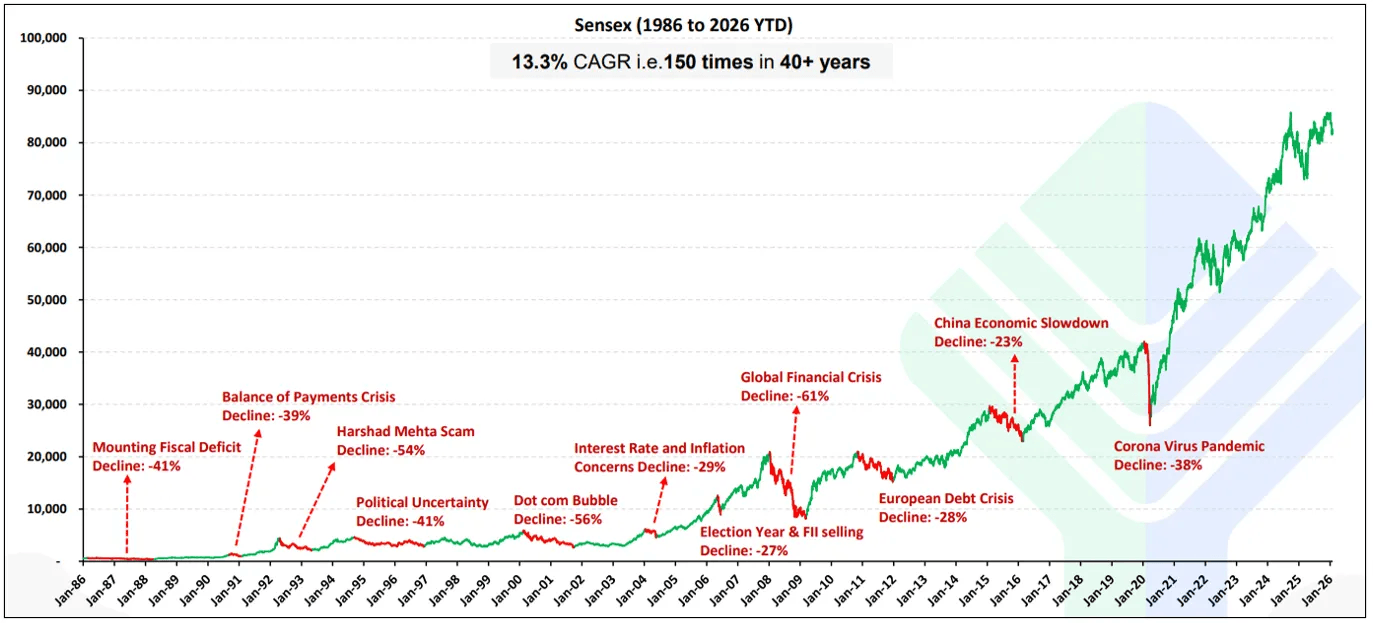
Despite several intermittent crises, Indian equities have gone up over the long run, mirroring earnings growth.
Simply by being patient and staying invested, one can potentially earn ~12–13% compounded returns over long periods.
Not every year. But over time.
Discipline & Temperament - The Unsung Superpower
All that said, the single biggest thing people lack when investing is “Consistency”.
As in our fast-paced world, where we expect instant results, it’s easy to quit when gains don’t show up overnight. So many give up too soon simply because patience feels boring.
And so,
Let’s now talk about something most people ignore.
“Discipline”.
Long-term investing is not difficult because it is complicated. It is difficult because it tests your emotions.
Markets will scare you.
Markets will excite you.
Markets will make you feel like a genius one year and foolish the next.
That emotional roller-coaster is exactly why consistency matters more than cleverness.
And if you’re inconsistent, it costs you badly.
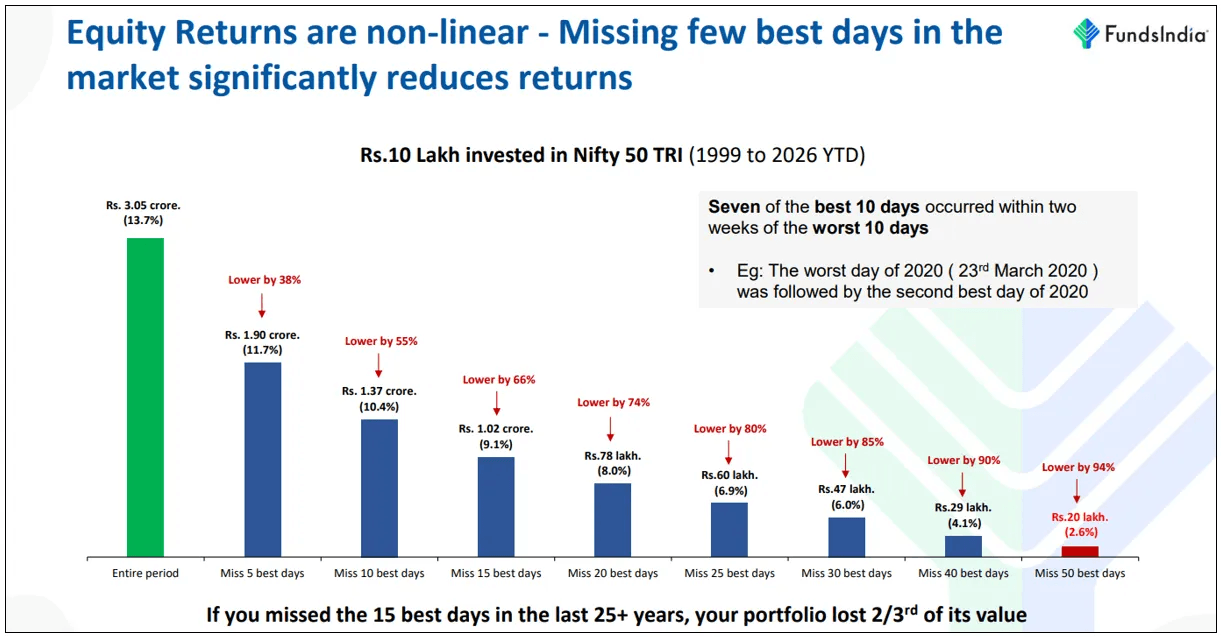
Missing a handful of the market’s best days can wipe out a huge portion of long-term returns.
Because the market’s biggest gains are packed into a few unpredictable days, waiting on the sidelines for a “perfect” entry often means you miss those spikes.
Even after this; if you might think of buying the dip and selling at the top.
Well, nice idea.
But, even if you buy right before a crash hoping for a deeper dip, history shows long-term returns still recover and look decent.
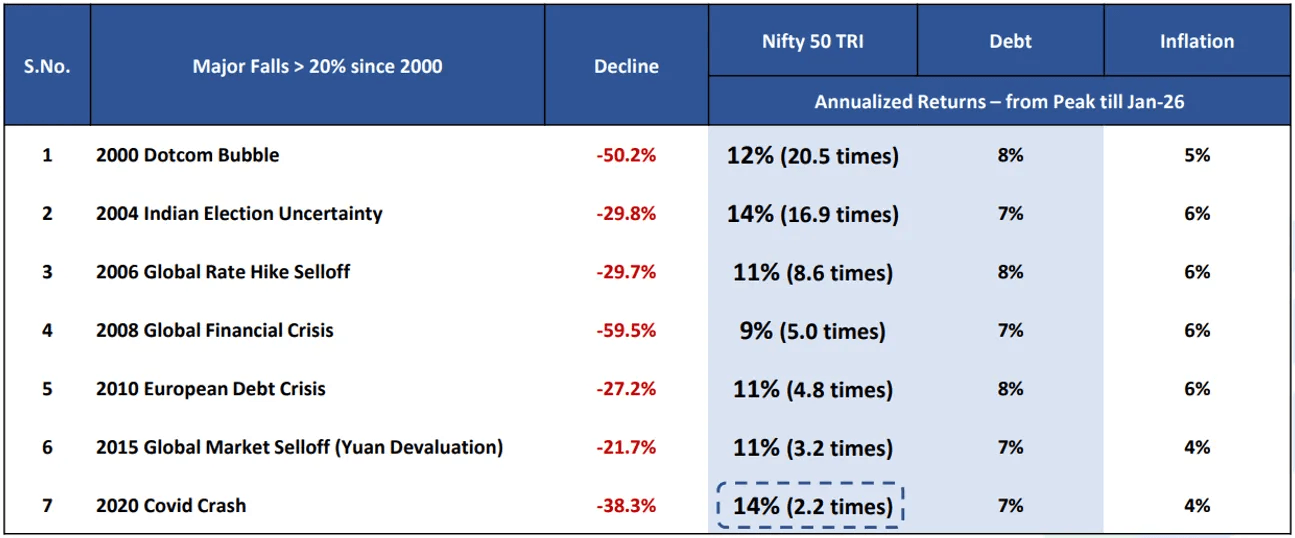
Here’s the blunt truth: equity returns are non-linear.
A few big up days drive a large share of the gains. You can’t predict them, and you can’t capture them if you panic or sit out. If you can’t control your reactions, compounding will never get the time it needs to work.
The biggest edge in investing is not IQ. It is temperament.
Stay calm.
Stay consistent.
Let time and compounding do the heavy lifting.
As Warren Buffett has demonstrated over decades, you don’t need extraordinary intelligence to succeed in markets. You need the ability to stay rational when others are emotional.
And as Charlie Munger repeatedly emphasized, the big money is not in the buying or selling; it is in the waiting.
Waiting while others panic.
Waiting while headlines scream.
Waiting while prices fluctuate.
Discipline means:
- Not checking your portfolio every hour.
- Not selling because the market fell 10%.
- Not buying because everyone on social media is making “easy money.”
If you truly understand long-term investing, you understand this: Volatility is the price you pay for superior long-term returns. If you cannot handle volatility, you cannot earn equity returns.
Simple.
Final Thoughts - Respect Time
We live in a world addicted to speed.
We want quick results. Quick profits. Quick success.
But wealth does not reward impatience.
It rewards discipline.
It rewards rational thinking.
It rewards those who understand that volatility is temporary, but compounding is permanent.
Long-term investing is not flashy.
It is not exciting every year.
It is often boring.
But boring, done consistently, becomes powerful.
Time reduces risk.
Compounding multiplies effort.
Discipline protects both.
If you can combine these three; time, compounding, and temperament; you tilt the odds massively in your favor.
And in investing, tilting the odds in your favor is all you ever need.
Ethica Invest - Principles Over Promises
Ethica Invest builds wealth the slow way: with principles, patience and proven process. We are a Shariah-compliant investment platform — but our philosophy is universal: avoid hype, favour strong balance sheets, and insist on responsible governance.
We screen companies against clear financial, operational and governance criteria, then let time and compounding do the heavy lifting. Our research is produced by SEBI-registered analysts and seasoned investors who prioritise evidence over storytelling and discipline over short-term excitement.
This isn’t about quick wins or catchy headlines. It’s about owning productive businesses that can grow earnings, compound cash flows, and withstand volatility; ethically. If you want investing that respects faith, follows the data, and plays the long game, connect with our Ethica team. We’ll help you tilt the odds in your favour.